Wedding Attire Around the World · The Gulf
Wedding Attire in the Gulf
A Gulf wedding dresses its bride twice over: first in heritage — a flowing, gold-embroidered dress in green or crimson for the henna night — and then, on the wedding night itself, in a white couture gown worn before an audience of women, under gold heavy enough to need both hands. The groom's dress answers in the region's other register: immaculate white, and over it a cloak edged in gold. This guide covers the shared wedding dress of the six Gulf states — the Emirates, Saudi Arabia, Qatar, Kuwait, Oman and Bahrain — building on our thobe and abaya of the Gulf guide, which covers the everyday garments underneath.
The Shape of It
Two Celebrations, One Wedding
A wedding in the Arabian Gulf is not one party but a small season of them, and its legal heart is not the party at all: it is the marriage contract — the milkha, also called katb al-kitab or nikah — signed before an imam, the two fathers and witnesses, often days or weeks before the celebration. Around that signature gather the events this guide dresses: the henna night, and then the wedding night itself, with its feasting, music and processions. The forms are shared across the six states, with local names and accents — the same robe is a thobe in one country and a dishdasha or kandura in the next — and the industry behind the celebrations, from gold souqs to couture ateliers, is profiled on our United Arab Emirates clothing industry page.
The defining structure is separation. On the wedding night, men and women celebrate in different halls — in Saudi Arabia, often in entirely separate wings of a wedding palace or hotel; in the Emirates, in a men's majlis-style gathering and a women's ballroom. This is not a footnote to the fashion; it is the fashion's engine. Inside the women's hall, guests arrive in abayas and remove them to reveal couture gowns, dressed hair and high jewelry, in a room where cameras are guarded against and no unrelated men are present. Gulf bridal dress is therefore both lavish and private at once: some of the most extravagant wedding dressing in the world, made for an audience of family and women friends. The groom enters that hall only near the night's climax, briefly, announced in advance so guests who wish to cover can do so — and his entrance, in white and gold-edged black, is staged as the meeting of the two celebrations.
Night by Night
The Nights, Dressed
The henna night — laylat al-henna
Days before the wedding — in Saudi practice often a week or two before — the bride hosts the henna night, called laylat al-henna across the region and ghomra in Saudi usage. It is a women-only evening at the bride's home or a hall: a professional henna artist paints intricate designs on the bride's hands, wrists and feet, female guests are hennaed too, and female musicians play while the women dance. The bride's dress for this night is the heritage garment of the whole wedding (next section). One honest regional note: the henna night is strongest in the Hijaz, the south and the Eastern Province of Saudi Arabia and across the smaller Gulf states; in Najd, central Saudi Arabia, it is traditionally not a given, and a Riyadh wedding may not include one.
The wedding night — the women's ballroom
The main celebration, the hiflat al-zafaf, runs late — in Saudi Arabia typically from around ten at night until four or five in the morning. In the women's hall the bride makes her grand entrance, the zaffa, processing slowly down the aisle, often around midnight, to music, ululation and clouds of bukhoor incense, and takes her place on the raised, decorated platform — the kosha — where she receives her guests like a queen on a throne, which is precisely the intention. Female singers or a DJ play; the women dance; dinner is served in abundance. Late in the night the groom enters with his father, the bride's father and his brothers, joins her on the kosha for photographs, the ring and the cake, and the couple departs together — the one moment the two halves of the wedding share a room.
The men's celebration
Across the hall — or across the palace — the men hold their own night: rows of white thobes and ghutras, Arabic coffee and dates served continuously, conversation, and the great folk performances. In central Saudi Arabia it is the ardha, the Najdi sword dance inscribed by UNESCO, two facing rows of men with swords moving to drums and chanted poetry; in the Emirates, the al ayala stick dance; everywhere, the groom is the guest of honor in the room's one unmistakably ceremonial outfit — the bisht over white, described below.
The Bride
The Bride: From Thobe Nashal to White Couture
The Gulf bride's wardrobe holds two dresses that could hardly differ more, and she wears both at full strength. For the henna night: heritage. For the wedding night: couture. Neither borrows from the other, and the contrast is the tradition.
- The thobe nashal — the henna-night dress
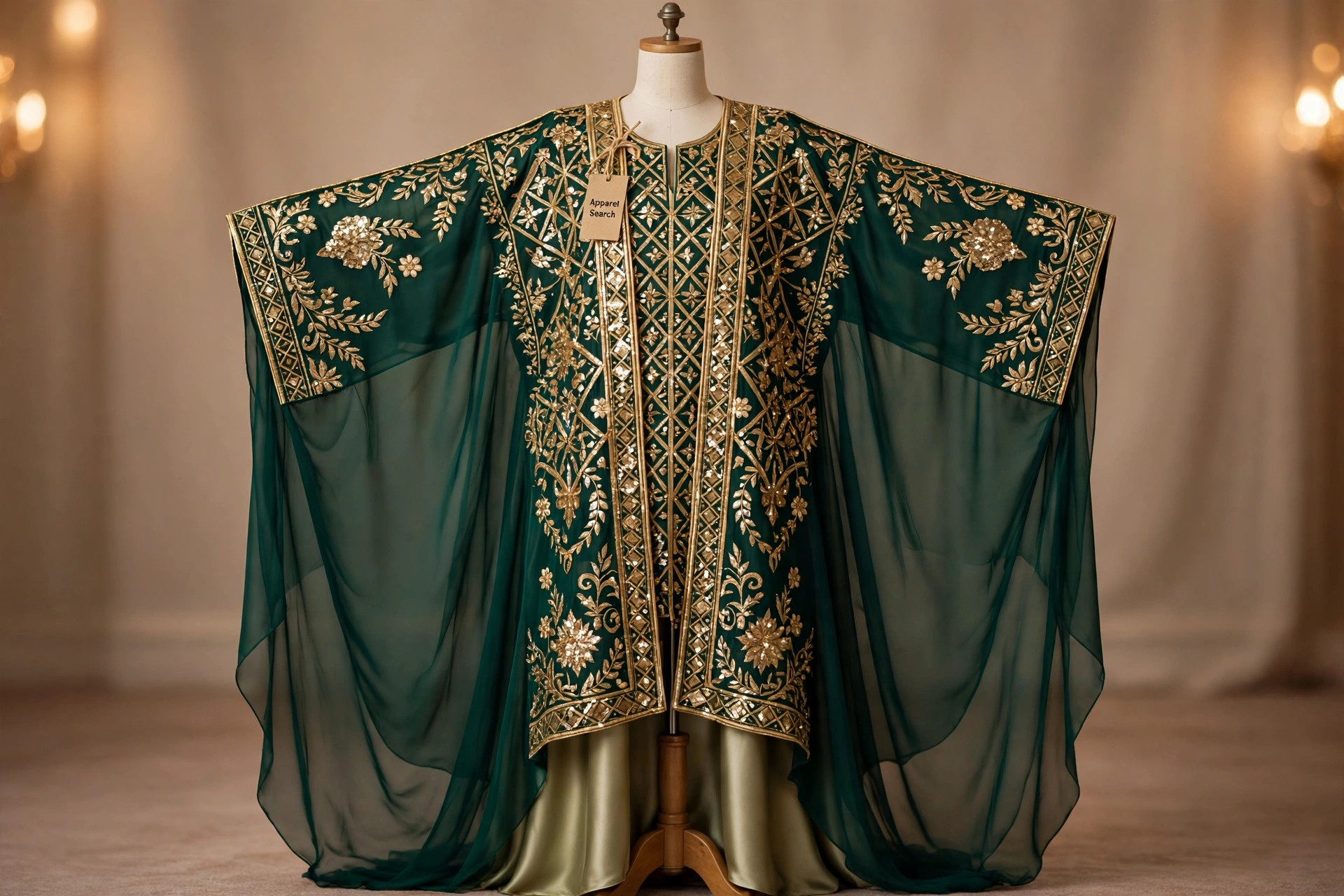
- The thobe nashal (also spelled thawb nashil, thob al-nashal or nashel) is the ceremonial overgown of Bahrain and the wider Gulf: a flowing, T-shaped dress of silk chiffon with wide, square sleeves, worn over a tunic dress (dara'a) and trousers (sirwal). Its whole front can be covered in zari — embroidery in gold and silver metallic thread, with sequins — in geometric, floral and even animal motifs; historic Bahraini examples carry paired peacocks worked down the front panel. The colors are rich, not white: crimson, maroon, royal blue, black — and green above all for the henna night, a custom sources describe as having spread through the Emirates from neighboring Gulf practice. The Zay Initiative's documentation of Bahraini examples records the dress as the bride's wear for her henna or wedding night across the Gulf, made in Bahrain since at least the 1940s and before that imported from India to order, its very name borrowed from the gorgeous cloths that draped ceremonial litters on the pilgrim road. Worn with it, historically, a bride's face might be partly veiled by the metallic-looking Gulf burqa — the battoulah — a tradition now carried mainly by older generations.
- The white gown — the wedding night
- On the wedding night the heritage dress gives way to the other pole of Gulf bridal fashion: a white or cream couture gown, commissioned for this one night, in silk or satin with lace, chiffon, pearls, sequins and crystal, cut in the international bridal silhouette and finished to ballroom scale — the zaffa entrance is a four- or five-minute procession, and the dress is built to be read at that distance, under that light. Bridal sources in the Emirates describe the gown as frequently the most considered — and often the most costly — single element of the wedding, fitted over many sessions. She wears it with the full weight of her wedding gold (next section) and, on arrival and departure, her abaya over it all.
- The layers around the dresses
- Both dresses live inside a system: the dazza in Emirati practice — the trousseau chest prepared by the groom's family, filled with perfumes, silks, clothes and jewelry for the bride — arrives before the wedding; the 40-day bridal preparation in Emirati tradition fills the weeks before it, with hair washed in flower extracts and the body treated with oils and perfumes. Dressing, in the Gulf, is a season, not a morning.
The Groom
The Groom: White Thobe, Gold-Edged Bisht
The groom's wedding dress is the men's national dress raised to ceremony. Its base never changes — the long white robe of the Gulf — and its meaning is carried by one added layer.
- The thobe — one robe, three names
- The ankle-length, long-sleeved white robe is thobe (thawb) in Saudi Arabia, Qatar and Bahrain, dishdasha in Kuwait and Oman, and kandura in the Emirates — the same garment family, cut with local signatures: the Saudi thobe with its closed collar and buttons, the Emirati kandura collarless with a long tassel (the tarboosh or karkousha) at the neckline, Oman's tassel kept short. For a wedding it is new, pressed and brilliant white.
- Ghutra and agal
- On the head, the ghutra — a square of light cotton, plain white in most of the Gulf, red-and-white checked shemagh also worn — folded and draped over a small cap and held by the agal, the doubled black cord. At a wedding the ghutra is arranged with particular care; it is the frame of every photograph the groom will be in.
- The bisht — the cloak of the day
- Over the thobe, for the wedding, goes the bisht (in Saudi Arabia also called mishlah): a flowing, open cloak of fine wool or camel hair in black, brown or cream, its front opening, neckline and edges worked with gold or silver zari. The bisht is the dress of rank — worn by royalty, officials, scholars, and grooms — and at a wedding it is how the room knows him. Al-Ahsa, in Saudi Arabia's Eastern Province, is famed as a bisht-weaving center, its cloaks edged in gold, silver or white zari. He wears it for the men's celebration and, above all, for his entrance into the women's hall.
| Country | The men's robe | Local signatures |
|---|---|---|
| Saudi Arabia | Thobe | Closed collar with buttons; bisht called mishlah; ardha sword dance at the men's celebration |
| United Arab Emirates | Kandura | Collarless, long neck tassel; al ayala stick dance; dazza trousseau tradition |
| Kuwait | Dishdasha | Thobe nashal worn by brides for the henna night, as across the Gulf |
| Qatar | Thobe | Battoulah face mask in women's heritage dress; gold souq shopping in Doha |
| Oman | Dishdasha | Short tassel on the robe; frankincense country — bukhoor at its most rooted |
| Bahrain | Thobe | Home of the thobe nashal; kurar hand-braided gold ribbon trim; pearl-diving heritage in its jewelry |
Jewelry & Scent
Gold Worn in Weight — and Bukhoor in the Air
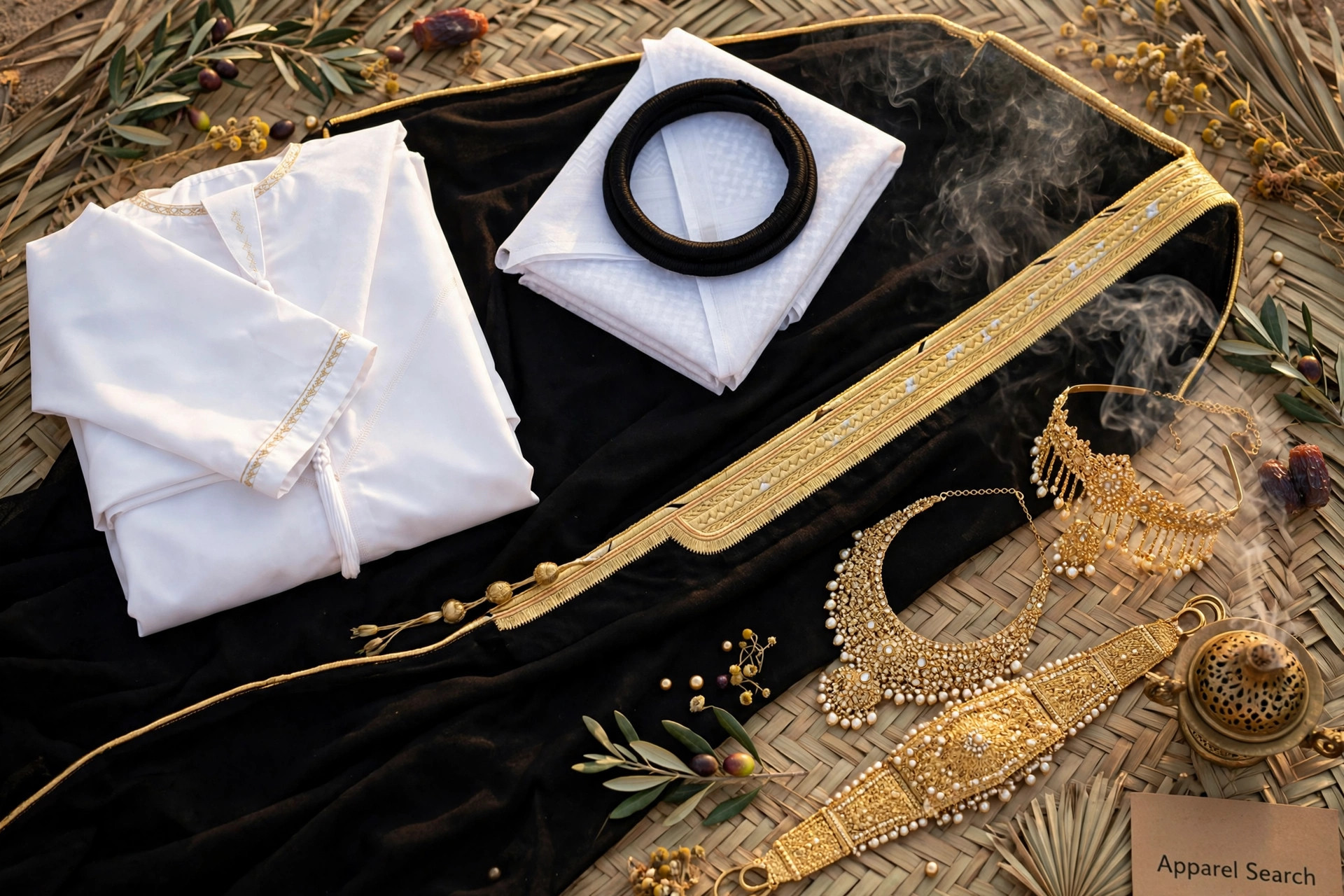
Gulf bridal gold is not an accent; it is a second wardrobe, and it arrives through two institutions. The mahr is the groom's gift to the bride written into the marriage contract itself — money or value that becomes her own property. The shabka is the presented jewelry: traditionally a matched gold set — necklace, earrings, bracelet and ring — given by the groom, in Saudi practice at an engagement ceremony of its own, the ring traditionally worn on the right hand. For the wedding night the bride wears gold in the Gulf manner: heavy, layered and architectural — tiered necklaces across the chest (Bahrain's murtahish is the named local form), a gold belt — the Emirati haqqab — worn over the dress, bracelets stacked, and headpieces such as the Emirati tassah, pure gold with chains draping over the hair, with Bahrain's pearl heritage adding pearls to the gold. Traditional bridal sets are made in 22-karat gold for its rich color; the gold is at once adornment, family honor displayed, and the bride's own wealth on her body. Our bridal necklaces guide covers the necklace forms in the Western jewelry tradition.
And before the gold goes on, the scent goes on. Bukhoor — wood chips soaked in fragrant oils, burned over charcoal in the mabkhara burner — is part of dressing itself in the Gulf: the bride's garments, hair and jewelry are perfumed with its smoke during preparation, oud oil is worked into hair and skin, and the burner is carried through the wedding hall and around the bride's entrance, so the zaffa arrives in a cloud of incense. Guests perfume their own clothes and hair from the passing mabkhara as a mark of welcome. A Gulf wedding is the one wedding in this series you could identify blindfolded.
Acquiring
Buying the Wedding Wardrobe
Gulf wedding dress is bought in the region's two great marketplaces: the souq and the atelier. For the gold, families go to the gold souqs — Dubai's Deira Gold Souk above all, hundreds of shops in covered lanes where bridal sets blaze in every window, with their counterparts in Doha, Manama, Kuwait City and Riyadh. The system is built for wedding buying: gold is priced transparently by weight against the day's international rate, displayed on boards around the souq; what you negotiate is the making charge for the workmanship, and every piece carries its hallmark. A shabka is chosen together, by both families, as the serious purchase it is.
For the dresses, the work is commissioned. The white gown is ordered from Dubai's bridal couture houses and international designers' Gulf boutiques months ahead and fitted repeatedly; the thobe nashal and the henna-night dress come from heritage dressmakers and the souqs' textile shops, in Bahrain from the makers who still work zari by hand; the groom's bisht is bought from specialist cloak shops — an Al-Ahsa bisht is the connoisseur's choice — or inherited, since a fine bisht outlives its first wedding by generations. Nothing in this wardrobe is fast, and none of it is meant to be: it is bought the way it is worn, in weight.
Today
The Modern Mix
The social-media era has changed Gulf bridal fashion in one paradoxical direction: the celebration is as private as ever — the guarded cameras, the women-only hall — and the fashion has become more public than ever, because the designers are. A generation of Gulf and Dubai-based bridal designers now shows henna-night and wedding collections to the whole region online, and brides plan across borders: a gown commissioned in Dubai, gold from the Deira souq, a bisht from Al-Ahsa, for a wedding in Doha or Riyadh. Within the hall, the newest fashion is heritage itself: the thobe nashal, once simply what a bride wore, is now chosen deliberately and revived proudly for the henna night, photographed (inside the hall, among women) as a statement of identity, while the wedding-night gown absorbs international couture whole. The structure underneath — contract, henna night, two celebrations, one brief meeting on the kosha — has not moved at all. If you are invited into it as a guest, our guide to dressing as a wedding guest covers the etiquette from the guest's side, including why the hall you are in is the whole dress code.
Common Questions
Common Questions
What does a bride wear at a Gulf wedding?
Two dresses on two nights. For the henna night she wears the heritage dress — classically the thobe nashal, a flowing T-shaped overgown of silk chiffon with wide sleeves, covered in gold zari embroidery, in a rich color such as green, crimson or maroon. On the wedding night she wears a white or cream couture gown, commissioned and fitted for the night, worn in the women-only ballroom with her full wedding gold — the shabka set, layered necklaces, a gold belt and headpieces — and her abaya over it on arrival and departure.
What is the henna night, or ghomra?
The henna night — laylat al-henna across the Gulf, ghomra in Saudi Arabia — is a women-only celebration held days before the wedding, where a professional artist paints intricate henna designs on the bride's hands, wrists and feet, female guests are hennaed too, and women sing and dance together. The bride wears her traditional embroidered dress for it. The custom is strongest in the Hijaz, southern and eastern Saudi Arabia and the smaller Gulf states; in Najd (central Saudi Arabia) it is traditionally less common.
What is the difference between the shabka and the mahr?
The mahr is the groom's gift to the bride written into the Islamic marriage contract — money or value that becomes the bride's own property. The shabka is presented jewelry: traditionally a matched gold set of necklace, earrings, bracelet and ring given by the groom to the bride, in Saudi practice at an engagement ceremony of its own. Gulf bridal sets are typically 22-karat gold, bought by weight in the gold souqs, and worn layered and heavy on the wedding night.
What does a Gulf groom wear?
A new white robe — called a thobe in Saudi Arabia, Qatar and Bahrain, a dishdasha in Kuwait and Oman, and a kandura in the Emirates — with a ghutra headscarf held by a black agal cord. Over it, for the wedding, he wears the bisht: a flowing cloak in black, brown or cream edged with gold or silver zari thread. The bisht is the dress of honor and rank in the Gulf, worn by officials and scholars as well as grooms, and it marks him out in both the men's celebration and his entrance into the women's hall.
Why do men and women celebrate separately at Gulf weddings?
Separate celebrations for men and women are the traditional structure of weddings across the Gulf, rooted in the region's Islamic and social customs of privacy for women. The women's celebration is held in a guarded hall where female guests remove their abayas and wear couture gowns, dressed hair and jewelry among women only, with cameras restricted. The groom joins the women's hall only briefly, late in the night and announced in advance, for photographs and the cake cutting on the kosha platform with his bride.
Keep Exploring
More to Explore
In This Series
Wedding Attire Around the World
The series hub — wedding dress country by country, from China's qun kua to Scotland's tartan, as each guide is published.
Visit the hub ↑The Gulf — Thobe and Abaya
The base garments behind this page: the thobe, kandura, bisht and abaya explained in the Traditional Dress series.
Read ↑Go Deeper on the Gulf
United Arab Emirates Clothing Industry
The UAE's apparel and textiles directory — Dubai's couture, retail and gold-trade fashion economy.
Explore ↑Abaya Guide
The abaya as clothing to buy and wear — cuts, fabrics and styling, from everyday black to occasion embroidery.
Read ↑Definition of Abaya
The short Apparel Search definition of the abaya and its key terms.
Read ↑Attending a Wedding?
Search Apparel Search