Wedding Attire Around the World · Ghana
Wedding Attire in Ghana
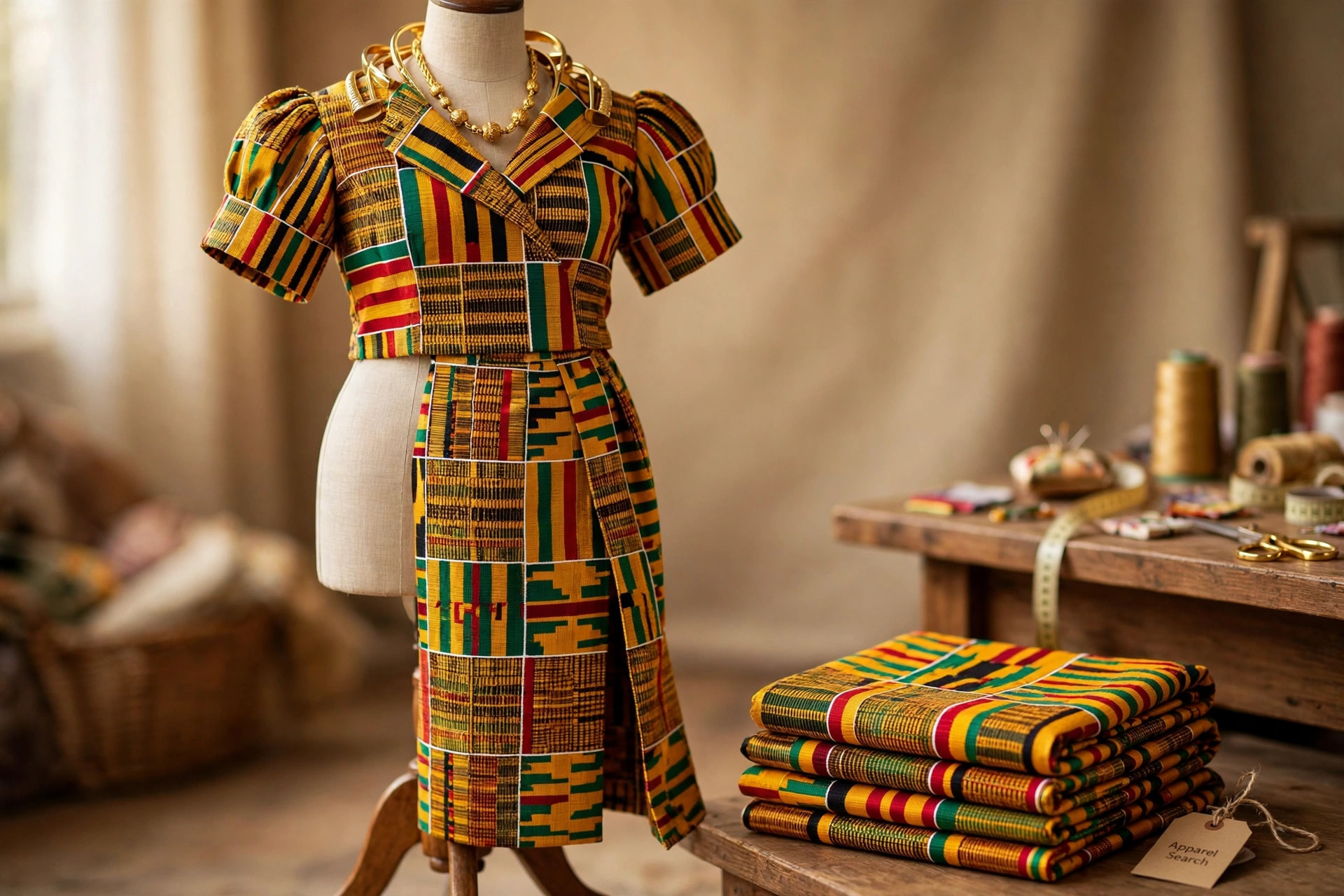
At a Ghanaian traditional wedding, the couple do not simply wear a famous cloth — they wear a text. Kente, the handwoven strip cloth of the Asante and Ewe weavers, carries its meanings in named patterns, each one a proverb or a piece of history, and couples choose their cloth the way other couples choose vows: for what it says. He drapes a full cloth over his shoulder like a Roman of the forest kingdom; she wears hers tailored as kaba and slit, or draped in the old way, under gold that recalls the dust-gold wealth of the Akan world. For kente itself as a textile, begin with our kente cloth of Ghana guide; this page is about the wedding built around it — the knocking at the door, the engagement ceremony, and the white wedding that follows.
The Shape of It
First the Knocking, Then the Cloth
A Ghanaian marriage begins with a knock. In the kokooko — the "knocking" ceremony (also called opon-akyi bo) — the groom's family formally visits the bride's family, announces their son's intention, and is received; the families meet, inquiries are made, and if the knocking is accepted, the marriage can proceed. From it flows the engagement list: the schedule of gifts the groom's family will present at the traditional ceremony — drinks for the libations and prayers, money for the bride and her parents, a sum called akonta sikan for the bride's brothers who have protected her, and the items of the bride's own list, among which cloth and jewelry stand first. The traditional engagement ceremony that follows — the presentation and acceptance of those gifts, the bride asked for her consent, the elders' blessings — is, in the eyes of both families, the marriage itself.
As in much of West Africa, a second event follows: the white wedding, a church or civil ceremony in gown and suit, held on the same weekend or another day. But the traditional ceremony is where Ghana dresses as Ghana. Its center is kente, and around the kente a whole economy of weavers, goldsmiths and tailors turns — the craft world our Africa clothing industry page surveys across the continent.
The Day Itself
Presented in Kente
On the traditional day itself, dress is part of the procedure. The groom's family arrives with the engagement items formally displayed — the drinks, the money, the cloth and jewelry carried in procession, often in decorated cases and baskets, so that the gifts are seen to be given. The bride is not present for the first exchanges; she is presented — brought in dressed in her kente to music and applause, shown to the gathering, and asked, in front of both families, whether the gifts and the marriage are accepted. Her outfit is therefore not merely worn at the ceremony; it is unveiled by it, and the moment of her entrance, gold catching the light over the woven proverbs of her cloth, is the photograph the whole day was built to produce. The couple are then seated together in their matching or answering kente to receive the elders' blessings and the community's congratulations.
The Cloth
Kente: A Cloth That Speaks in Proverbs
Kente is not printed, dyed or embroidered into its patterns. It is woven — on a horizontal loom, traditionally by men — in narrow strips roughly a hand's width across, each strip a sequence of pattern blocks in silk and cotton; a full cloth joins some twenty or more strips sewn edge to edge, which is why genuine kente shows its seams and repeats its designs in bands. The work is slow: a substantial cloth represents weeks to months at the loom. Historically it was royal cloth, the finest patterns reserved for the Asantehene and his court at Kumasi, and it still reads, instantly, as the dress of honor — for weddings above all.
What sets kente apart from every other wedding fabric in this series is that its patterns are named, and the names are proverbs, histories and claims. Weavers and wearers alike insist that a cloth is chosen for its meaning, so a couple's wedding kente is a statement made in public, legible to every elder in the room:
| Pattern | Its name means | What it says at a wedding |
|---|---|---|
| Sika Futoro | "Gold dust" | Before coinage, gold dust was the Akan medium of exchange; woven in yellows, oranges and reds that imitate its glitter, the cloth stands for wealth, royalty, elegance and honorable achievement |
| Emaa Da | "It has never happened before" | A pattern a king is said to have named in awe at its novelty; it symbolizes creative ingenuity, innovation and exceptional achievement — a marriage unlike any before it |
| Abusua Ye Dom | "The extended family is a force" | The cloth of family unity, collective work and shared responsibility — perhaps the most wedding-apt proverb in the repertoire, worn for the two families becoming one |
| Adwinasa | "All motifs are used up" | The weaver is said to have exhausted every known motif in one cloth to please the Asantehene; it stands for mastery, excellence and superior craftsmanship |
Color speaks too, alongside pattern: gold for royalty and wealth, green for growth and renewal, blue for peace, harmony and love, maroon for the earth and protection. A couple choosing wedding kente are therefore composing — pattern, color and cloth — and their families read the composition. Ewe weavers of the Volta Region weave their own distinguished tradition of strip cloth alongside the Asante one, and a Ghanaian wedding may honor either or both heritages in the couple's dress.
The Couple
Draped Cloth for Him, Kaba and Slit for Her
The groom's traditional dress is the full cloth worn as it has been worn for centuries: a complete kente cloth draped over the body toga-style, passing over one shoulder — the left, leaving the right arm free — and arranged in folds by attendants who know the draping, because a man's cloth is put on him as much as by him. Under or over the drape, some grooms choose a tailored alternative: a kente-trimmed suit, a kaftan-style top, or kente accents on a modern outfit — but the draped cloth remains the image of the day. On his feet, ahenema: the ceremonial sandals of Akan tradition, leather with an ornamented strap, in formal versions worked in gold. Gold rings and a gold chain finish a look that needs no tailoring to announce itself: the cloth is the garment, and its weight and pattern do the speaking.
The bride wears kente in one of two great forms. The tailored form is the kaba and slit: the kaba, a fitted blouse — today often corseted, beaded or lace-trimmed — with the slit, a long fitted skirt, the pair sewn from the couple's chosen kente and finished with a matching wrap or train. The draped form is older: cloth wrapped and arranged over a torso covering, in the manner associated with royal dress, with beads at the neck, arms and waist. Many brides change during the ceremony — from the formal kente presentation outfit into a second look, sometimes a second family cloth honoring the other side. Her hair carries the royal reference: the sculpted, blackened dansinkran style belongs historically to Asante queen mothers — its disc-like, egg-and-charcoal-darkened form is a royal insignia rather than everyday bridal dress — and modern brides more often wear a crown-like tekua headdress or an elegant contemporary coiffure that nods to it. The distinction matters, and Ghanaian dressers observe it: the bride is dressed as royalty for the day without literally wearing a queen mother's office on her head.
Jewelry
Gold: The Dust-Gold Heritage, Worn
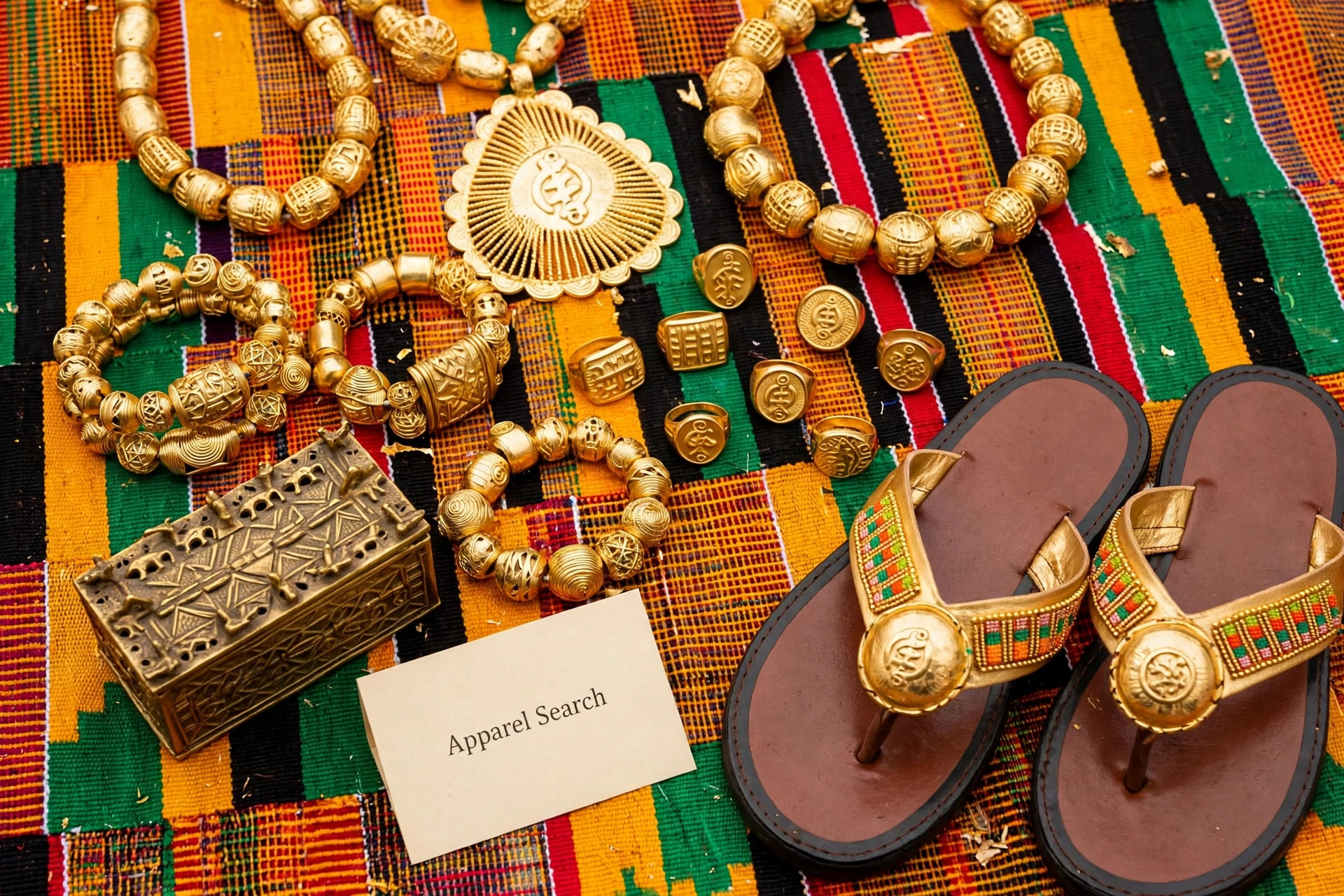
Ghana's old European name was the Gold Coast, and the name was earned: the Akan world measured wealth in gold dust, kept in ornate cast-brass dust boxes, weighed with figurative goldweights, and worn as some of the most inventive jewelry in Africa. The wedding inherits all of it. The bride's gold — necklaces in strands and pendants, bracelets stacked on both arms, earrings, rings — is worn heavy, much of it family gold borrowed for the day from mothers and aunties, so that a bride may carry three generations on her neck at once. Cast and worked pieces carry adinkra symbols, the proverb-signs of the Akan — the same visual language as the kente patterns, spoken in metal: a pendant or ring stamped with an adinkra is a proverb you can wear on your hand.
The groom's gold is quieter — rings, a chain, the gold-worked ahenema — because his cloth does the shouting. Beads run alongside the gold in many families' dress: glass beads from the Krobo tradition, worn at the neck and waist, are Ghana's other ancient jewelry, and a bride's full engagement dress may layer bead and gold together, the two treasuries of the culture on one body. Our bridal necklaces guide shows the Western tradition at its most restrained; the Ghanaian engagement is its gorgeous opposite — jewelry as inheritance, displayed all at once, on purpose.
Acquiring
Buying Kente: Bonwire, and the Honest Price of Handwork
True wedding kente begins in the weaving villages — above all Bonwire, the Asante town tradition names as kente's birthplace, and neighboring Adanwomase, both near Kumasi, where master weavers still work the strip looms and a couple can commission a cloth, choose its pattern by its proverb, and watch it grow strip by strip. Commissioning takes time — weeks to months for a full cloth — and the engagement calendar has to be planned around the loom, not the other way round. Tailors then cut the tailored half of the wardrobe: the bride's kaba and slit from the woven cloth, a skilled job in itself, since every cut crosses pattern blocks that must be matched.
The cost logic must be stated honestly, because the market will not always state it for you. Handwoven kente is expensive for a simple reason: it is months of a master weaver's labor in silk and cotton, and a full groom's cloth is the largest single piece of it. Against it stands printed "kente" — ordinary cloth printed with kente-style patterns. It is not woven at all: no strips, no seams, no loom time — and it costs a small fraction of the real thing. Printed cloth has its place for guests, decorations and everyday wear, and no shame attaches to it honestly sold; the defect is only in the selling of print as handwoven. For the couple's own dress, Ghanaian families who can manage it treat one true cloth as the wedding's permanent asset: kente does not date, is re-worn at festivals and funerals and naming ceremonies for life, and is handed down — which is more than can be said for any other garment in this guide.
There is also a middle path many couples take with a tailor's help: one genuine handwoven cloth for the groom's drape, where the weaving shows at full scale, and the bride's kaba and slit cut from a smaller handwoven length, with printed kente reserved for the bridal party, the decorations and the guests' own outfits. The hierarchy is honest and visible — the handwork concentrated where the photographs and the inheritance will be — and it lets a family put its money into the loom rather than into yardage nobody will examine closely.
Today
The Modern Mix
The contemporary Ghanaian bride has made the kente gown a fashion form: corseted, sculpted, sometimes beaded or fringed, the kaba and slit rebuilt by Accra's designers into silhouettes that walk red carpets — while the cloth itself, woven strip by strip in Bonwire, refuses to hurry. Grooms meet the modern halfway with kente accents — a sash, a pocket square, a kente-panelled jacket over a tailored suit — for the white wedding or the reception, keeping the full drape for the traditional ceremony where it belongs. And the two-event structure is now a design brief in itself: kente day and white day planned as a pair, the gown's palette answering the cloth's proverb.
What anchors it all is that the traditional ceremony has not become the costume party before the real wedding — in Ghana it remains the real wedding, the one the families witness, the one where consent is asked and the gifts are accepted. The white wedding adds the church's blessing; the kente already did the marrying. If you are attending rather than starring, our Wedding Guest Attire section covers the guest's side of Ghanaian celebrations and weddings like them.
Common Questions
Common Questions
What is the knocking ceremony at a Ghanaian wedding?
The kokooko, or knocking, is the formal first visit: the groom's family calls on the bride's family to announce their son's wish to marry, and the families meet and make their inquiries. If the knocking is accepted, the marriage process proceeds to the engagement list of gifts and then the traditional engagement ceremony itself.
What do a Ghanaian bride and groom wear for the traditional wedding?
Kente — handwoven strip cloth — for both. The groom drapes a full cloth over one shoulder, toga-style, with ahenema ceremonial sandals and gold. The bride wears a kente kaba (fitted blouse) and slit (long skirt), or a draped cloth in the older manner, with heavy gold jewelry and a crown-like tekua headdress or a modern coiffure.
What do kente patterns mean?
Kente patterns carry names, and the names are proverbs or histories. Sika Futoro means 'gold dust' and stands for wealth and royalty; Emaa Da, 'it has never happened before,' symbolizes innovation and exceptional achievement; Abusua Ye Dom, 'the extended family is a force,' celebrates family unity. Couples choose their wedding cloth for what its pattern says.
What is the difference between handwoven and printed kente?
Handwoven kente is built on a loom in narrow strips that are sewn together into a cloth — weeks to months of a weaver's work, priced accordingly, and identifiable by its strips and seams. Printed kente is ordinary cloth printed with kente-style patterns: no weaving, no strips, and a small fraction of the price. It is fine honestly sold, but it is not the same cloth.
Why do Ghanaian couples hold two weddings?
The traditional engagement ceremony is the marriage in the eyes of the two families — gifts presented and accepted, consent asked, elders blessing. The white wedding adds a church or civil ceremony in a gown and suit. Many couples hold both, with kente for the traditional day and a separate wardrobe for the white wedding.
Keep Exploring
More to Explore
In This Series
Wedding Attire Around the World
The series hub — wedding dress country by country, from China's qun kua to Scotland's tartan, as each guide is published.
Visit the hub ↑Ghana — Kente Cloth
The base garment behind this page: how kente is woven strip by strip, its colors and its royal history, in the Traditional Dress series.
Read ↑Go Deeper on Ghana
Africa Clothing Industry
The clothing and textile industries of Africa, country by country — including the weaving villages where wedding kente begins.
Explore ↑Bridal Necklaces
Bridal necklaces in the Western tradition — a quiet counterpoint to Ghana's layered gold, worn heavy for the engagement.
Read ↑Wedding Bands
Wedding bands explained — the exchanged ring beside Ghana's older gold heritage of dust, beads and cast pieces.
Read ↑Attending a Wedding?
Search Apparel Search