Wedding Attire Around the World · Ethiopia
Wedding Attire in Ethiopia
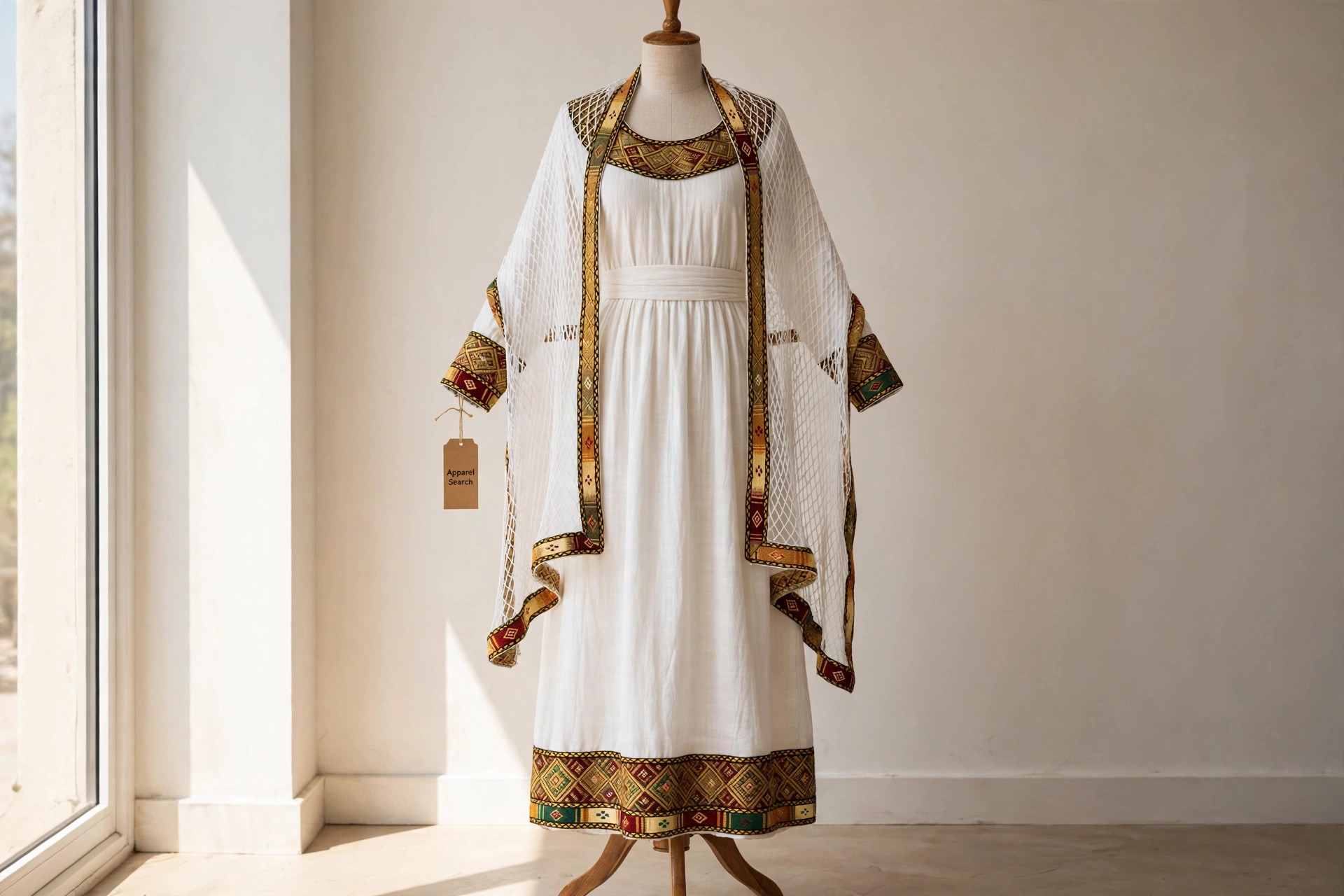
An Ethiopian wedding is dressed in white on white. The bride wears a habesha kemis — a long dress of handwoven white cotton whose whole design lives in its tibeb, the woven border bands in gold and colored thread at the hem, cuffs and neckline — with a netela shawl over her shoulders. The groom stands beside her in matching white, and together they look less like two outfits than one cloth cut in two. Ethiopia has no guide of its own in our Traditional Dress by Country series yet, so Ethiopian dress is introduced here through its wedding form; the wider industry picture is on our Africa clothing industry page.
The Shape of It
White on White: A Wedding in Handwoven Cotton
Most wedding traditions choose a color and build around it. Ethiopia's highland tradition chooses a cloth. The base fabric is shemma — cotton grown, hand-spun and handwoven, traditionally by women spinning and men weaving on narrow looms, so that a wide garment is built up from strips stitched side by side. From that one white cloth come the dress, the shawls and the groom's wraps, and the sameness is the point: at a wedding, a festival or a church feast, a whole community in white shemma reads as one people celebrating together.
Onto that white ground, the weaver adds the tibeb: intricate geometric bands woven directly into the edges of the cloth on the loom, in silk or cotton thread — gold above all for celebrations, with reds, greens and blues in patterns that can signal a region, a weaving center and a maker's skill. A wedding is where the finest tibeb a family can commission comes out. Everything else about the day — the Orthodox church ceremony, the feasting, the dancing, the coffee — is built around that white-and-gold center. Ethiopia's peoples number more than eighty, and dress far beyond the highlands follows other logics entirely; this guide covers the Habesha wedding dress of the Amhara and Tigray highlands, the form the world knows, while our guide to Africa's clothing industry sets it in the continent's wider textile picture.
Day by Day
The Celebrations, Dressed
Telosh — the dress arrives
A day or two before the wedding, the groom's family comes to the bride's home for the telosh, bringing the gifts that formally open the marriage: gold jewelry, perfume, shoes — and, in the traditional telling, the wedding dress itself, the habesha kemis and its scarves presented to the bride by the family she is joining. Female relatives sing the bride's praises, prayers are said, and incense and coffee frame the evening. Dress for the telosh is traditional but not yet at full wedding strength; the great kemis is being given, not yet worn.
The church wedding — Teklil
For Orthodox Christian couples — the majority tradition in the highlands — the wedding's heart is the matrimony service, the Teklil, in an Ethiopian Orthodox Tewahedo church. Dress answers the setting: the bride's kemis is long-sleeved and ankle-length by design, and her netela is drawn up over her head, as women cover their heads in church; shoulders and knees stay covered, and the whole effect is modest as well as splendid. During the service the priest blesses ceremonial crowns placed on bride and groom — for the length of the rite they are king and queen of a new home — and ceremonial capes may be worn over the white dress. The service is long, sung and standing, and the clothing is built for it: layers of cotton, not a costume for photographs.
The reception — feasting and eskista
After the service comes the reception: communal platters of injera with doro wat and the other wedding stews, tej honey wine, and dancing — above all eskista, the shoulder dance of the highlands, all rapid shoulders, chest and neck movement, which pulls guests onto the floor in circles. What the couple wears now depends on the family's shape of wedding: many couples keep the traditional white for the whole day; in city and diaspora weddings the reception is often the Western chapter — a white gown for the bride, a suit for the groom — with the traditional dress saved, deliberately, for the mels.
The mels — the traditional day
The day after the wedding, the celebration turns fully traditional at the mels (also spelled melse or melsi). Sources differ on the hosting — some place it with the groom's family welcoming the bride into her new home, others with the bride's family and close relatives — but all agree on its character: closer, warmer and more deeply Habesha than the day before. The bride changes into a distinct habesha kemis, her hair is braided for the occasion, gold jewelry comes fully out, and a great loaf of dabo bread is cut by the groom as elders bless the couple. If the wedding day balanced two worlds, the mels belongs entirely to one of them.
The coffee ceremony — buna
Running through every stage is the coffee ceremony, buna: green beans roasted over coals in front of the guests, ground by hand, brewed in the black clay jebena and poured in a single stream into small handleless cups, with frankincense burning and popcorn passed around. It is served in three rounds — abol, the strongest; tona; and baraka, which means blessing — and a guest stays for all three. At a wedding the ceremony is hospitality and benediction at once: at the mels it is often the bride herself, or a senior woman of the family, who roasts and pours.
The Bride
The Bride: Habesha Kemis and Tibeb
The bridal garment is the habesha kemis: a long, flowing dress of white handwoven shemma cotton, usually ankle-length with long sleeves, its plain white body chosen precisely so that the borders can speak. The word kemis is simply Amharic for dress; habesha names the peoples of the Ethiopian and Eritrean highlands whose dress this is. At everyday strength the kemis is working clothing in the countryside and church dress everywhere. At wedding strength, everything intensifies — finer cloth, wider borders, more gold.
- Shemma — the white cloth
- The dress begins as cotton: hand-spun into yarn and woven on narrow looms into strips, then stitched into a full garment. The named cloths of the Addis Ababa tradition run from gauze-soft fetel to the finer menen developed in the capital's Shiro Meda weaving workshops, and premium saba, woven with silk or rayon threads for luster. A bridal kemis is chosen by hand and eye — the cloth should be soft, even and strong enough to carry heavy borders without puckering.
- Tibeb — the woven borders
- The signature. Tibeb are the multicolored geometric bands woven into the cloth's edges during weaving itself — not printed, not applied afterward — placed at the hem, the cuffs and the neckline, and across the netela. Gold thread traditionally signals richness and protection, and wedding tibeb leans on gold accordingly, with cross motifs answering the Orthodox faith and patterns that connoisseurs read for region and maker. The related crafts are distinct: tilf is true needle embroidery added after weaving, and the placement of the borders — a full band around the hem, a panel descending the front, a half border at the back — has its own names and fashions.
- Netela — the shawl
- Over the kemis goes the netela, a light, single-layered cotton shawl with its own tibeb borders, draped over the shoulders for the celebration and drawn over the head for church. It is the modesty layer, the warmth layer and the second field for the weaver's pattern all at once. The heavier wrap in the same family is the gabi, built from several layers for cold highland mornings and evenings.
- Hair — albaso braids
- For the mels especially, the bride's hair is dressed in albaso: fine cornrows swept back from the forehead, in layered patterns — one braid worked over another — that fan toward the back and fall to the shoulders, sometimes finished with small gold pins or beads. The braiding is communal work, done by women together on the morning of the celebration, and particular raised, fish-like patterns such as asa shuruba are long associated with weddings and rites of passage in the Amhara region.
- The kaba — the cape of honor
- At the most formal moments, bride and groom may both wear the kaba: a long cape of dark velvet — black, deep red or navy — heavily embroidered in gold or silver, historically the dress of royalty and nobility. Over the white kemis it turns the couple, for an hour, into the crowned pair the church service names them.
The highland pattern is shared, but its accents are regional:
| Tradition | The bridal emphasis | Signature details |
|---|---|---|
| Shewa / Addis Ababa | The classic zuria form — a continuous tibeb band encircling the hem | Fine menen cloth from the capital's weaving workshops; the form carried worldwide by the diaspora |
| Gojjam | The maximalist answer — denser, bolder work | Wide green or red borders, swirling zege needle embroidery, heavier fetel cotton for the cold highlands |
| Tigray | Heavy, intricate tibeb with formal richness | Albaso braiding emphasized, silver jewelry often stacked alongside gold, circular group dances at the mels |
| Beyond the highlands | Other peoples, other dress | Oromo, Gurage, Somali and southern communities marry in their own garments and colors — Ethiopia's wedding dress is plural, and the white kemis is its highland chapter |
The Groom
The Groom: The Matched White Pair
The groom's dress is built to stand beside the kemis, not to compete with it. His base is white like hers: white trousers and a white shirt or long tunic — the knee-length, narrow-sleeved tunic called eje tebab in the Amhara tradition is one classic form — and over it the woven wraps that carry his share of the tibeb.
- The netela and kuta
- For the church and the formal photographs, the groom drapes a netela or the finer kuta shawl over his shoulders, its woven borders chosen to answer the bride's — matching, or close enough that the pair reads as a set. The shawl is also practical reverence: it is the layer he adjusts entering church.
- The gabi
- When the celebration moves outdoors or into the evening, the groom's wrap thickens into the gabi — several layers of shemma in one heavy shawl, the highland answer to cold air at altitude. A groom in white trousers, white shirt and a great white gabi is the male silhouette of the whole tradition.
- The modern white suit
- City grooms increasingly build the same idea in tailored form: a white or ivory suit, or a white suit jacket over traditional trousers, with the netela or gabi worn over the tailoring — the matched-white effect kept, the cut updated. At diaspora weddings the groom's two days mirror the bride's: a suit for the church-and-reception day, the full traditional white for the mels, his shawl's tibeb matched to her kemis.
The bridal party extends the picture: attendants — the mizoch — dress in coordinated traditional clothes, so the couple processes through a field of white edged, like them, in pattern and gold.
Jewelry
Gold Against the White
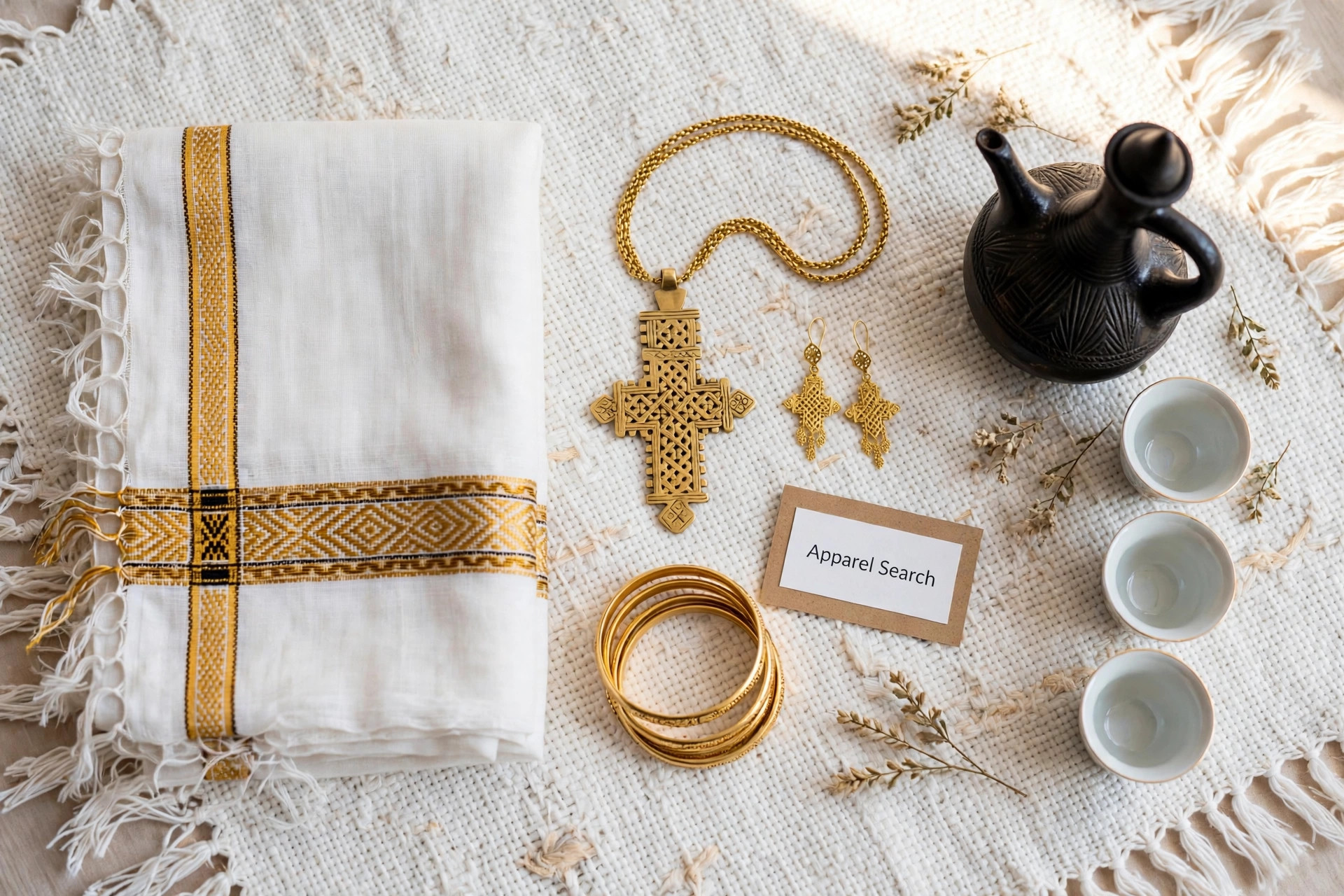
Against all that white, the jewelry is the color. Ethiopian wedding gold is given as much as it is worn: the telosh gifts from the groom's family — necklaces, earrings, rings — are part of the marriage settlement of honor between the households, and the bride may also wear family pieces carried down through earlier weddings. The forms are distinctive. The great lattice-work cross pendants of the highlands, inspired by the processional crosses of the Orthodox church, hang at the chest over the kemis; matching cross earrings and stacked bangles complete the set, and in Tigray tradition silver is layered in alongside the gold. Orthodox brides and grooms alike may wear the mateb, the blessed cord of the faith, at the neck. Nothing here is minimal: the gold is meant to be seen across a church, and to say that this woman is married with honor and her family's wealth and blessing on her body. For the Western counterpoint in bridal gold and stones, see our bridal necklaces guide.
Acquiring
Buying the Wedding Wardrobe
A wedding kemis is commissioned, not pulled from a rail. The work begins months ahead — the sources for diaspora weddings advise ordering custom traditional attire well in advance, because the cloth itself must be woven before the dress can be sewn. In Addis Ababa, the great address is Shiro Meda, the market quarter below Entoto where weavers have worked since the capital's founding: stalls of kemis, netelas and gabis sorted by quality, where the tibeb is the price — the wider, finer and more gold the border work, the higher the figure, and bargaining is normal and expected.
Buying well means reading the border. True tibeb is woven in: turn the cloth over and the pattern is in the structure, with the slight irregularities of handwork; printed imitations sit on the surface and repeat perfectly. Families buy as a set — bride's kemis and netela, groom's wraps with answering borders, attendants' cloth to coordinate — and the diaspora buys the same way at a distance, through Habesha clothiers in the big emigrant cities and online, shipping finished sets home or bringing them in suitcases. A fine kemis is not spent on one day, either: it returns for Timkat, for Easter, for the next family wedding, softening with every wearing.
Today
The Modern Mix
The modern Ethiopian wedding — above all in the diaspora, in Washington, Dallas, Minneapolis, Seattle and a dozen other cities — is frankly two weddings, and the clothes tell you which one you are at. Day one is the white wedding: a Western bridal gown, a suit or tuxedo, a reception of speeches and a first dance. Day two, the mels, is the answer: habesha kemis and traditional white for everyone, braided hair, gold out, eskista on the floor and the coffee poured from the jebena. Couples describe the second day as the one that connects them to home, and they dress it at full strength.
Designers are meeting the moment from both directions: tibeb borders applied to modern gown silhouettes — a fitted bodice, a mermaid skirt, a shorter cocktail kemis for dancing — and Western white dresses given a netela to wear over them, so one bride can carry both traditions in a single day with a change of layers rather than a change of dress. What has not changed is the grammar underneath: white handwoven cotton, woven pattern at the edges, gold at the throat, and a shawl ready to rise over the hair when the church doors open. If you are attending rather than starring, our guide to dressing as a wedding guest covers the guest's side of the dress code — at a Habesha wedding, arriving in traditional dress yourself is welcomed as respect.
Common Questions
Common Questions
What does an Ethiopian bride wear?
A habesha kemis: a long dress of handwoven white cotton (shemma), usually ankle-length with long sleeves, decorated with tibeb — woven border bands in gold and colored thread — at the hem, cuffs and neckline. Over it she wears a netela, a light shawl with its own tibeb borders, draped over the shoulders or drawn over the head in church. Gold jewelry, often including a lattice-work cross pendant, and braided hair complete the dress; at the most formal moments a velvet kaba cape may be worn over everything.
What is tibeb?
Tibeb is the decorative pattern woven directly into the edges of Ethiopian shemma cloth on the loom — geometric bands in colored and metallic thread at a garment's hem, sleeves, neckline and shawl borders. It is woven in, not printed or sewn on afterward (needle embroidery added later is called tilf). Gold tibeb traditionally signals richness and protection, and the patterns can indicate a region, a weaving center and the maker's skill. At a wedding, the bride's tibeb is at its widest and most gold.
What does an Ethiopian groom wear?
White to match the bride: white trousers with a white shirt or a long tunic such as the eje tebab, with a netela or kuta shawl draped over the shoulders — its tibeb borders answering the bride's — and a heavier multi-layered gabi wrap for outdoors and evening. Modern grooms often wear a white or ivory suit with the traditional shawl worn over the tailoring. Like the bride, he may wear a gold-embroidered velvet kaba cape for the most formal moments.
What is the mels, or melse?
The mels (also spelled melse or melsi) is the traditional celebration held the day after the wedding, hosted by one of the two families — accounts differ between the groom's family welcoming the bride and the bride's family hosting close relatives — for family, elders and the bridal party. It is the most fully traditional part of the wedding: the bride wears a distinct habesha kemis with her hair in albaso braids, gold jewelry is worn in full, a large dabo loaf is cut with blessings, and the coffee ceremony is poured, often by the bride herself.
What happens at an Ethiopian wedding coffee ceremony?
The buna ceremony runs through the wedding celebrations: green coffee beans are roasted over coals before the guests, ground by hand and brewed in a clay jebena, then poured into small handleless cups in three rounds — abol (the strongest), tona, and baraka, which means blessing. Frankincense burns and popcorn is served alongside. Guests stay for all three rounds; the baraka round is understood as a blessing on everyone present, which at a wedding extends to the couple and their union.
Keep Exploring
More to Explore
In This Series
Wedding Attire Around the World
The series hub — wedding dress country by country, from China's qun kua to Scotland's tartan, as each guide is published.
Visit the hub ↑Traditional Dress by Country
The series hub — every country guide, from the kimono of Japan to the kilt of Scotland, as each is published.
Visit the hub ↑Go Deeper on Ethiopia
Africa Clothing Industry
The continent's apparel and textile industry directory — Ethiopia's weavers and garment sector in their regional setting.
Explore ↑Definition of Wedding Dress
The short Apparel Search definition of the wedding dress and its key terms.
Read ↑Wedding Dress Guide
Wedding dresses as clothing to buy and wear — silhouettes, fabrics and shopping guidance.
Read ↑Attending a Wedding?
Search Apparel Search