Attars & Perfume Oils
Scent captured in oil, not alcohol — the Kannauj deg-bhapka tradition, classic attars from rose to shamama, and how oil fragrances wear, layer and last.
Before there were spray bottles, there was oil. The attar — a concentrated, alcohol-free fragrance carried in oil rather than alcohol — is one of the oldest ways of wearing scent in the world, and in India and the Middle East it never went away. This guide explains what an attar actually is, how the distillers of Kannauj still make it in copper stills over open fires, how a traditional attar differs from the modern roll-on perfume oils now sold everywhere, and why oils behave so differently on skin from the sprays most of us grew up with. It belongs to our Fragrances & Perfumes Guide, and it follows on from how perfume is made, because the attar method is one of the oldest extraction stories in that whole account.
Whether you have arrived here from an interest in natural perfumery, in alcohol-free fragrance, or simply in a small crystal bottle you were given as a gift, the key idea is the same: an attar is scent captured in oil at the moment of distillation, and everything about how it smells, lasts and should be worn follows from that single fact.
The Short Version
- What an attar is: a botanical scent hydro-distilled directly into a base oil — traditionally sandalwood oil — so the fragrance is captured in oil, with no alcohol involved.
- Where it comes from: Kannauj, in Uttar Pradesh, India, has made attars for centuries using the copper deg-bhapka method, and “Kannauj Perfume” holds a Geographical Indication tag.
- Attar vs perfume oil: every attar is a perfume oil, but modern perfume oils are usually fragrance compounds blended into a carrier oil, not distilled into one.
- How oils wear: close to the skin, with a small, intimate scent zone — but commonly eight to twelve hours of wear.
- How to use them: one to three dabs or swipes on pulse points; excellent worn alone or layered under a spray.
Fragrance Guides
What Is an Attar?
The word attar — also written ittar or itra, from the Arabic ʿitr, meaning perfume or scent — names a concentrated fragrance oil made by distilling aromatic plant material directly into a base oil. Rose petals, jasmine blossoms, vetiver roots, saffron, herbs, spices and even, in one famous case, baked earth go into the still; what comes out is not an essential oil to be blended later, but a finished perfume, already living in its oil base and ready to wear. Traditionally that base is sandalwood oil, whose soft, creamy, long-lasting scent both carries the captured fragrance and contributes its own character to the result — which is why the price of a true attar tracks the price of sandalwood as much as the price of the flower on its label.
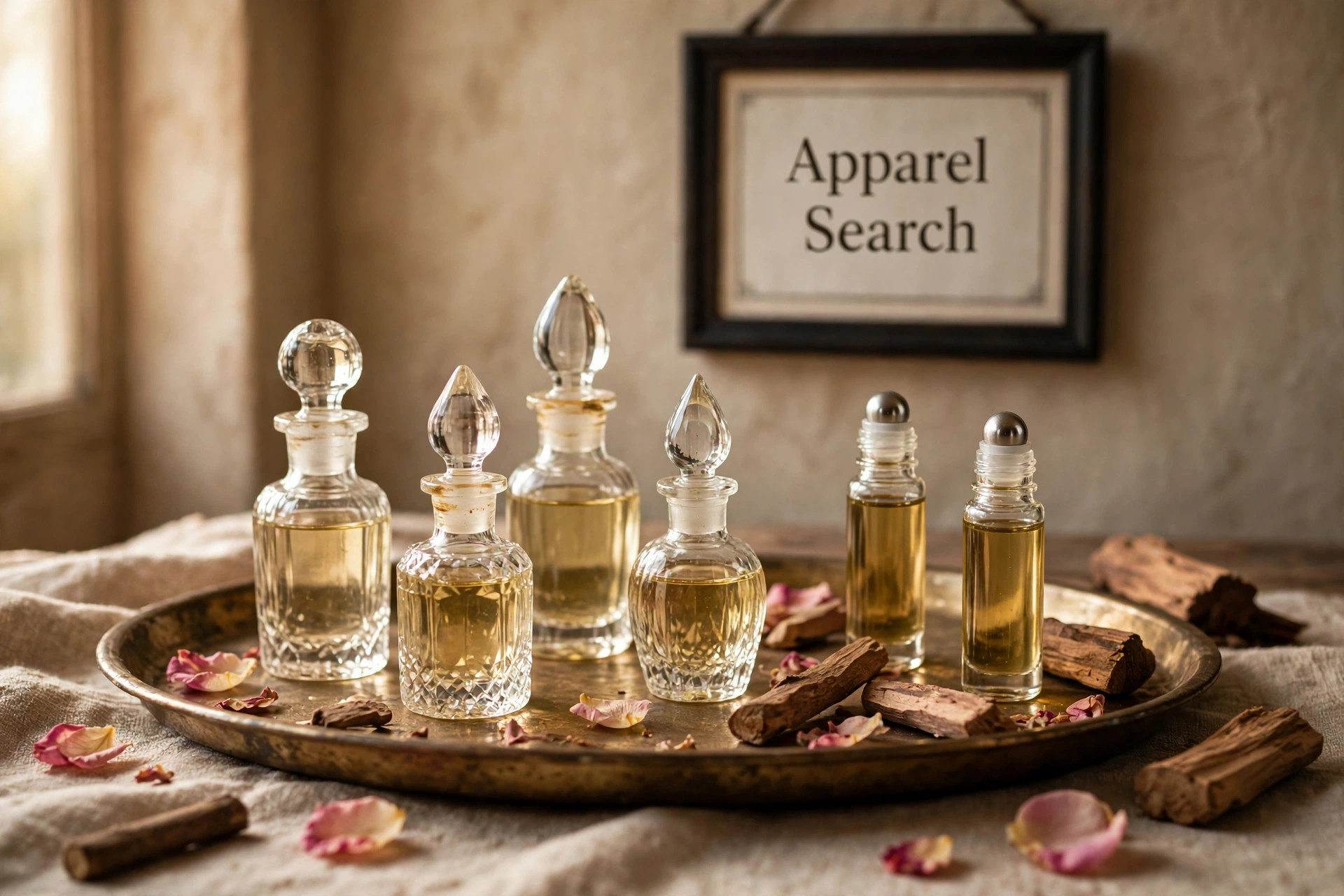
Attars are worn straight, in tiny amounts, dabbed or rolled onto the skin from small bottles — traditionally ornate crystal or glass flacons with a dipstick or stopper, today often a roll-on. They contain no alcohol, no water and no spray mechanism. A bottle of a few millilitres can last for months, because a full application is measured in dabs, not sprays.
Kannauj and the Deg-Bhapka Method
If attar has a capital, it is Kannauj, a small city on the Ganges in Uttar Pradesh that has been making attar for centuries — by local tradition, for more than four hundred years — and is known as the perfume capital of India. The craft was prized at the Mughal courts, and in 2014 “Kannauj Perfume” received a Geographical Indication (GI) tag, protecting the name for attar actually produced there by the traditional method. What makes Kannauj remarkable is how little that method has changed. It is called deg-bhapka, after its two main vessels, and it works like this:
- The deg
- A large copper still, set into a brick or clay furnace (the bhatti) fired with wood or dung cakes. Fresh flowers or other botanicals are loaded into the deg with water, and the lid is sealed not with a clamp but with a paste of clay and cloth that hardens as it heats.
- The chonga
- A hollow bamboo pipe, wrapped in twine for insulation, that carries the aromatic vapour from the deg to the receiver. There is no separate condenser of the modern kind; the vapour cools as it travels.
- The bhapka
- A round copper receiving vessel with a long neck, charged with sandalwood oil and standing in a tank of cooling water (the gachchi). The vapour condenses into the oil, and the oil absorbs the fragrance directly — this capture of scent into oil, in a single step, is the heart of the whole method.
- The kuppi
- After distillation, the finished attar is stored in leather bottles called kuppi. Leather is slightly porous to water but not to oil, so residual moisture from the distillation slowly escapes through the walls while the oil stays — a traditional finishing step that gently matures the attar.
The process is slow and stubbornly manual. There are no gauges: the distiller judges the fire by sound, sight and experience, and a single attar may require the deg to be recharged with fresh flowers again and again over many days, each run adding another layer of scent to the same base oil until it is saturated. Flowers are picked at dawn and must be distilled the same day, so the work follows the harvest calendar — rose in spring, jasmine and kewda in the summer months, the earth attar before the monsoon. It is, in the best sense, an agricultural craft as much as a chemical one.
Attar vs the Modern Perfume Oil
Walk into a beauty shop today and you will find roll-on “perfume oils” everywhere, and it helps to know how they relate to the Kannauj tradition. A modern perfume oil is usually made by blending: finished fragrance compounds — natural, synthetic or both — are mixed at high concentration into a neutral carrier oil such as jojoba, fractionated coconut oil or sweet almond oil, and bottled, very often as a roll-on. Nothing is distilled, and the carrier is chosen to be as odourless as possible so it stays out of the way.
A traditional attar is made by capture: the fragrance does not exist separately from its base until the moment the vapour condenses into it, and the base — sandalwood — is an active, scented partner rather than a neutral one. Neither approach is automatically better. Blended oils can reproduce almost any modern fragrance style, are consistent and affordable, and are a perfectly good way to wear scent. Distilled attars offer something else: the particular depth and softness of a scent that was born in oil, made by a method that has barely changed in centuries. Knowing which of the two you are holding explains most of the difference in price — and in character — between them. For the purest and most potent oil of all, see our guide to oud perfume: pure oud oil has been sold and worn as an attar-style oil across the Middle East for as long as the format has existed.
Why Alcohol-Free Matters
The absence of alcohol is not a marketing garnish; it changes the product in three practical ways. First, skin feel: alcohol evaporates in seconds and can sting, dry the skin or irritate freshly shaved or sensitive skin, whereas an oil sits comfortably, spreads slowly and can even feel mildly conditioning thanks to its carrier. Many people who cannot wear sprays comfortably find oils unproblematic — though anyone with a specific ingredient sensitivity should still patch-test, since “alcohol-free” does not mean “allergy-proof.”
Second, cultural and religious preference: because traditional attars contain no alcohol, they have long been the fragrance format of choice for many Muslim wearers, for whom alcohol-based perfume raises religious questions, and they are widely worn for prayer and on Fridays and festivals in the Gulf and South Asia. We state that neutrally, as one well-documented reason among several for the format's enduring popularity — alongside travellers who prefer a small, leak-resistant, non-flammable bottle, and wearers who simply like a scent that stays personal rather than announcing itself across a room.
Third, the scent itself: with no alcohol flash, an oil has no sharp alcoholic opening blast. What you smell in the first minute is close to what you will smell in the third hour, only gradually softening — a calmer, more linear unfolding than the dramatic top-heart-base arc of a spray.
How Oils Wear Differently from Sprays
An alcohol spray and an oil are two different delivery systems, and they trade strengths. Alcohol is a projector: it evaporates fast, lifts the fragrance off the skin and throws it into the air, creating the opening burst, the projection and the scented trail — the sillage — that sprays are loved for. Oil does the opposite. It barely evaporates at all, so the fragrance is released slowly, warmed by the skin over many hours. The result is a scent that stays close — a personal zone noticeable to you and to someone near you, rather than to the whole room — and that commonly lasts eight to twelve hours on skin, with heavy materials such as oud, amber and musk sometimes detectable on fabric the next day.
Oils also develop differently. A spray performs its pyramid in sequence — bright top notes first, heart next, base last — because its ingredients evaporate at different rates into the air. An oil compresses that performance: the notes emerge together and evolve gently, more like a chord slowly changing colour than a melody. If you love watching a fragrance transform dramatically over an evening, a spray gives you more theatre. If you want a scent that is simply, steadily there — for work, for travel, for close company — the oil's quiet persistence is the point.
Classic Attars Worth Knowing
The traditional repertoire is a tour of India's botanicals. Gulab is rose — Damask roses distilled into sandalwood — rich and honeyed. Motia is jasmine sambac, sweet and luminous. Kewra (also spelled kewda) comes from the pandanus flower and smells fruity, honeyed and almost fizzy. Ruh khus is vetiver — wild green roots giving a cool, earthy, grassy oil traditionally worn in the heat of summer. Mitti attar may be the most poetic perfume in the world: discs of local alluvial clay are half-baked and then distilled into sandalwood oil, capturing the smell of first rain on dry earth. Shamama is the opposite of a single-flower attar — a closely guarded house recipe in which dozens of herbs, spices, roots, resins and flowers are co-distilled together into a warm, spicy, dark oil traditionally worn in winter; every maker's shamama is different, and the recipes are family secrets. Henna (mehndi) attar, distilled from henna flowers, is another old Kannauj speciality, green and honeyed. Together these show the range of the method: if it grows, blooms or can be baked, Kannauj has probably tried to distil it into oil.
How to Apply — and How to Layer
Application is simple and economical. Warm the bottle briefly in your hands if the oil is thick, then roll or dab a small amount onto pulse points — inner wrists, sides of the neck, behind the ears, the chest — where warmth will help the scent unfold. Do not scrub your wrists together; press them lightly or leave the oil undisturbed. Start with less than you think you need: concentrated oils build quietly, and you can always add another dab an hour later, while an over-application of a heavy attar cannot be taken back. Apply to skin, not clothing, since oils can stain delicate fabrics, and give the oil a minute to settle before dressing.
Layering is where oils become a creative tool. Worn under a spray, an oil acts as a rich, slow base that extends the spray's life and deepens its dry-down — a technique with a long history in the Gulf and a growing following everywhere else; our guide to perfume layering works through combinations in detail. The reliable pairings share a note or a family: a rose attar under a rose eau de parfum, a sandalwood-based attar under a woody spray, a drop of oud oil beneath an amber fragrance for the evening. Keep quantities small on both layers, and test a pairing on a wrist before committing it to a whole day.
Choosing and Storing Attars and Oils
When buying, the most informative question is also the simplest: is this a distilled attar or a blended oil, and what is the base? A traditional attar should name its botanical and, ideally, its sandalwood base; a blended oil should name its carrier. Small bottles are a virtue, not a compromise — oils are used in dabs, so 6 to 12 millilitres lasts a long time, and a smaller bottle is finished while still fresh. Store oils as you would any fine fragrance: upright, capped, in a cool dark drawer away from sunlight and bathroom humidity. Kept well, an oil commonly stays good for years, and some traditional attars — shamama above all — are deliberately aged, deepening and rounding in the bottle in a way alcohol sprays rarely do.
Common Questions
What is the difference between an attar and a perfume oil?
An attar, in the strict traditional sense, is a specific kind of perfume oil: a botanical material — rose, jasmine, vetiver roots, even baked earth — hydro-distilled directly into a base oil, traditionally sandalwood oil, using the copper deg and bhapka method of Kannauj in India. The scent is captured into the oil during distillation itself, not blended in afterwards. The broader term perfume oil covers any fragrance carried in oil rather than alcohol, including modern roll-ons in which ready-made fragrance compounds are simply mixed into a neutral carrier such as jojoba or fractionated coconut oil. Every traditional attar is a perfume oil, but not every perfume oil is a traditional attar.
Are attars and perfume oils really alcohol-free?
Traditional attars are, yes: the carrier is oil — classically sandalwood oil — and no alcohol is used at any stage, which is one of the format's defining features. Modern perfume oils are also normally alcohol-free, with the fragrance held in a carrier oil instead. It is still worth reading the label on any individual product, because a small number of products marketed loosely as oils or oil-based sprays do contain alcohol, but a genuine attar or concentrated perfume oil should be exactly what the name promises: scent in oil, nothing else.
Do perfume oils last longer than sprays?
On the skin, usually yes — a good oil commonly wears for eight to twelve hours where a typical eau de parfum wears for five to eight — because there is no alcohol to flash off and carry the scent away quickly; instead the oil releases its fragrance slowly as the skin warms it. The trade-off is projection. An alcohol spray throws scent into the air and leaves a noticeable trail, while an oil stays close, forming a small personal scent zone that people notice when they are near you rather than across a room. Think of it as duration in exchange for volume: oils are quieter, but they stay.
How do I apply an attar or perfume oil?
A little goes a long way. Roll or dab a small amount onto warm pulse points — the wrists, the sides of the neck, behind the ears, or the chest — and resist the urge to rub your wrists together hard, which crushes the more delicate top facets; pressing them together gently, or simply letting the oil settle, is better. One to three swipes or dabs is a full application for most concentrated oils. Because oils can mark delicate fabrics, apply to skin rather than clothing, and let the oil absorb for a minute before dressing over it.
Can I layer a perfume oil under a spray perfume?
Yes — it is one of the best uses of the format. An oil applied first gives a spray something rich and slow-releasing to sit on, extending the spray's wear and adding depth to its base; a woody or musky oil under a fresher spray is a classic combination. Apply the oil to pulse points, let it settle for a few minutes, then spray over or beside the same spots. Choose pairings that share a family or a note — rose oil under a rose perfume, a sandalwood-based attar under a woody spray — and experiment in small amounts, because layering concentrates two fragrances at once.