Apparel Search Jewelry Guides
Bracelet and Watch Sizing Guide
Wrist measuring and ease, bangles sized over the knuckles, cuff fit, watch case proportion — and how to stack them.
Bracelets are where jewelry sizing splits into three different questions wearing one name, and watches add a fourth. A chain bracelet is sized by length, a cuff by how it grips, a bangle by a diameter that has nothing to do with your wrist — and a watch by a case proportion plus a strap. This page of the jewelry sizing and wearing guide takes each measurement in turn, then closes with the basics of stacking, where several sized pieces have to agree with each other. The bracelet styles themselves — every type and stone — live in the Jewelry Guide's bracelets guide, and the watch types in its watches guide.
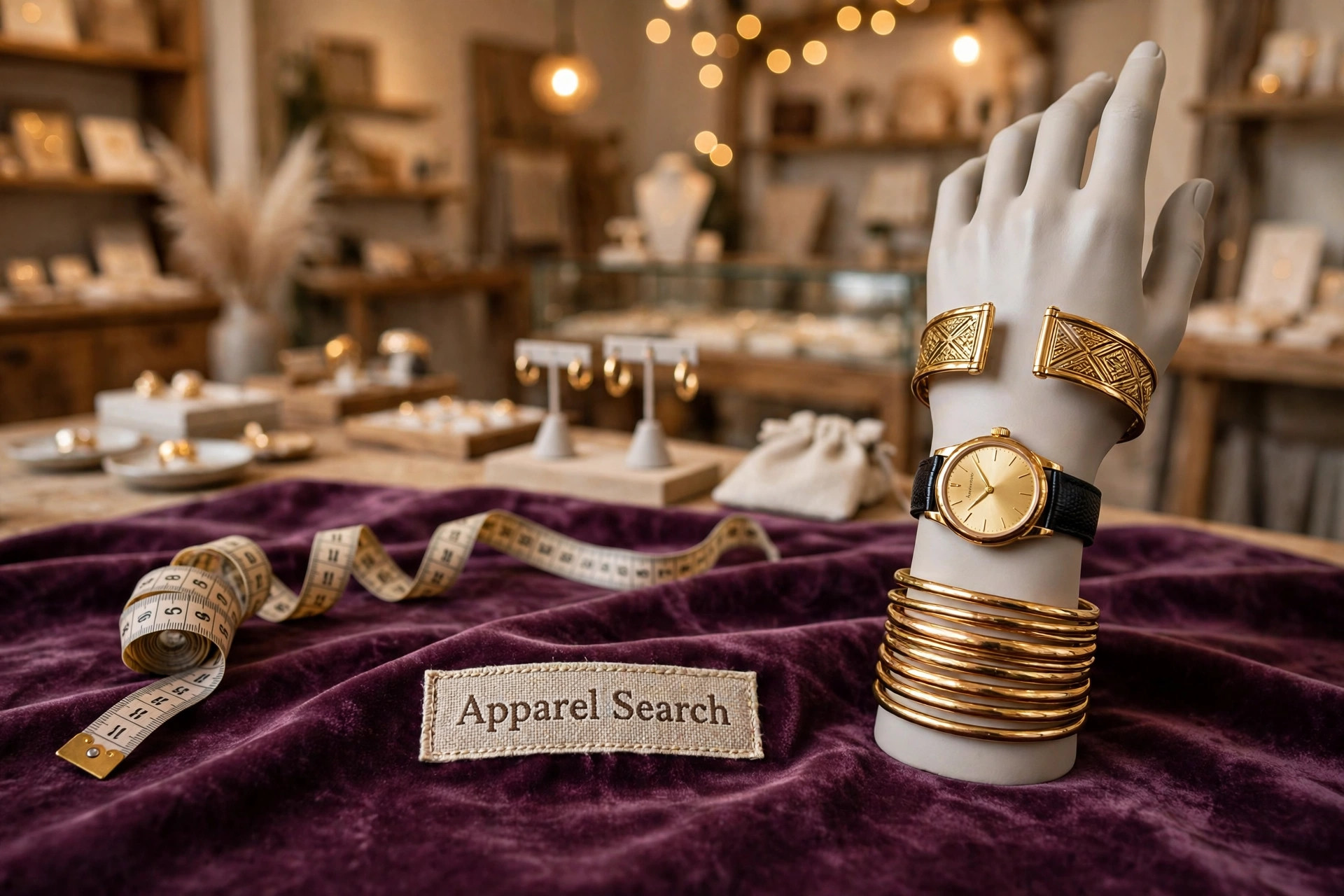
Start with the Wrist Measurement
Three of the four sizings below begin from the same number, so take it properly once. Wrap a flexible measuring tape around your wrist just below the wrist bone — the spot where a bracelet naturally settles — snug against the skin, not cinching it. Read where the tape meets. Without a tape, use the paper-strip stand-in: wrap a strip of paper, mark the meeting point, and measure the strip flat against a ruler. (The strip method is adequate here in a way it is not for rings, because bracelet ease is measured in generous fractions of an inch, not in half-millimetres.) Note the number in your sizes note; sellers' charts will ask for it directly or convert it.
Ease: the Difference Between Wrist and Bracelet
Ease is the amount added to a body measurement to get a garment or jewelry size — the wearing room built into the number. For chain bracelets, ease is usually between half an inch and an inch: about half an inch gives a close fit that stays near the wrist, about an inch gives the drape most people picture. A seller who lists a bracelet by length is quoting wrist-plus-ease already spent; a seller who asks your wrist size is about to spend it for you.
Chain and Link Bracelets: Wrist Plus Ease
Chain, link, charm and tennis bracelets are flexible circles that close with a clasp, so they size like necklaces: total length. Choose the length by deciding the fit first. A close fit — wrist measurement plus about half an inch — keeps the bracelet up near the wrist, tidy under a cuff and less prone to catching. A relaxed fit — plus about an inch — drapes onto the base of the hand and moves as you do, which is the classic charm-bracelet behavior, since charms need room to hang and turn. Beyond an inch of ease most bracelets start working their way over the hand at inconvenient moments. When a listing gives only "small, medium, large," the maker's chart maps those to lengths; measure rather than guessing your letter.
Cuffs: Snug, Shaped, and On Sideways
A cuff is a rigid arc, open at the back, and it sizes by grip rather than length. The right cuff sits close against the wrist with its opening narrower than the wrist is wide, so it stays on by shape rather than by clasp; it goes on sideways, slipped over the narrow side of the wrist above the wrist bone, then turned into place — never forced straight over the hand, and never repeatedly bent open and closed, which fatigues the metal and eventually cracks it. Cuff sizes are commonly listed by the inside circumference of the arc plus the gap, or by wrist-size ranges; a cuff that spins freely is too large, and one that pinches or will not turn into place is too small. Because a cuff is shaped, it is also the bracelet most worth trying before buying where you can.
Bangles: Sized by the Hand, Not the Wrist
A bangle is a closed rigid circle, so its size is its inside diameter — and the fit question is whether that circle passes over your hand. Make the measuring pose: fingertips extended, thumb tucked across the palm to meet the little finger's base, the shape your hand takes sliding into a bangle. Measure around the widest point of the knuckles in that pose, or — more directly — measure the inside diameter of a bangle that already fits you and order that. Common bangle inside diameters run about 2.25 inches for small, 2.5 inches for medium, and 2.75 inches for large, with makers varying around those anchors. A bangle that passes the knuckles will always be looser on the wrist than a chain bracelet is; that movement is the nature of the type, and its sound and swing are part of its character. Oval bangles, shaped to the wrist's own oval, sit quieter than round ones of the same passing size.
Watches: Case Proportion, Then Strap Fit
A watch is sized twice. The case first: its diameter across the face sets the watch's visual scale against your wrist, and the working convention is that 34–40 millimetres suits most wrists, smaller reading classic and larger reading sporty or deliberately oversized. The number that decides comfort, though, is lug-to-lug — the full length of the case from the top strap attachment to the bottom. When the lugs extend past the edges of your wrist, the watch wears large and catches on everything regardless of its diameter; when they sit within your wrist's width, even a bigger case settles properly. Then the strap or bracelet: it should hold the watch above the wrist bone with about a finger's ease, neither sliding toward the hand nor pinching. Metal bracelets size precisely by adding or removing links — a quick job for a jeweler or watchmaker, and worth having done rather than tolerating a traveling watch — while straps size by holes, and leather or fabric straps also come in lengths, so a wrist at the small or large end should order the strap length, not just the watch.
Stacking Basics
Stacking is wearing several bracelets — often with a watch — as one arrangement, and its sizing rules are the individual rules above applied with a little choreography. Anchor the stack with one substantial piece (a cuff, a bangle or the watch) and build lighter pieces around it. Mix widths and textures so the pieces read as separate lines — the bracelet version of the necklace layering principle. Leave movement room: a stack sized so every piece is at its loosest will wander and clatter as one mass, so run chain bracelets a touch closer in a stack than you would worn alone. Odd numbers and one empty stretch of wrist keep a stack composed rather than crowded, and pieces worn together daily should be of comparable hardness where they touch, since bracelets in a stack rub — the materials side of that question belongs to the jewelry metals guide. For the pieces themselves, the product guides are the next stop: bangle bracelets, cuff bracelets, chain bracelets and charm bracelets, and for watches, the men's watches and women's watches guides.
Common Questions
How do I measure my wrist for a bracelet?
Wrap a flexible tape around your wrist just below the wrist bone — the place a bracelet actually sits — snug against the skin without compressing it, and read the measurement where the tape meets. If you have no tape, wrap a strip of paper or string, mark it, and measure it flat. That number is your wrist measurement, not your bracelet size: chain bracelets add roughly half an inch to an inch of ease to it, and the maker's chart converts it. Measure the wrist the bracelet is for, and measure later in the day when wrists are at their typical largest.
How is bangle sizing different from other bracelets?
A bangle is a closed circle, so the measurement that decides fit is not your wrist but your hand: the bangle's inside diameter must be wide enough to pass over your knuckles. To find it, bring your thumb across your palm toward your little finger — the pose your hand makes slipping into a bangle — and measure around the widest part of your knuckles, or measure the inside diameter of a bangle that already fits you. Common bangle sizes run around 2.25 inches inside diameter for small, 2.5 for medium and 2.75 for large.
What watch case size should I choose?
Case diameter is a proportion choice. As a working convention, cases around 34 to 40 millimetres suit most wrists; smaller wrists and a classic dress look sit toward the lower end, larger wrists and sport styles toward and beyond the upper end, with 42 millimetres and up reading as deliberately large. Diameter is not the whole story, though: the lug-to-lug length — the full top-to-bottom span of the case — decides whether the watch overhangs your wrist, and a watch whose lugs stay within the width of your wrist almost always wears better than a nominally smaller one whose lugs spill over.
How loose should a watch be on the wrist?
A watch should sit above the wrist bone, stay in place when your arm moves, and allow about a finger's width of ease — snug enough not to slide down over the hand or spin around the wrist, loose enough not to pinch or leave the crown digging in. Bracelet-style watch bands are sized by removing or adding links, a quick jeweler's job; straps size by their holes, and if you consistently land between holes, that strap is the wrong length. A watch that travels is a watch that gets knocked — fit is protection as well as comfort.
Back to the Jewelry Sizing and Wearing Guide
Ring sizing, necklace lengths and layering, proportion and choosing metals — the whole fit map.