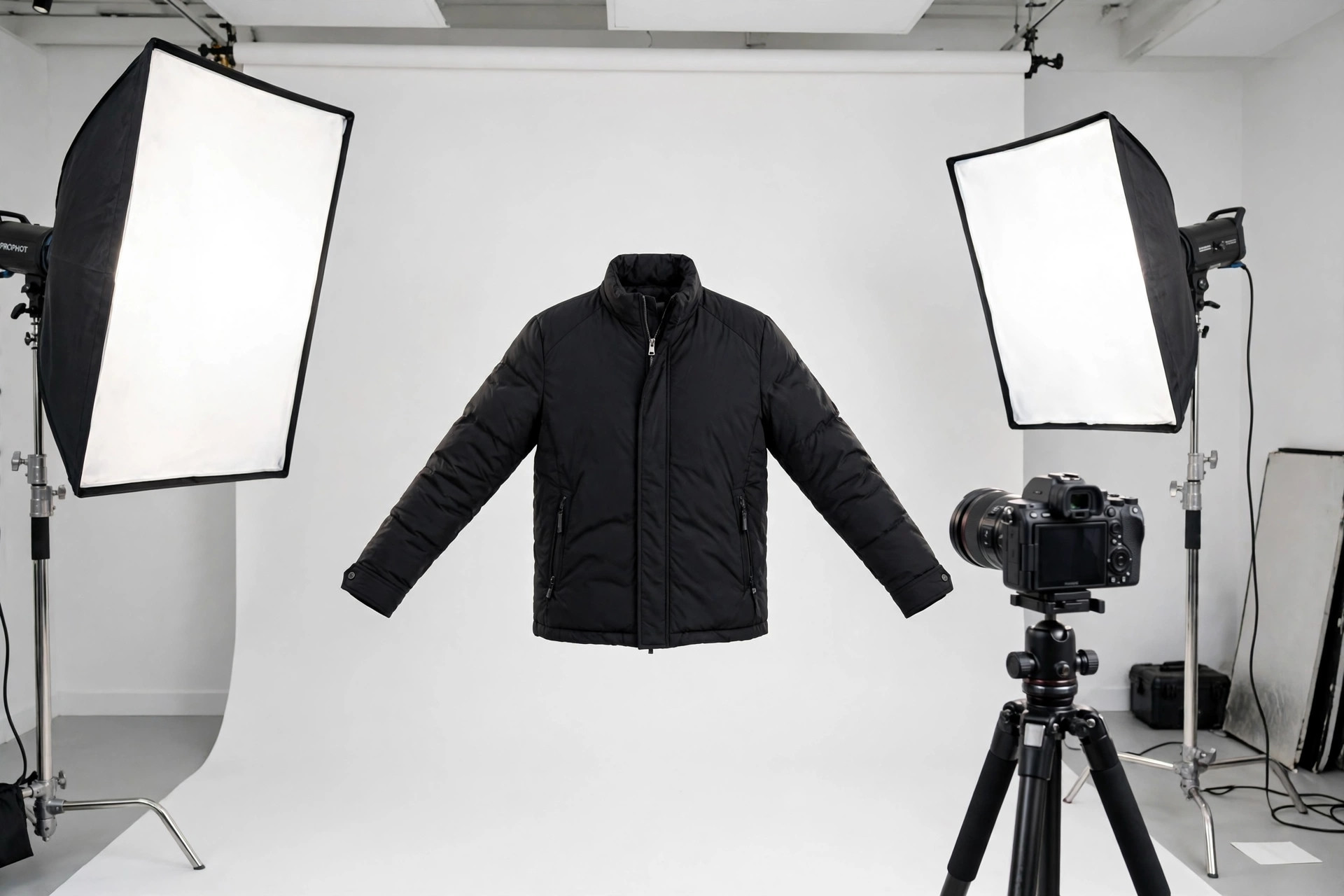
Catalog photography is the consistent, accurate product imagery that fills wholesale catalogs and line sheets — the documents buyers order from. Where editorial photography sells a mood, catalog photography sells information. This chapter of the Fashion Photography & Media Production Guide covers the standards that make catalog imagery trustworthy: identical setups, complete views, true color, and files organized by style number.
Consistency Is the Whole Product
A buyer flipping through sixty styles is comparing them. If one jacket is photographed closer than another, lit warmer, or shot at a different angle, the comparison breaks and the buyer stops trusting the page. Catalog consistency means one fixed setup for the whole session: camera locked on a tripod at a set height and distance, the same background, the same lighting ratio, and garments presented at the same scale in frame. Marks on the floor and a framing template in the capture software keep every frame aligned.
This is why catalog work is planned as a production line rather than a creative session — the workflow in our shoot planning chapter applies directly. Garments arrive steamed and in style order, each is shot in the same view sequence, and files are named by style number as they are captured, not in a renaming session weeks later.
The Views Buyers Need
A complete catalog set for a garment normally includes:
- Front view — the primary image, full garment, squared to camera.
- Back view — where fit, vents, yokes, and closures are judged.
- Detail views — fabric texture, hardware, stitching, prints at true scale.
- Colorway set — every color shown, not described, since buyers order color by eye.
- On-model or form view — at least one view showing how the garment sits on a body or form, for fit-critical styles.

Ghost mannequin presentation — garments shot on a removable form so the product appears to hold its shape on an invisible body — is the catalog standard for tailored pieces; the technique is covered in depth in our e-commerce photography chapter, where the same images usually end up.
Color Accuracy and File Discipline
Catalog color must match the physical garment, because orders are written against it. Shoot with a color reference chart in the first frame of each lighting setup, set a custom white balance, and check images on a calibrated monitor against the garment under daylight-balanced light. Retouching cleans backgrounds and removes pins; it must never shift a color a buyer will rely on.
File discipline is the unglamorous half of catalog quality. Name files by style number, color, and view (for example, ST1042_RED_FRONT), keep the untouched originals, and deliver in the sizes each destination needs: high-resolution for print, sized and compressed for the web. When a style is revised, reshoot or clearly version the file — a line sheet carrying last season's photograph of a changed garment creates claims, returns, and chargebacks.
From Photographs to Line Sheet
The line sheet assembles each style's photograph with its commercial facts: style number, description, fabric, sizes, colorways, wholesale price, and delivery dates. Photography and document must be built together — the sheet's layout fixes the image shape and size the shoot must deliver. Our practical guide to creating a line sheet covers the document itself, and our lookbook chapter covers the styled presentation that usually accompanies it to market. Together — story in the lookbook, facts on the line sheet, consistency in the catalog — they form the complete wholesale package.
Common Questions
- What is a packshot in fashion photography?
- A packshot is a clean product photograph of a single garment on a plain background, shot to show the item exactly as it is. Packshots are the building blocks of catalogs, line sheets, and online stores.
- How many photographs does each style need for a catalog?
- At minimum a front and a back view, plus a fabric or detail shot and one image per colorway. Fit-critical styles add an on-model or on-form view. More views help buyers, but consistency matters more than quantity.
- Why do catalog photos have to be so consistent?
- Because buyers compare styles against each other. If scale, angle, or lighting changes between items, the comparison is distorted and confidence in the whole catalog falls.
- What is the difference between catalog photos and line sheet photos?
- They are usually the same images used in two documents. The catalog presents the range; the line sheet adds the ordering facts — style numbers, sizes, prices, and delivery dates — beside each photograph.
Back to the Fashion Photography & Media Production Guide
This page is one part of the complete guide. Return to the Fashion Photography & Media Production Guide to follow the whole production workflow from first concept to final delivery.