The Product
An Outfit Sold as a Set of Pieces
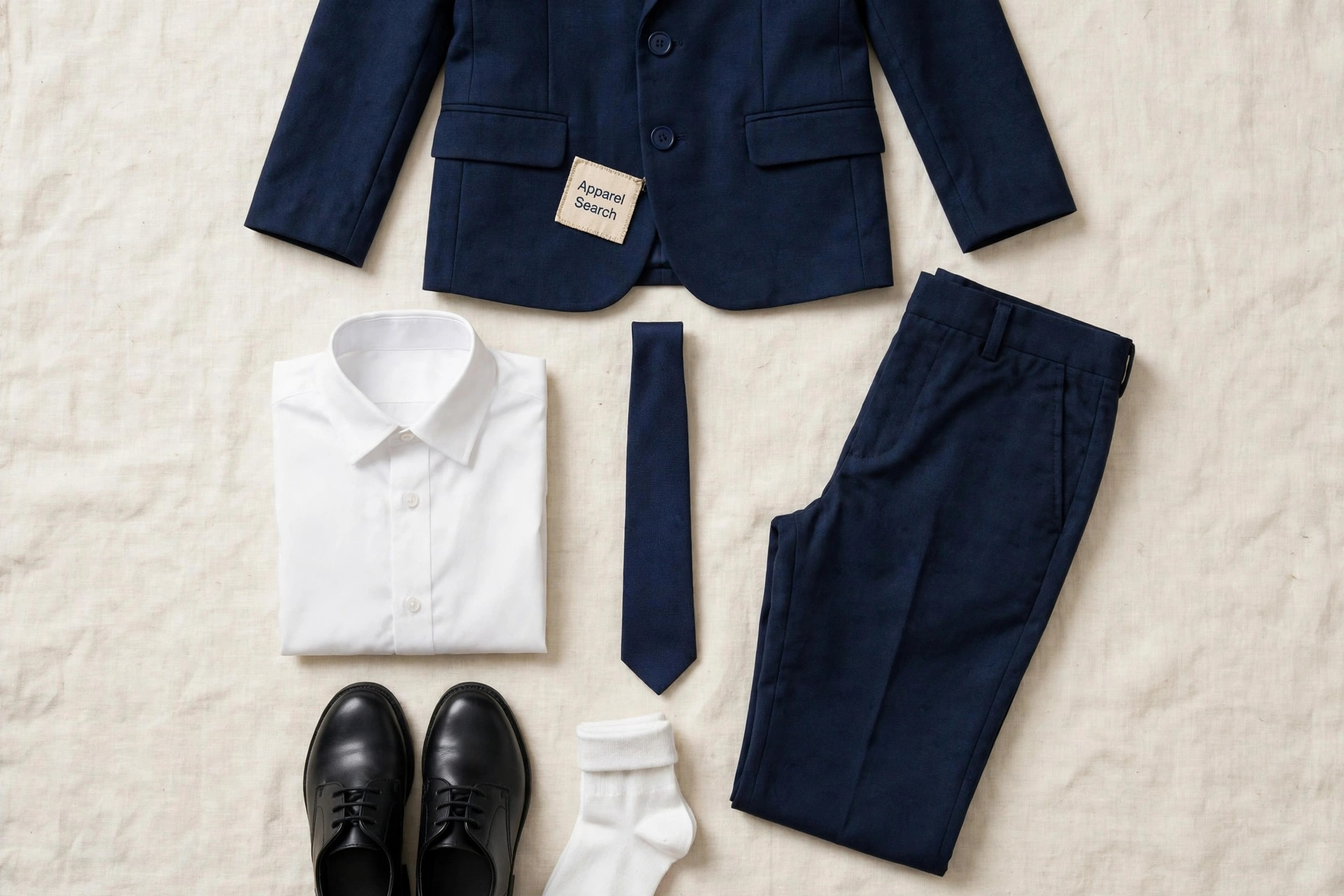
A boys’ first communion outfit is a small tailored set: a jacket and trousers, a white dress shirt, a tie, dress shoes and socks. Unlike the dress, it is a group of standard formalwear products, which makes it easier to buy in pieces and to reuse afterward. This guide works through the set piece by piece: the options, the conventions, and where the money is well spent.
The outfit belongs to the category of the children’s formal clothes guide, and its tailored core is covered by the boys’ suits guide. Parish conventions differ on colour, so check the parish guidance sheet first.
The Two Formats
Matching Suit, or Blazer and Trousers
The matching suit — jacket and trousers in one fabric — is the formal standard, stocked by communion specialists as a set, often a three-, four- or five-piece product bundling waistcoat, shirt and tie. Bundled sets are the simplest purchase and best value per piece; the trade-off is uniform sizing — shirt and trousers come in the jacket’s size. The blazer-and-trousers format buys each piece separately — a navy blazer with grey or navy trousers is the classic combination — which lets each piece be sized independently, and the blazer recombines with other trousers later.
Colour conventions. The white or ivory suit mirrors the dress convention and is a communion-specific, seasonally stocked product. The navy suit with a white shirt is the other standard, and converts directly into a general formal outfit. Fabric is usually smooth polyester or polyester-wool suiting; check for a jacket lining, hem allowance and a waist adjuster.
Before You Buy
Parish Requirements, Read as Product Options
Boys’ conventions are shorter than the dress list but just as specific: check the set against the list before buying.
The Parish-Requirements Checklist
- Jacket: a suit jacket or blazer is standard. Confirm the parish colour convention: white, navy, or any dark suit.
- Shirt: a white dress shirt with a tie collar, long sleeves and a plain front — no logos or coloured trim.
- Tie: most parishes expect a tie; a few supply a communion tie or armband — check before buying. Conventional colours: white, ivory, navy.
- Trousers: dress trousers matching the jacket, hemmed to the shoe; shorts suits are regional and no substitute where full trousers are specified.
- Shoes and socks: dark dress shoes — black with dark suits; white or dark with a white suit, per local convention — and plain socks to match.
- Extras: a waistcoat is an optional layer in most sets; tie pins, pocket squares and armbands are parish-specific — confirm rather than assume.
The Pieces
Shirts, Ties and Shoes in Detail
Shirts are cotton or cotton-polyester dress shirts, sized by age band or, in larger ranges, by collar size. A blend fabric creases less and irons more easily; fit points are a finger’s width of collar room and sleeves ending at the wrist bone. The product choice, covered in the boys’ neckwear guide, is a standard tie, a clip-on in the same fabrics, or a pre-tied zipper tie — all stocked in communion white and navy, and all legitimate products at this size. Shoes are black leather or leather-look dress shoes, lace-up or slip-on, bought with the outfit so the trouser hem can be set to the shoe.
Sizing & Growth Room
Sizing by Age Band, Fitted for the Day
Suit sizing runs by age band, cross-checked against height, chest and waist. Fit the jacket first: the shoulders are a suit’s fixed point, and a jacket right at the shoulder alters easily everywhere else.
| Age band | Typical suit size | Measurements to check before ordering |
|---|---|---|
| 6–7 | 6, 7 | Height and chest; waist against the adjuster range |
| 7–8 | 7, 8 | Chest, waist and inseam; the core band, stocked deepest |
| 8–9 | 8, 10 | Jacket shoulder fit; check for slim or husky cuts |
| 9–10 | 10, 12 | Chest and sleeve length; collar size where ranges switch to it |
| 10–12 | 12, 14, 16 | All measurements, plus waistcoat fit if the set includes one |
Growth room is built into the products, not bought as extra size: trousers carry hem allowance, waist adjusters take the waist in or out, and sleeves lengthen slightly. Buy the size that fits now — a full size up misplaces the shoulder seam, the one fault alteration cannot fix economically. Order four to six weeks ahead for hemming and adjustments.
Budget & Care
Budget Tiers and Looking After the Suit
Budget tiers. The entry tier is the bundled set — jacket, trousers, shirt and tie in one box — the least expensive route to the full specification. The mid tier buys suit and shirt separately in better fabrics — wool-blend suiting, a cotton shirt. The top tier is separates throughout, including leather shoes, and converts best into a reusable formal wardrobe. At every tier, include the shoes in the budget from the start — they are the cost line most often underestimated.
Care. Suiting here is labelled dry-clean or gentle machine wash by fabric and construction — the garment’s own label governs. Hang jacket and trousers after the day, brush the suiting down, and store the set in a breathable garment bag. Kept that way, a navy suit stays in service as a formal outfit long afterward.
Questions
Common Questions
Is a suit or a blazer-and-trousers set the better buy?
A matching suit is the more formal product and the one most communion specialists stock as a set. A blazer with separate trousers costs less as separates in many ranges and recombines more easily with other garments afterward. Both meet the usual parish convention of a jacket, shirt and tie — the deciding factors are budget and how much reuse the pieces will get.
White suit or navy suit — which is the convention?
Both are established conventions and parishes differ. A white or ivory suit mirrors the dress convention and is stocked as a communion-specific product; a navy suit with a white shirt is the other standard and doubles as a general formal outfit afterward. Check the parish guidance first, since a small number specify one or the other.
How much growth room should a communion suit have?
Buy the size that fits on the day, with the standard alteration allowances doing the growth work: trousers are sold with hem allowance to let down and jackets with sleeve length that can be adjusted slightly. Sizing up a full size for growth spoils the shoulder fit, which is the one part of a suit that cannot be altered economically.
More to Explore
Search Apparel Search