Men's Hosiery Guide
Men's hosiery - also called legwear - describes garments worn directly on the feet and legs, and for men that means, above all, socks: the knitted foot-and-leg coverings every man wears daily and almost no man buys deliberately. The word is older than the wardrobe: hosiery was originally the collective term for the products of a hosier, and 'hose' remains its generic name; the term also covers all types of knitted fabric, whose thickness and weight are defined by denier or opacity - lower denier, 5 to 15, is sheer, while 40 and above is dense and 100 is effectively opaque. For men the hosiery drawer divides into dress, casual, athletic and boot socks, and this guide treats them as the engineered garments they are.
Shop Men's Hosiery Now
Shop Men's Hosiery on Amazon Shop Men's Hosiery on eBayThe Amazon and eBay links on this page are affiliate links. If you make a purchase through them, Apparel Search may earn a commission.
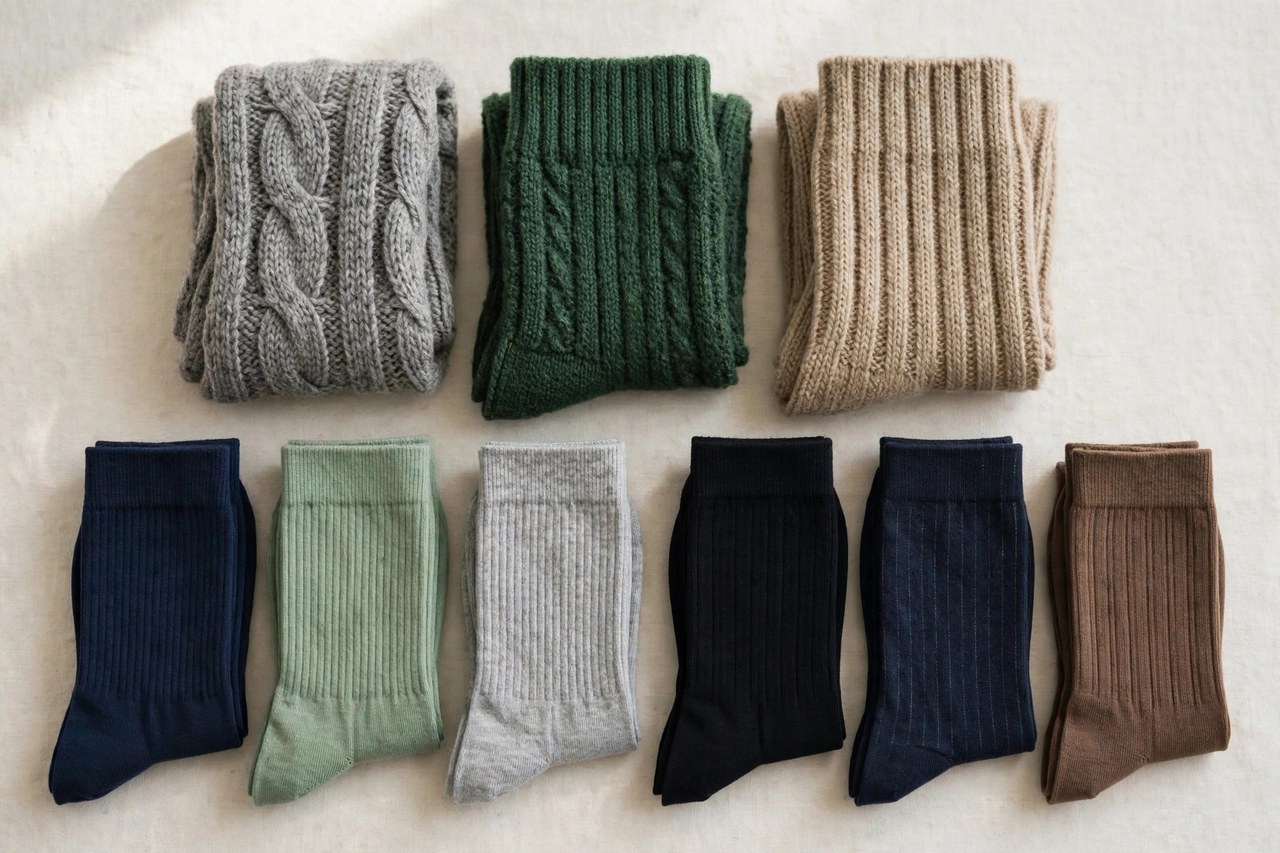
Men's hosiery - also called legwear - describes garments worn directly on the feet and legs, and for men that means, above all, socks: the knitted foot-and-leg coverings every man wears daily and almost no man buys deliberately. The word is older than the wardrobe: hosiery was originally the collective term for the products of a hosier, and 'hose' remains its generic name; the term also covers all types of knitted fabric, whose thickness and weight are defined by denier or opacity - lower denier, 5 to 15, is sheer, while 40 and above is dense and 100 is effectively opaque. For men the hosiery drawer divides into dress, casual, athletic and boot socks, and this guide treats them as the engineered garments they are. This guide is built around the questions buyers actually ask: which style, which size, which fabric, and what will it look like after a year of real use - answered in order, with the trade-offs stated plainly.
Styles and Construction
Shop socks by fiber and by job. Dress socks are fine-gauge merino wool or cotton lisle, thin enough for dress shoes, long enough - over the calf - to stay up and to keep bare leg from ever showing when trousers ride up, which is the style rule socks exist to satisfy. Casual socks trade fineness for pattern and cushion. Athletic socks are engineering: moisture-wicking synthetics or merino, zoned cushioning, arch compression and left-right shaping. Boot socks are thickness and height chosen against the boot's shaft - too thin and the boot rubs, too thick and the fit you bought disappears, which is why the hiking and hunting boot guides link back here. Novelty socks are the family's licensed mischief and obey only one rule: wear them on purpose.
Judge knitwear by gauge, ply and finishing rather than by softness in the shop, because every knit feels kind on day one. Gauge counts stitches per inch - finer gauges drape and layer, coarser gauges insulate and read casual. Ply counts the strands twisted into the yarn: more plies mean more warmth, roundness and price. Fully-fashioned shaping, knitted in rather than cut and sewn, marks better garments, and linked seams at the shoulders and neck lie flatter and last longer than overlocked ones.
Fit and Sizing
Sock fit is a foot measurement that men habitually skip: socks are sized by shoe-size ranges, and a sock too large bunches and blisters while one too small strains at the heel and wears through it. The heel pocket should sit on your heel, the toe seam flat and beyond pressure, the cuff holding by knitted recovery rather than strangulation. Over-the-calf dress socks stay up by their longer rib and a correct size; mid-calf socks stay up for a season of washes and then begin their slide, which is information about their elastic, not your legs. Buy boots and socks as a system, dress shoes and socks as a system - hosiery is the layer where two other garments meet, and it fails, or succeeds, at both interfaces.
Fit knitwear by the body, not the shoulders alone: a sweater should skim rather than cling, with ease for a shirt beneath at the chest, sleeves ending at the wrist bone, and body length covering the waistband without pooling. Knits relax with wear - a slightly firm new fit is often the right long-term fit - but ribbed cuffs and hems should recover when stretched, and a neckline should sit flat against the base of the neck, neither gaping nor strangling.
Wearing and Care
Sock care is rotation and moderation: a drawer deep enough that no pair is worn twice in a week outlasts a thin drawer of better socks worn in rotation of two. Wash cool or warm, inside out to protect the knit face and any pattern, and dry low - heat kills the elastic that is a sock's whole staying-up mechanism. Mend nothing below the ankle line except as a stopgap; a darned toe seam is a blister with good intentions. Retire socks when the heel or ball thins to translucency - thin socks are how good shoes get blamed for bad days. Kept this way, the humble sock becomes what it should be: the cheapest comfort in the entire wardrobe, renewed on schedule.
Knitwear care is gentle by default: wash cool by hand or on a wool cycle with knitwear detergent, never wring, roll in a towel to lift water, and dry flat on a mesh or towel, reshaped to its measurements. Fold for storage - hangers stretch shoulders into points - with cedar or lavender against moths, and rest a sweater a day between wears so its fibers recover their loft. Depill with a comb or electric shaver; pilling is loose fiber migrating, not the garment failing.
Common Questions
What does hosiery mean for men?
Legwear: garments worn directly on the feet and legs. Historically hosiery was the collective term for a hosier's products - hence hose as the generic name - and the term also covers knitted fabrics generally, graded by denier or opacity. In a men's wardrobe the category is overwhelmingly socks: dress socks, casual socks, athletic socks and boot socks, plus the rarer legwear used for dance, costume and sport. The socks guide linked below takes the main family member in full.
What is denier, and does it matter for men's socks?
Denier measures the weight and thickness of a knitted fabric or yarn: lower denier numbers (5 to 15) describe sheer hose with light passing through, 40 and above is dense, and 100 denier is effectively opaque. Men's socks are rarely sold by denier - gauge and fiber content carry that information instead - but the scale explains the family: the sheer end is stocking territory, the dense end is the opaque knits men's socks are made from.
Why do men's dress socks fall down?
Usually because they are mid-calf socks past their elastic life, or the wrong size. Over-the-calf dress socks are the standing answer: their longer ribbed leg holds above the calf's widest point, which both keeps them up all day and guarantees no bare leg shows when you cross your legs - the detail dress socks exist for. Heat in washing and drying is the other culprit: it destroys elastic recovery, so socks that slid after a year of hot drying were retired by the laundry, not by wear.
More in Men's Clothes Guide H
Hosiery and the Denier Scale
Hosiery, also referred to as legwear, describes garments worn directly on the feet and legs — and this includes socks. The term originated as the collective term for products of which a maker or seller is termed a hosier, and those products are also known generically as hose. The term is also used for all types of knitted fabric, and its thickness and weight is defined by denier or opacity: lower denier measurements of 5 to 15 describe a hose which may be sheer in appearance, whereas styles of 40 and above are dense, with little to no light able to come through on 100 denier items. Hosiery leggings have primarily been worn by women more than men, but have been used by men for dance, costume and other activities. Whatever type of socks you are wearing is in style, even if you decided to wear some odd appearing novelty socks.
Looking for Men's Clothing Stores?
This guide explains men's hosiery. To browse where to buy, visit our men's clothing store directory, where you can find retailers that carry them.