Men's Peacoats Guide
A peacoat is a short, heavy, double-breasted wool coat with broad lapels, large buttons and vertical or slash pockets - the naval coat that became a menswear staple. Sailors wore it because melton wool stays warm wet, the double breast overlaps against wind, and the cropped length never tangles in rigging or ladders; civilians kept it because the same build flatters almost every frame and pairs with everything from jeans to tailoring. This guide covers the cloth, the details that mark a true peacoat, and how its naval fit differs from a civilian fashion version.
Shop Men's Peacoats Now
Shop Men's Peacoats on Amazon Shop Men's Peacoats on eBayThe Amazon and eBay links on this page are affiliate links. If you make a purchase through them, Apparel Search may earn a commission.
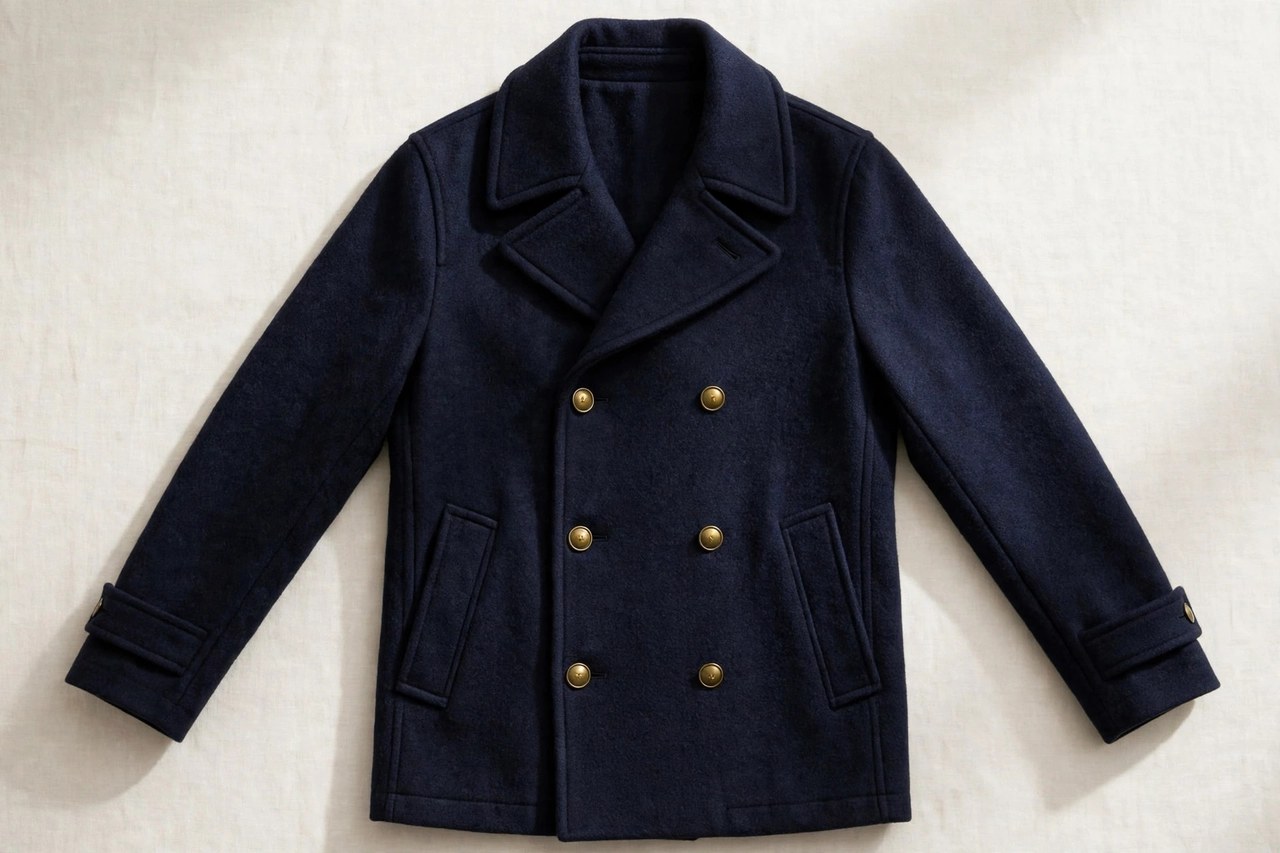
A peacoat is a short, heavy, double-breasted wool coat with broad lapels, large buttons and vertical or slash pockets - the naval coat that became a menswear staple. Sailors wore it because melton wool stays warm wet, the double breast overlaps against wind, and the cropped length never tangles in rigging or ladders; civilians kept it because the same build flatters almost every frame and pairs with everything from jeans to tailoring. This guide covers the cloth, the details that mark a true peacoat, and how its naval fit differs from a civilian fashion version. This guide covers the styles worth knowing, the fit points that decide comfort, the fabrics and construction that separate a good buy from a regret, and the simple care that makes the garment last.
Melton, Buttons and the Ulster Collar
The cloth is the coat. Traditional peacoats are cut from heavy melton wool - a dense, felted weave that sheds wind and light rain and hides its own texture - in navy so dark it reads black indoors. Civilian versions lighten the cloth, narrow the cut, and add colors beyond navy and black; each change trades a little of the original's weather honesty for style, which is fine when chosen knowingly. True details: six or eight large buttons (anchor-embossed on naval and naval-styled coats), a double-breasted front that can button either way or to the top in weather, an Ulster collar that stands and closes at the throat, corduroy-lined slash pockets placed for hands, and a single vent. A half lining or unlined shoulder keeps the heavy cloth mobile. Judge a peacoat by weight in hand and button security - those big buttons take the strain of the overlap and should be sewn, ideally on shanks, like they mean it.
Outerwear value hides below the surface: taped versus merely stitched seams, a zipper whose slider runs true under one hand, cuffs and hems that adjust to seal weather out, and a lining slippery enough to glide over the layers beneath. Shoulder build decides the hang over knitwear or a jacket, and pocket engineering decides whether hands and kit ride where your body expects them. Specify for the worst honest day, not the brochure day.
A Short Overcoat's Fit
A peacoat should fit like a short overcoat, not a blazer: close over a sweater without the double breast pulling apart, with the buttons meeting at your natural stance rather than a sucked-in one. Length ends at mid-thigh to hip - long enough to cover a jacket's hem in most cuts, short enough to sit in a car comfortably, which is half the style's enduring appeal. Shoulders should be your shoulders; melton's structure forgives nothing past them. The collar test matters: buttoned to the top with the collar up, the coat should seal the throat without strangling it, because that is the configuration the coat was designed for and the one a cold platform will demand. Sleeves end at the wrist bone with arms forward, meeting gloves without a bare gap.
Fit outerwear over the bulkiest layer it will honestly cover, and test the working range: arms forward as if driving, arms overhead, sitting with every closure fastened. The coat's shoulders should echo yours rather than extend past them, closures should meet without strain, and the hem must reach the coverage the garment exists to give. A coat fitted over a T-shirt alone belongs to a climate you may not live in.
Brush, Rest, Check the Buttons
Melton wool asks for restraint. Brush the coat down after wear, hang it broad, rest it between wears, and dry-clean once a season at most - the dense weave sheds most soil and resists odor, and over-cleaning thins the very cloth that makes the coat. Store it clean in a breathable bag with cedar; moths prize heavy wool above almost everything in the wardrobe. Check the big buttons each autumn and resew the loose one in October rather than losing it in January - replacements that match are harder than the story suggests. Kept this way, a sound peacoat is a decade-plus garment: the naval original was issued, reissued and handed down, and a well-bought civilian version inherits that lifespan.
Hang outerwear on broad hangers that carry the shoulders, rest it between wears, and resist washing it often - spot-clean first, and wash by the maker's method with the detergent the fabric demands when a full clean is due. Refresh water-repellent finishes when rain stops beading, never store a coat dirty or compressed, and send leather and tailored pieces to professionals rather than experimenting at home.
Common Questions
Why are peacoats double-breasted and short?
Because they are naval working coats. The double-breasted overlap closes against wind from either side and buttons up to a high collar in weather, and the short, hip-to-mid-thigh length keeps the coat clear of ladders, rigging and machinery while still covering the torso's core. The weight of melton wool does the warming; the cut does the weatherproofing. Civilian fashion kept both features because they also happen to look sharp.
What fabric should a real peacoat be made from?
Heavy melton wool - a dense, felted wool weave that blocks wind, shrugs off light rain and stays warm even when damp, in the traditional near-black navy. Lighter wool blends and fashion cloths make a peacoat-shaped jacket rather than the working coat; they are fine as style pieces but give up weather protection and lifespan. Judge by weight and density in hand: a true peacoat feels substantially heavier than its size suggests.
How should a peacoat fit over winter layers?
Like a short overcoat: it should button fully over a sweater with the double breast lying flat, not gapping, and close to the top with the collar standing comfortably at the throat. Shoulders should match your own, sleeves should reach the wrist bone with arms forward, and length should end between hip and mid-thigh so it covers a jacket hem yet still sits comfortably in a car.
More in Men's Clothes Guide P
Melton, Bridge Coats and Reefers
A pea coat (or pea jacket, pilot jacket) is an outer coat, generally of a navy-colored heavy wool, originally worn by sailors of European and later American navies, characterized by short length, broad lapels, double-breasted fronts, often large wooden, metal or plastic buttons, and vertical or slash pockets; references to the pea jacket appear in American newspapers at least as early as the 1720s. A bridge coat is a pea coat that extends to the thighs, a uniform exclusively for officers and chief petty officers, and the reefer is identical to the basic design but usually has gold buttons and epaulettes — only officers wear the epaulettes. The standard for historical pea coats was 30 ounces (approx. 850 g) wool, most often heavy Melton cloth through the 1970s in the U.S. Navy; presently coats are made from 22–32 oz (620–910 g) wool.
Looking for Men's Clothing Stores?
This guide explains men's peacoats. To browse where to buy, visit our men's clothing store directory, where you can find retailers that carry them.