Men's Printed Medical Uniforms Guide
Printed medical uniforms are the coordinated clinical uniforms - scrub sets, warm-up jackets and uniform tops - that carry printed patterns as part of a facility's or practice's dress system. Where our printed scrubs guide in this letter treats the individual scrub garment, this guide treats the uniform as a program: how departments choose print families to identify roles, comfort patients and keep a ward looking coordinated, and what a man buying into such a program should check about fabric, fit and the laundry that will decide the uniform's real lifespan.
Shop Men's Printed Medical Uniforms Now
Shop Men's Printed Medical Uniforms on Amazon Shop Men's Printed Medical Uniforms on eBayThe Amazon and eBay links on this page are affiliate links. If you make a purchase through them, Apparel Search may earn a commission.
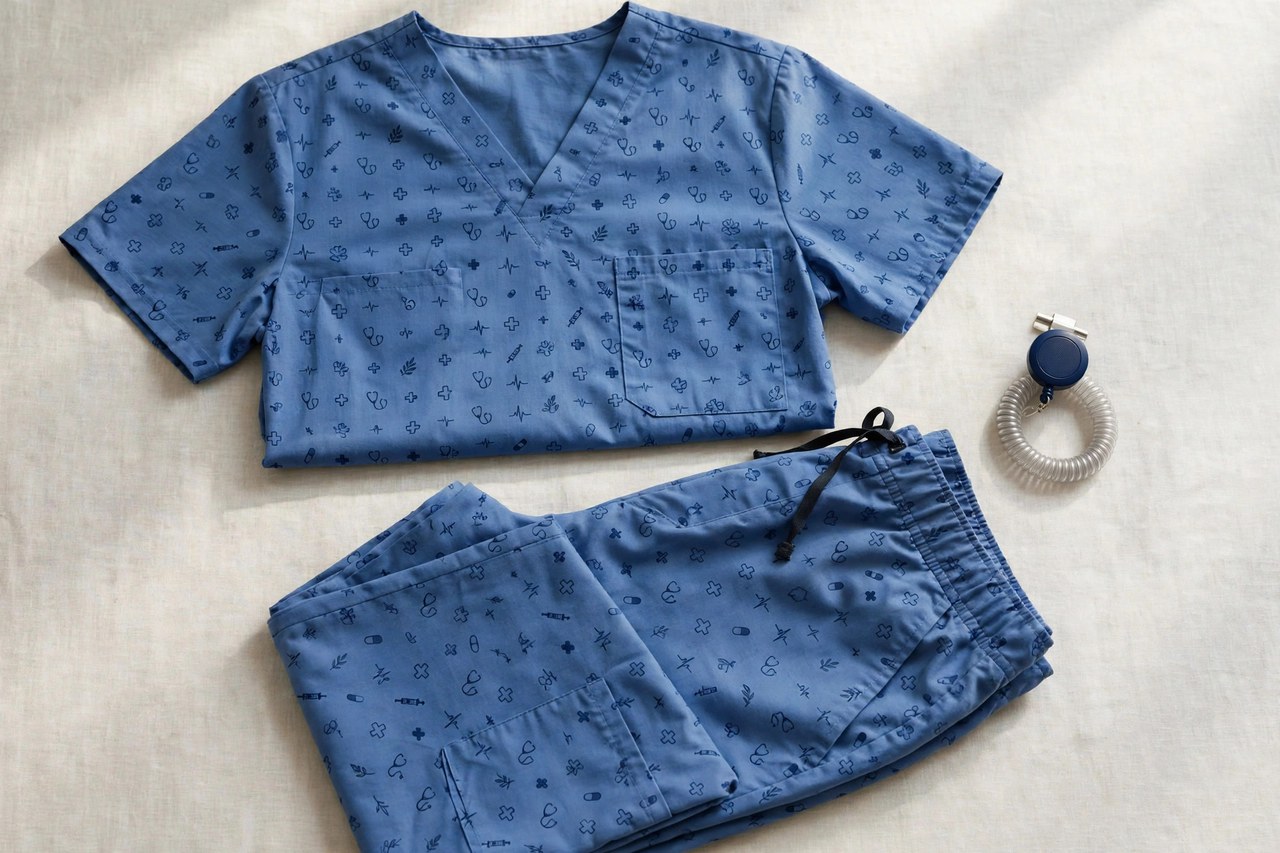
Printed medical uniforms are the coordinated clinical uniforms - scrub sets, warm-up jackets and uniform tops - that carry printed patterns as part of a facility's or practice's dress system. Where our printed scrubs guide in this letter treats the individual scrub garment, this guide treats the uniform as a program: how departments choose print families to identify roles, comfort patients and keep a ward looking coordinated, and what a man buying into such a program should check about fabric, fit and the laundry that will decide the uniform's real lifespan. This guide covers the styles worth knowing, the fit points that decide comfort, the fabrics and construction that separate a good buy from a regret, and the simple care that makes the garment last.
Print as a System
A uniform program prints with intent. Prints identify: pediatrics wards wear the friendly patterns, other departments take solids or calmer prints, and the eye learns to read role and place from color and pattern before a badge is close enough to read. Prints coordinate: a set's printed top pairs with solid trousers in a matched color drawn from the print, which is why uniform prints are designed in families with named coordinating solids. And prints reassure: the same psychology as this letter's printed lab coats, extended ward-wide. Under the design sit the uniform specifications that outlast any pattern - cotton-poly or polyester performance twills, soil-release and moisture finishes at the program end, reinforced pockets and bartacked stress points, and colorfastness rated for the facility's laundry, because a uniform set whose top fades three shades away from its trousers has stopped being a uniform while both pieces still function as clothes.
Workwear is judged at the stress points, because the job finds them first: bar-tacked pocket corners and belt loops, double or triple-stitched main seams, reinforced knees, elbows and seats, and hardware - zippers, snaps, rivets - rated for daily cycling rather than occasional wear. Fabric weight is a specification, not a brag: heavier cloth resists abrasion and holds shape, lighter cloth breathes and dries, and the right answer is the one matched to the actual shift, climate and laundry the garment will live in.
The Shift Test
Fit inside a program follows the wearer's day, not the size chart's letter. Scrub-based uniforms are unisex or men's-cut with a drawstring or elastic-drawstring waist, and the correct test is the shift test from our workwear guidance: charting seated, reaching overhead to shelves and monitors, bending to beds and equipment, with pockets loaded as you actually load them. Printed tops in a V-neck or mock-wrap should neither gape nor bind, and their length should cover the waistband through a full reach. Because programs buy in size runs, the honest wardrobes keep a try-on set; a man between sizes in a drawstring uniform usually takes the larger and lets the drawstring work, since a uniform that restricts at hour two will be hated by hour ten. Personal sets bought to a facility's pattern rules follow the same logic, with the facility's print family and coordinating solid as the first specification.
Fit workwear in the postures of the job: reach overhead, bend, kneel, climb, sit through a charting session or a cab ride. Seams should never be the thing that stops a movement, waistbands should stay where they were put without a belt doing structural work, and lengths should clear the floor and the machinery. Work garments are sized generously by design - buy your measured size and let the cut do its job, rather than sizing down into a uniform that fights every task.
Matching Is the Audit
Uniforms live or die by laundry discipline, whoever owns the wash. Facility-laundered sets follow the institution's cycle, and the wearer's job is inspection: report fading, thinning and failing drawstrings early, because a program replaces on evidence. Self-laundered uniforms wash warm, inside out to protect the print, separated from home clothes as hygiene and habit both suggest, and dried promptly - prints and performance finishes both tire fastest in hot, forgotten loads. Keep a private rotation of at least three sets so no set is worn unwashed twice. The uniform's final audit is matching: top and trousers aging together, print still reading at the family's shade. When a piece drifts, replace the piece - a mismatched 'uniform' announces the one thing a uniform exists to deny.
Work garments earn a laundry system, not a laundry day: wash by the employer's or the label's hygiene rules, treat stains before heat can set them, and inspect as you fold - a pocket corner letting go, a hem fraying, a button hanging by a thread are all two-minute repairs now and garment failures next month. Keep the rotation honest: a spare set washed and ready is what makes daily laundering possible without wearing any single set to death.
Common Questions
Why do medical facilities use printed uniforms?
For identification, coordination and reassurance at once. Print families mark departments and roles at corridor distance - pediatrics in friendly patterns is the famous case - coordinate tops with matched solid trousers so a whole ward reads as one service, and soften the clinical atmosphere for patients. It is the same reasoning as printed lab coats and scrubs, run at program scale, and it only works while every piece holds its color: a faded print stops identifying anything except a tired laundry system.
What should a man check when buying into a uniform program?
The program's rules first - approved print family, coordinating solid colors, any logo or title requirements - then the garment: fabric and finish rated for the laundry it will actually meet, reinforced pockets and drawstrings that survive cycling, and a fit proven in the shift's real postures, seated charting, overhead reaching and bending with loaded pockets. Between sizes, take the larger in a drawstring style and let the drawstring set the waist. Keep three sets rotating from day one.
How should printed medical uniforms be washed at home?
Warm, inside out, promptly and separately from household laundry - as a hygiene habit as much as a garment rule. Inside-out washing protects the print that carries the uniform's identifying job, moderate drying protects its finishes, and a three-set rotation keeps any set from being worn twice unwashed. Inspect as you fold for fading against the set's other pieces, thinning fabric and tired drawstrings, and replace the drifting piece before the set stops reading as a uniform.
More in Men's Clothes Guide P
Medicine, Then the Uniform
Medicine is the science and practice of the diagnosis, treatment, and prevention of disease. The printed uniforms identify, coordinate and reassure across a department.
Looking for Men's Clothing Stores?
This guide explains men's printed medical uniforms. To browse where to buy, visit our men's clothing store directory, where you can find retailers that carry them.