Men's Printed Scrubs Guide
Printed scrubs are scrub tops - and occasionally full sets - printed with patterns, from the cheerful motifs of pediatric and veterinary practice to subtle geometrics that simply hide a long shift better than a solid. The scrub itself is healthcare's working garment: a loose V-neck top and drawstring trousers built for movement, pockets and relentless laundry. This guide is about the print on that garment - why clinical areas choose it, which prints work hardest, and how to judge the set underneath - while our printed medical uniforms guide covers the same prints as a department-wide program.
Shop Men's Printed Scrubs Now
Shop Men's Printed Scrubs on Amazon Shop Men's Printed Scrubs on eBayThe Amazon and eBay links on this page are affiliate links. If you make a purchase through them, Apparel Search may earn a commission.
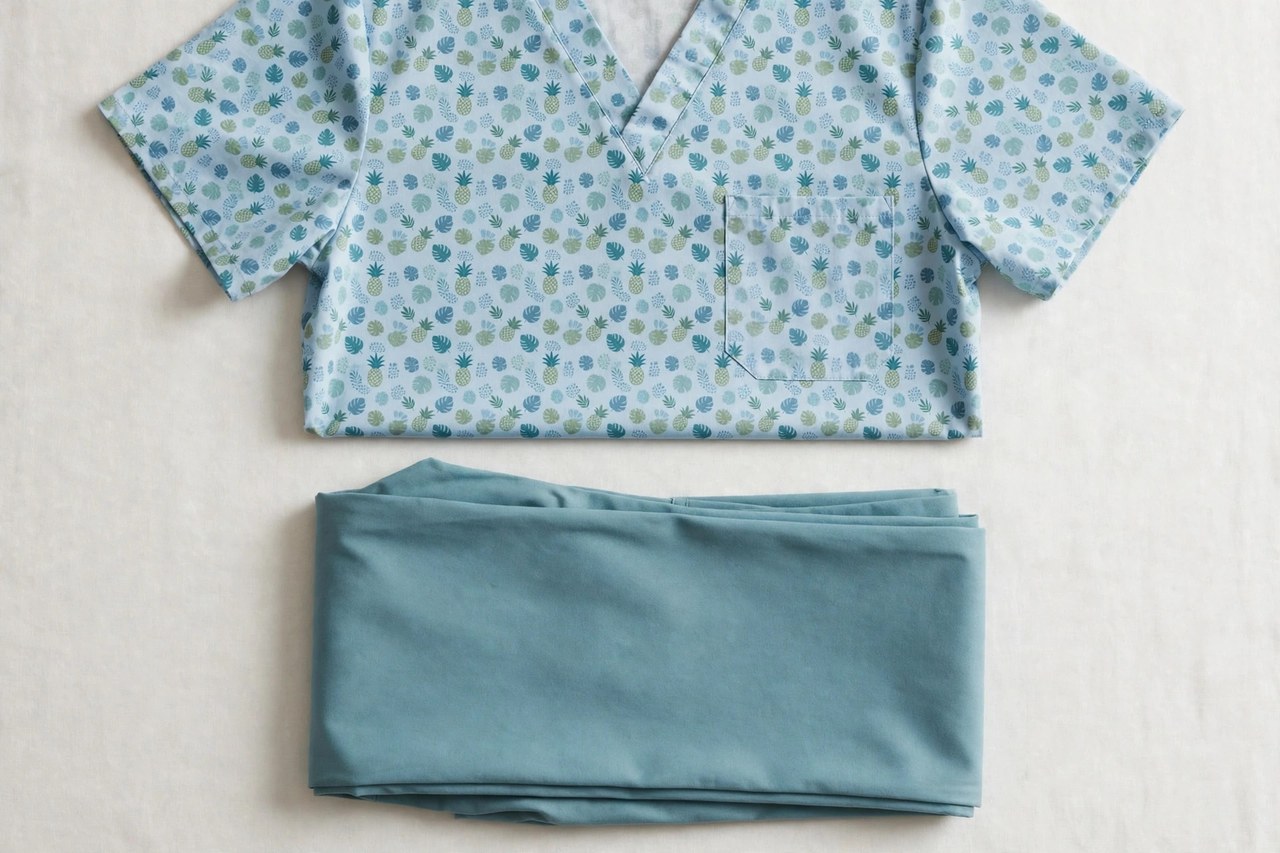
Printed scrubs are scrub tops - and occasionally full sets - printed with patterns, from the cheerful motifs of pediatric and veterinary practice to subtle geometrics that simply hide a long shift better than a solid. The scrub itself is healthcare's working garment: a loose V-neck top and drawstring trousers built for movement, pockets and relentless laundry. This guide is about the print on that garment - why clinical areas choose it, which prints work hardest, and how to judge the set underneath - while our printed medical uniforms guide covers the same prints as a department-wide program. This guide is built around the questions buyers actually ask: which style, which size, which fabric, and what will it look like after a year of real use - answered in order, with the trade-offs stated plainly.
Expressive or Camouflage
A scrub print is chosen like a tool. Pediatric, dental and veterinary teams wear the expressive end - animals, cartoons, seasonal motifs - because the audience is frightened and small, and the print gives a child something to talk about that is not the procedure. Adult acute care takes the restrained end: small geometrics, tonal patterns and textures whose first job is camouflage, since a busy small-scale print hides the splashes, wrinkles and wear of a twelve-hour shift better than any solid. Print placement follows scrub anatomy - the pattern lives on the top, trousers stay solid in a coordinating color drawn from the print, and the set is designed as that pairing. The garment beneath must be scrub-honest regardless of decoration: a V-neck or mock wrap that neither gapes nor binds, patch pockets that carry, side vents for movement, and fabric - cotton-poly or performance polyester - whose print is dyed in or rated to survive the laundry, not surface-printed to fade by spring.
Workwear is judged at the stress points, because the job finds them first: bar-tacked pocket corners and belt loops, double or triple-stitched main seams, reinforced knees, elbows and seats, and hardware - zippers, snaps, rivets - rated for daily cycling rather than occasional wear. Fabric weight is a specification, not a brag: heavier cloth resists abrasion and holds shape, lighter cloth breathes and dries, and the right answer is the one matched to the actual shift, climate and laundry the garment will live in.
Fit by the Shift
Fit scrubs by the shift, not the mirror. The top should let you raise both arms to a monitor, bend to a bed and sit to chart without the hem leaving the waistband or the neckline opening; the trousers should drawstring to a waist that survives the same motions, with a rise that stays put bending and a length that clears the floor and the shoe. Scrubs are cut generously by design - buy your measured size and resist sizing down into a tailored silhouette, because a scrub that fits like fashion restricts like it too. Print can mislead the eye here: busy patterns hide a multitude of fit sins in the shop mirror while doing nothing for the tenth hour, so test movement with pockets loaded as you load them on shift. Between sizes, the larger set plus the drawstring is the working answer, with sleeve and hem lengths the only real compromises to check.
Fit workwear in the postures of the job: reach overhead, bend, kneel, climb, sit through a charting session or a cab ride. Seams should never be the thing that stops a movement, waistbands should stay where they were put without a belt doing structural work, and lengths should clear the floor and the machinery. Work garments are sized generously by design - buy your measured size and let the cut do its job, rather than sizing down into a uniform that fights every task.
Colorfast or Retired
Scrubs launder like the workwear they are: frequently, hot where the facility's rules and the fabric allow, and with the print's fastness as the standing audit. Home-laundered scrubs wash separately, inside out, warm, and dry promptly, and a rotation of three or more sets is the difference between a system and a nightly emergency. The print earns its keep in this cycle only if it is colorfast at the real temperature - check the rating, watch the first cycles, and retire a top whose pattern has faded a ward away from its trousers, because mismatched sets read as sloppy in exactly the settings where scrubs are meant to read as clean. Inspect drawstrings, pocket corners and vents as you fold; scrubs fail at their stitching long before their cloth, and a two-minute mend keeps a favorite print in service for years.
Work garments earn a laundry system, not a laundry day: wash by the employer's or the label's hygiene rules, treat stains before heat can set them, and inspect as you fold - a pocket corner letting go, a hem fraying, a button hanging by a thread are all two-minute repairs now and garment failures next month. Keep the rotation honest: a spare set washed and ready is what makes daily laundering possible without wearing any single set to death.
Common Questions
Why do some healthcare workers wear printed scrubs?
For the audience and for the shift. In pediatrics, dentistry and veterinary care, friendly prints comfort frightened patients - especially children - and give them something harmless to focus on. Elsewhere, restrained small-scale prints are camouflage: they hide splashes, wrinkles and the visible wear of a long shift better than solid colors do. Both uses are deliberate, and departments often assign print families by area, which our printed medical uniforms guide covers as a program.
What makes a good printed scrub top?
A good print on an honest scrub. The print should be dyed in or rated colorfast for the laundry's real temperature, scaled to its job - expressive for children's settings, small and busy for camouflage on adult wards - and paired with solid trousers in its coordinating color. The top beneath needs a non-gaping neck, working patch pockets, side vents and generous, movement-first fit. A pretty print on a flimsy, fast-fading top fails both halves of the definition within a season.
How many sets of scrubs should you own?
At least three if you launder your own - one worn, one washed, one ready - and more if your shifts bunch together or your laundry is weekly. Rotation is what makes daily fresh scrubs possible without wearing any single set to death, and it spreads the hot washing that is the scrub's lifespan. Inspect each set as it rotates through your hands; drawstrings and pocket stitching announce their failures early to anyone folding with attention.
More in Men's Clothes Guide P
Brightening the Ward
Scrubs are the sanitary clothing worn by surgeons, nurses, physicians and other workers involved in patient care in hospitals; originally designed for use by surgeons and other operating room personnel, who would put them on when sterilizing themselves, or “scrubbing in”, before surgery, they are now worn by many hospital personnel, and their use has extended outside hospitals to work environments where clothing may come into contact with infectious agents. Scrubs are typically designed to be simple, with minimal places for contaminants to hide — and they are also on occasion printed with patterns or novelty designs. The printed versions are ways to brighten up the mood in a hospital or similar typically sad environment: a fun novelty print can possibly bring a smile.
Looking for Men's Clothing Stores?
This guide explains men's printed scrubs. To browse where to buy, visit our men's clothing store directory, where you can find retailers that carry them.