Men's Tees Guide
Men's tees are t-shirts considered from the styling side: the printed, pocket, ringer, striped and fashion-cut variations that turn the basic crew-neck garment into an outfit's statement piece. Where our t-shirts guide specifies the base garment - cloth weights and construction - this guide is about choosing among tee styles: which print methods last, which cuts suit which builds, and how a tee is worn as the visible top rather than as a foundation layer.
Shop Men's Tees Now
Shop Men's Tees on Amazon Shop Men's Tees on eBayThe Amazon and eBay links on this page are affiliate links. If you make a purchase through them, Apparel Search may earn a commission.
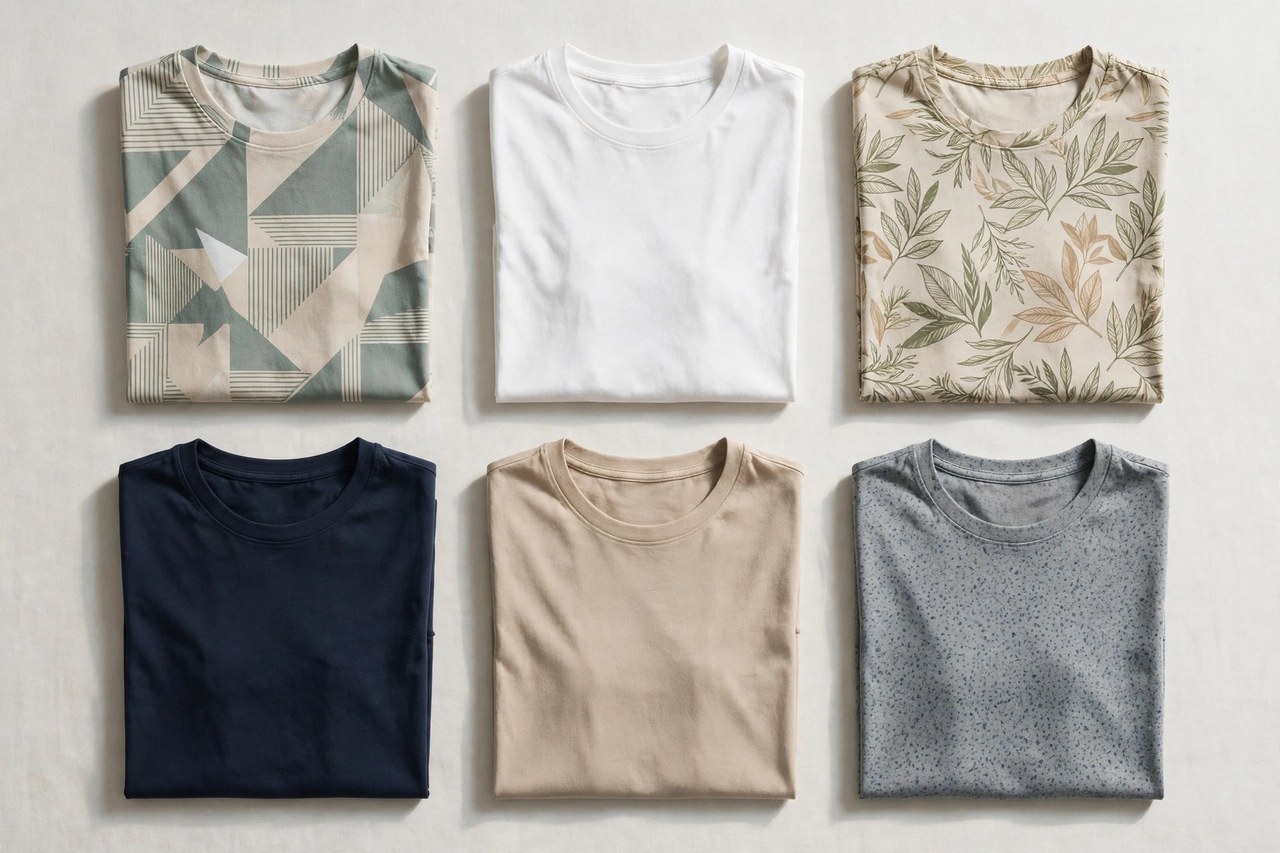
Men's tees are t-shirts considered from the styling side: the printed, pocket, ringer, striped and fashion-cut variations that turn the basic crew-neck garment into an outfit's statement piece. Where our t-shirts guide specifies the base garment - cloth weights and construction - this guide is about choosing among tee styles: which print methods last, which cuts suit which builds, and how a tee is worn as the visible top rather than as a foundation layer. This guide is built around the questions buyers actually ask: which style, which size, which fabric, and what will it look like after a year of real use - answered in order, with the trade-offs stated plainly.
Styles and Construction
Print method is the tee's quality frontier. Screen printing lays durable ink on the surface and suits bold graphics; direct-to-garment printing renders photographs and gradients but fades sooner; embroidery and applique add texture that outlives any ink. Ringer tees bind neck and sleeves in a contrasting rib - a 1970s athletic pattern revived in cycles - while pocket tees add a chest pocket that must be sewn square and bar-tacked to survive laundering. Cut divides the shelf: classic straight bodies, slim fashion cuts, and longline or curved-hem streetwear patterns, each honest when labeled and sized by measurement rather than mood.
A top earns its keep in finishing: seams that hang straight and stay even at eight to twelve stitches per inch, collars and plackets that lie flat after washing, buttons sewn with thread shanks so they sit in their holes without pulling. Hold the cloth to the light - a tight, even weave or knit outwears a loose one at the same labeled weight, and pattern pieces cut on grain keep the garment from twisting around your body by the third wash.
Fit and Sizing
Fit a fashion tee by the look it is built for: classic cuts skim, slim cuts follow the torso, and oversized patterns are proportioned through the shoulder rather than simply sized up. The shoulder seam still tells the truth - it should sit at or deliberately just past the shoulder bone, never halfway down the arm by accident. Printed tees shrink like any cotton knit, mainly in length, so buy the post-wash length you want to wear.
Fit tops shoulders and chest first, because tailors cannot cheaply move either: the shoulder seam ends at the shoulder bone, the chest closes without pulling, and both arms raise without the hem escaping the waistband. Tucked lengths must stay tucked sitting; untucked lengths should end mid-fly. Sleeves are the cheap alteration, shoulders the permanent one - reject a wrong shoulder for any reason, forgive a long sleeve for many.
Wearing and Care
Prints set the care rules: wash printed and embroidered tees inside out, cool, and dry low or on the line to keep ink and thread at their best. Avoid ironing directly on a print. Fold fashion tees rather than hanging them, store limited or favorite prints out of sunlight, and accept the honest life of a graphic - a well-made print softens with age, while a cheap one cracks, and the difference is visible by the fifth wash.
Launder tops by the label with three defaults: cool or warm water to protect color and trims, dark and printed pieces inside out, and low or line drying, which is the largest single lever on a shirt's lifespan. Fasten buttons and zips before washing to protect the whole load, treat stains before the dryer can set them, and store knits folded so their shoulders keep the shape they were knitted with.
Common Questions
How is a tee different from a t-shirt?
In substance, it is not - tee is simply the short name for the same T-shaped shirt. In shopping, the words signal emphasis: plain basics are usually sold as t-shirts, while printed, pocket, ringer and fashion-cut styles are merchandised as tees. This guide covers the styled side of the family; our t-shirts guide covers the base garment's fabrics and construction.
Which print method lasts longest on a tee?
Embroidery first, then well-cured screen printing: both survive years of washing when the garment is washed inside out and dried gently. Direct-to-garment prints look the most detailed when new but fade fastest. Whatever the method, heat in the dryer is the common enemy - line drying doubles a print's good-looking life.
Should a pocket tee's pocket match the body size?
The pocket is standard-sized regardless of shirt size, which is why it can look small on larger sizes - a proportion question, not a defect. What matters is placement (centered on the chest, top edge level) and stitching: a pocket sewn with reinforced corners survives carrying sunglasses; a lightly tacked one tears at the corners within a season.
More in Men's Clothes Guide T
Background and History
A Tee or tee shirt is the same thing as a "T-shirt". It is a style of unisex fabric shirt, named after the T shape of the body and sleeves (torso and outstretched arms form a "T"). It is normally associated with short sleeves and a round neck line known as a crew neck, with no collar. However, they can come in other necklines and sleeve lengths. T-shirts are generally made of a light weight fabric and are for the most part relatively easy to clean. Basic tees can be rather inexpensive but some brands can become very expensive. Although the majority of them will be produced in cotton, polyester, or blended fibers, some can go the luxury route and be made of expense fibers such as cashmere or silk. Learn about different types of men's tees . It is always a fabulous day to learn more about men's fashion. Men's Clothing Directory: Men's Clothes Guide T Men's Clothes Guide A-G Men's Clothes Guide H-P Men's Clothes Guide Q-Z Thank
Looking for Men's Clothing Stores?
This guide explains men's tees. To browse where to buy, visit our men's clothing store directory, where you can find retailers that carry them.