Women's Capri Pants Guide
Mid-calf, unmistakably Capri — the warm-weather classic born on an Italian island in the 1950s.
Shop Women's Capri Pants Now
Shop Women's Capri Pants on Amazon Shop Women's Capri Pants on eBayThe Amazon and eBay links on this page are affiliate links. If you make a purchase through them, Apparel Search may earn a commission.
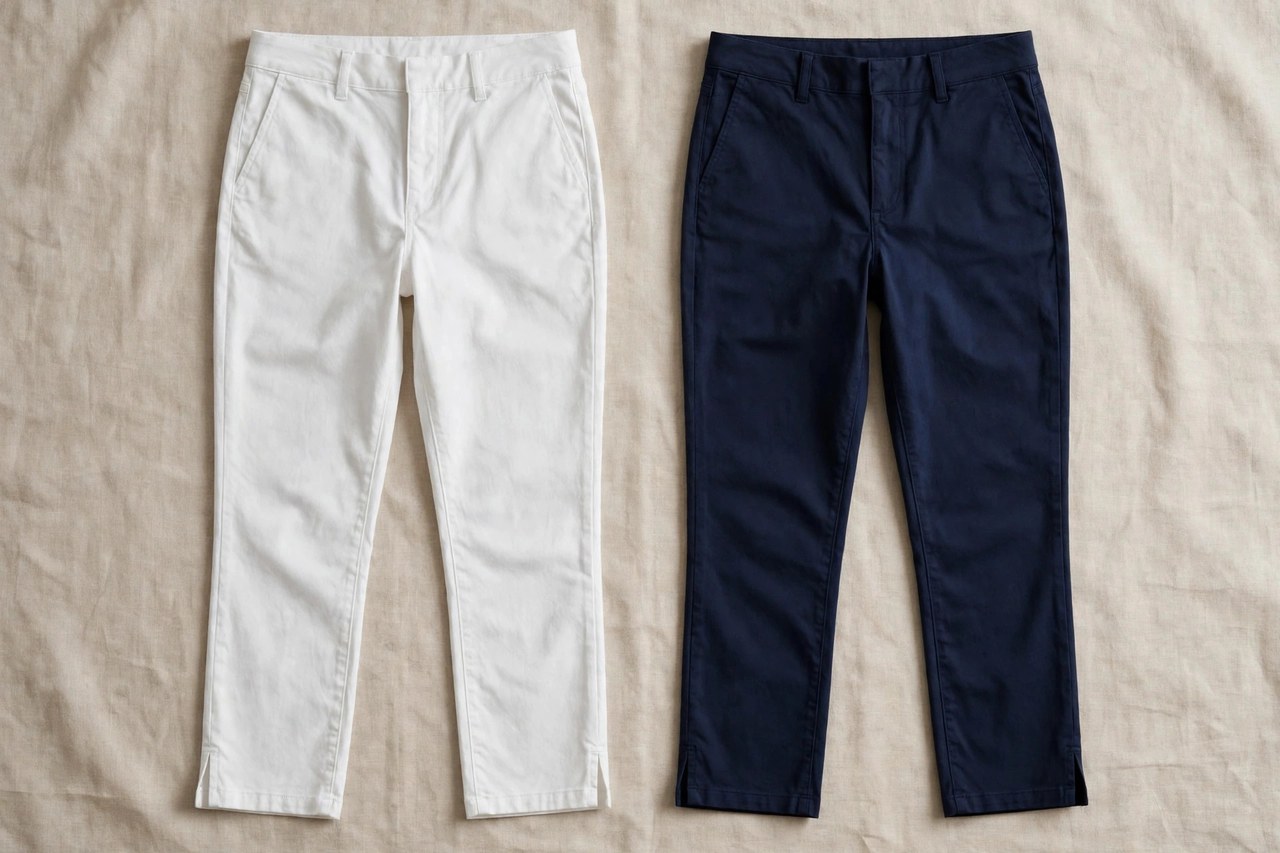
A capri pant is defined by one measurement: the hem ends at mid-calf, well below the knee and well above the ankle. That specific length — not just any short trouser — is what makes a capri a capri, and it is what separates this guide from cropped pants, which end higher at the ankle, and from clam diggers, which stop just below the knee. The classic capri is slim and tapered, often with a small side slit at the hem so the narrow opening can move with the calf. It is a warm-weather staple designed to show the lower leg and the shoe while still reading as a pant, not a short. When the proportion is right, capris look crisp, cool, and deliberate. When the hem lands at the widest part of the calf, they can look awkward, which is why length and leg shape get so much attention in this guide.
From the Isle of Capri to Everywhere
Capris take their name from the Italian island of Capri, where designer Sonja de Lennart introduced the cropped, slim trouser in the late 1940s and early 1950s as resort wear for women who wanted freedom of movement without shorts. The style spread quickly through European holiday dressing and then to America, helped by film and television: slim mid-calf pants became a signature of 1950s and early 1960s screen style, paired with flat shoes, fitted tops, and headscarves. Their close relative, the pedal pusher, was slightly shorter and looser, named for cycling, and the two terms were often used interchangeably in period catalogs. Capris faded in the 1970s, returned in the late 1990s in lower rises and wider legs, and have since settled into a classic cycle — never fully gone, always refreshed by a new fabric or a cleaner, higher rise.
Silhouettes: Slim, Straight, and Wide-Leg Capris
The traditional capri is slim and tapered, following the leg closely and ending in a narrow hem with a vent or slit. It is the most polished version and the one that pairs best with ballet flats and loafers. Straight-leg capris keep the same width from knee to hem for a more relaxed, modern line that suits a wider range of calf shapes. Wide-leg and culotte-style capris borrow volume from cropped trousers while keeping the mid-calf hem; they feel breezier and dressier in fluid fabrics. Waist treatments vary from a classic zip fly with belt loops to flat-front pull-on styles with hidden elastic, which give the smoothest line under untucked tops. Details to look for include a hem slit that actually opens when you walk, pockets that do not add bulk at the hip, and a rise that matches how you plan to wear them — tucked tops need a clean, higher waistband.
Fabrics for a Crisp Mid-Calf Hem
Capris live or die by fabric recovery, because a mid-calf hem that bags looks untidy by noon. Cotton sateen and cotton twill with elastane are the standards: smooth, structured, and able to hold a tapered shape. Bengaline, a stretch woven with a fine rib, is a pull-on capri favorite for its firm hold and wrinkle resistance. Linen blends bring airflow for the hottest days but soften the crispness, so choose them for relaxed rather than tailored looks. Ponte knit capris feel more like a legging-pant hybrid, comfortable for travel but less formal. White and pale capris deserve a close check for opacity — hold them to the light and confirm pockets do not shadow through. Whatever the fabric, the hem should be finished evenly on both legs; uneven hems are unusually visible at mid-calf height and spoil the symmetry the style depends on.
Proportions, Length, and Shoe Pairings
The hem should end at a narrower point of the calf, just below its widest curve, rather than cutting straight across it. Petite wearers often need a true petite capri so the hem does not drift toward the ankle and turn the pant into an awkward crop. Taller wearers should check that the hem does not creep up to the knee, which reads as a clam digger instead. Shoes define the mood: ballet flats and loafers give the classic resort look, flat sandals and espadrilles lean casual, low wedges add polish without formality, and clean sneakers modernize straight-leg styles. Avoid heavy, chunky shoes that overwhelm the exposed lower leg, and be cautious with ankle straps that crowd the hem — capris already create one horizontal line at the calf, and a competing strap just above it shortens the leg visually. A tucked or shorter top keeps the waist visible and the proportion balanced.
Care and Keeping Capris Looking Sharp
Capris wrinkle most visibly across the lap and behind the knee, so hang them promptly after wearing and smooth the legs by hand. Wash stretch cotton and bengaline styles in cold water inside out, dry on low or line dry, and remove while barely damp to protect the elastane that keeps the leg slim. White capris benefit from prompt stain treatment, since the exposed hem picks up splashes from wet pavement and grass more than a full-length trouser does. Press the hems flat and check the side slits, which can fray if the stitching is light. Store capris folded over a hanger rather than clipped by the hem, which can leave marks at mid-calf. With their hems and shape cared for, a good pair of capris stays in rotation for many summers — the style's seventy-year survival is proof that the length, once fitted well, rarely feels dated.
Related Women's Guides
Looking for Women's Clothing Stores?
This guide helps you choose women's capri pants by style, fabric and fit. To browse where to buy, visit our women's clothing store directory, where you can find retailers that carry them.