Women's Cashmere Headwear Guide
Everything cashmere makes for the head — hats, headbands, ear warmers, balaclavas and hoods, compared in one place.
Shop Women's Cashmere Headwear Now
Shop Women's Cashmere Headwear on Amazon Shop Women's Cashmere Headwear on eBayThe Amazon and eBay links on this page are affiliate links. If you make a purchase through them, Apparel Search may earn a commission.
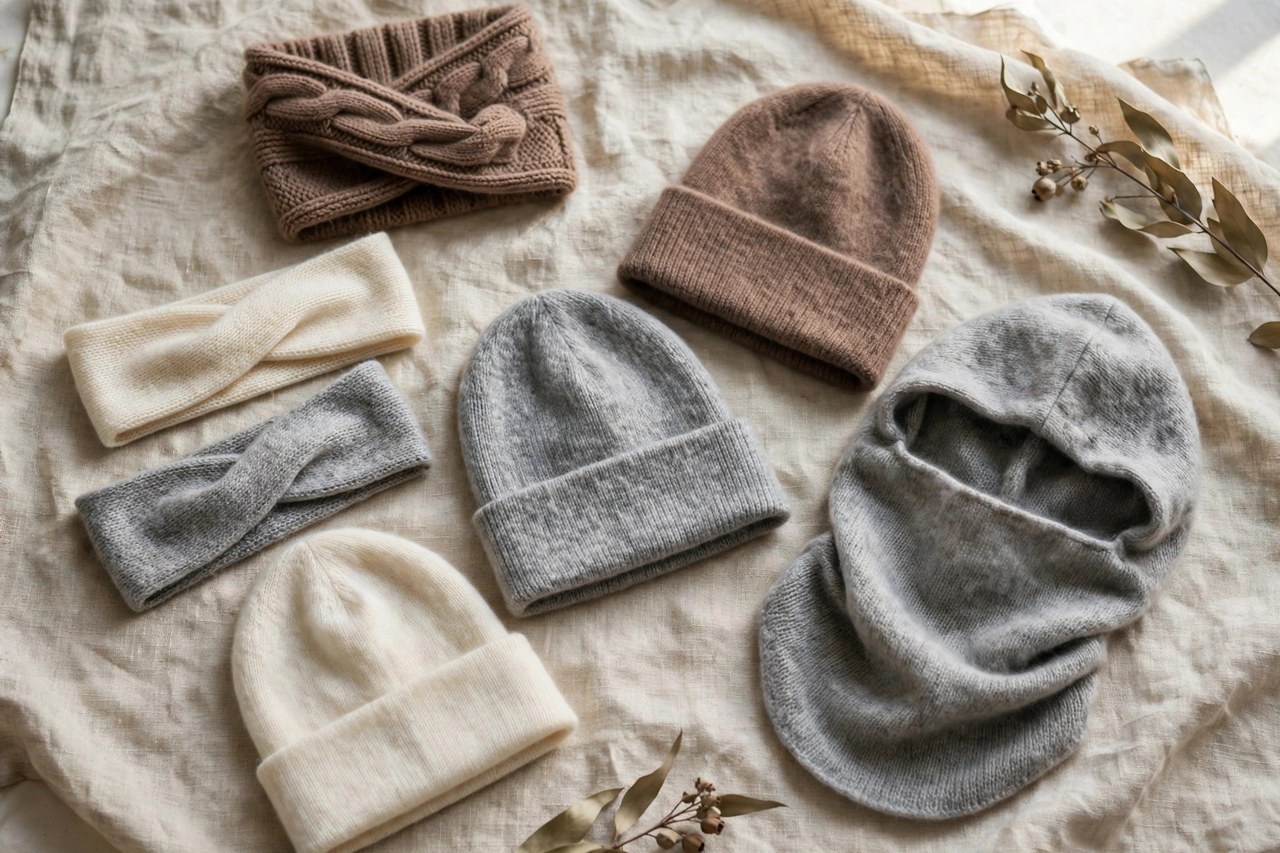
Headwear is the umbrella term for everything worn on the head, and in cashmere it covers more territory than hats alone: beanies and berets, yes, but also knit headbands, ear warmers, balaclavas, hooded scarves, and ear-muff bands. This guide maps the whole family and helps you choose by the only criteria that matter — how cold it is, what you will be doing, and how much of your head and hairstyle you want to protect or preserve. Cashmere's warmth without bulk makes it the ideal fiber across all of these forms, because headwear must be light to be worn for hours. The individual hat guide goes deep on hat styles and fit; here we compare categories against each other, so the woman choosing between a headband and a beanie for a winter running habit, or between a balaclava and a hood for a northern commute, can decide on evidence.
The Cashmere Headwear Family
Arrange the family by coverage. At the light end sit headbands and ear warmers: a band of knit, often ribbed or cabled, covering the ears and forehead while leaving the crown open. Next come hats proper — beanies, watch caps, berets, cloches — covering the crown and most of the ears. Hooded scarves and snood-hoods extend coverage down the neck in one piece. At the full end, the balaclava covers head, ears, neck, and as much of the face as its opening allows. Cashmere serves every rung: its softness is uniquely welcome in pieces that sit on the forehead and ears for hours, and its insulation means even the lightest band delivers surprising warmth. Most women end up owning two rungs — typically a headband for active and mild days, and a full hat or hood for serious cold.
Headbands and Ear Warmers
The knit headband is the athlete's and the hairstyle's friend. It keeps ears and forehead warm through runs, rides, and dog walks while venting heat from the crown, so you never hit the overheating point that makes people tear off a hat mid-exercise. It preserves a ponytail, a bun, and a blowout, which is why it dominates the school-run and gym-commute hours. Cashmere headbands are usually ribbed for grip, sometimes fleece-lined for wind, and wide enough — ten centimeters or so — to cover the ears fully; narrower fashion bands are really hair accessories and warm little. Ear warmers in the wrap-around style and classic ear-muff bands with cashmere covers serve the same niche with a more structured fit. Choose a headband with some elastane or a firm rib if it will be worn for sport, because a band that migrates down over one ear is a band that ends up in a pocket.
Balaclavas and Hooded Scarves
The balaclava has completed its journey from ski slope and special forces to fashion staple, and in cashmere it is a genuinely civilized piece of equipment: total warmth for the head, ears, neck, and cheeks in one fine knit that fits under a coat collar without bulk. Wear it pulled up for the walk and pushed down into a snood at the door. Hooded scarves — sometimes called hooded wraps — take the softer route: a wide scarf with an integrated hood, draped rather than fitted, ideal over styled hair and with formal coats where a beanie would spoil the effect. Both pieces answer the same problem, the gap between hat and coat where winter gets in. For commuters, travelers in cold cities, and anyone whose winter involves waiting on platforms, one of these in cashmere replaces a hat, a scarf, and a certain amount of suffering.
Choosing by Weather and Activity
Match coverage to conditions honestly. Above freezing with wind, a headband or a fine-gauge hat suffices for most outings. Around freezing and below for anything longer than a dash to the car, a proper two or four-ply hat earns its place. Deep cold, wind exposure, or stillness outdoors — watching a match, waiting for a train — calls for the hooded scarf or balaclava, because standing still generates no heat of your own. Activity cuts the other way: the more you move, the less coverage you need and the more ventilation matters, which is why runners live in headbands at temperatures where spectators are in balaclavas. Also consider the rest of your kit: a coat with a good hood reduces the need at the top of the range, while a hoodless tailored coat makes serious headwear non-negotiable. Cashmere's range means the fiber is rarely the limit; coverage choice is.
Care for Small Knits
Headwear pieces are small, hard-working, and easy to care for in batches. Hand-wash them in cool water with wool wash a few times a season — headbands and balaclavas, which sit on skin and hair, need it most often — and dry flat, reshaping hoods and bands as they dry. Keep an eye on elastic edges and ribbing: when a band begins to lose its snap, a wash often restores some life by letting fibers reset, but a truly exhausted rib is retirement. De-pill the friction points where straps, hoods, and seatbelts rub. Store the whole family clean and flat together, with cedar in the drawer, because small unattended knits are exactly what moths find first. Rotating two pieces extends both their lives and gives each a rest day to recover its shape. Headwear is the most-used, least-expensive end of the cashmere wardrobe; a little routine care keeps it performing like the serious equipment it is.
Related Women's Guides
More to Explore on Apparel Search
Looking for Women's Clothing Stores?
This guide helps you choose women's cashmere headwear by coverage and activity. To browse where to buy, visit our women's clothing store directory, where you can find retailers that carry them.