Women's Cotton Argyle Socks Guide
The pattern story — hand-linked diamond intarsia from Scottish tartan roots to the classic cotton sock drawer.
Shop Women's Cotton Argyle Socks Now
Shop Women's Cotton Argyle Socks on Amazon Shop Women's Cotton Argyle Socks on eBayThe Amazon and eBay links on this page are affiliate links. If you make a purchase through them, Apparel Search may earn a commission.
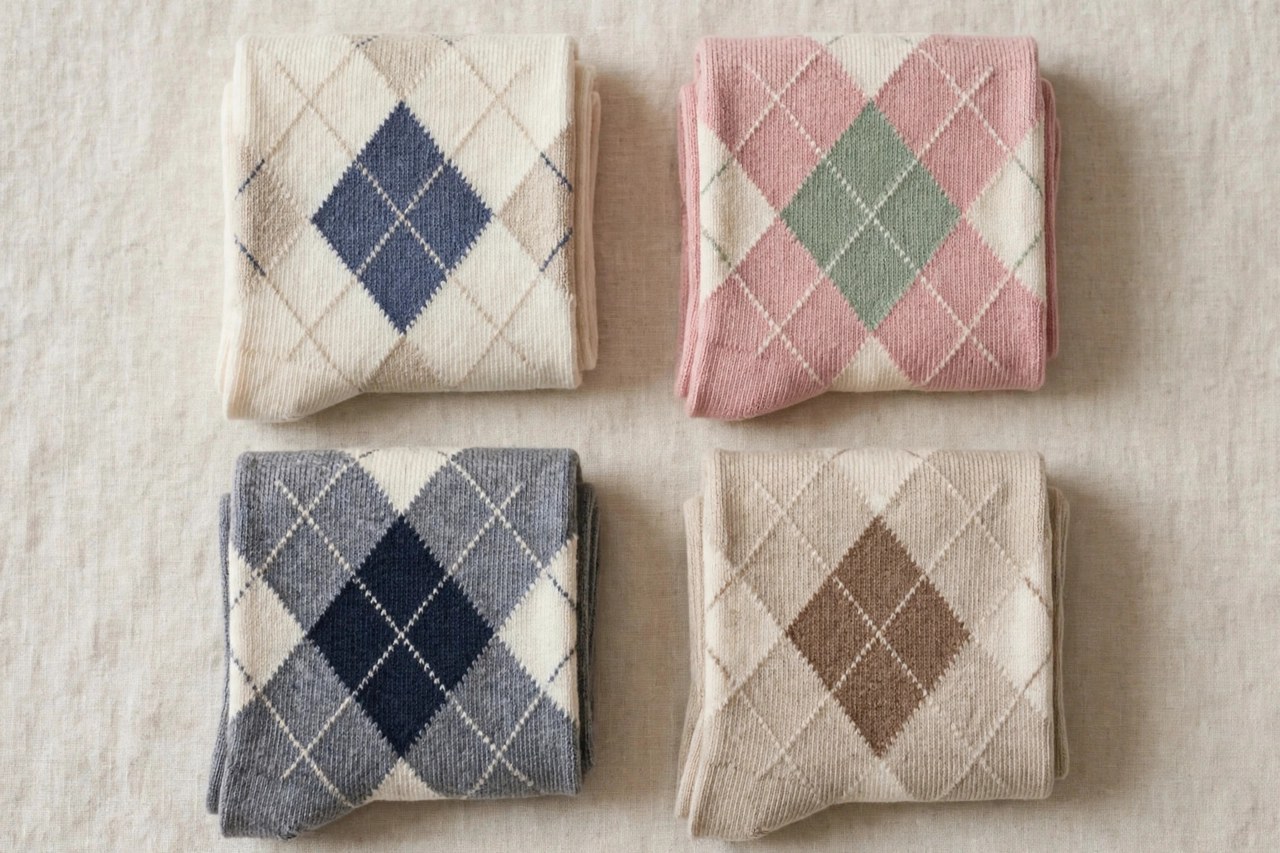
Argyle socks carry the most recognizable pattern in the sock drawer: rows of diamonds in contrasting colors, overlaid with thin diagonal lines, called the overplaid, that cross through the diamond centers. In women's cotton argyle socks, that pattern is knitted into a fine-gauge cotton-rich sock, usually a crew length, turning a plain outfit's smallest visible detail into its most deliberate one. Argyle is not printed decoration, at least not in a well-made sock; it is a knitting technique with a genuine heritage in Scottish tartan and a century of golf and campus styling behind it. This guide explains how intarsia knitting builds the diamonds, why the inside of the sock reveals its quality instantly, how the colors in a classic argyle are chosen, and how to wear and care for cotton argyles so the pattern stays crisp instead of blurring into a pilled shadow of itself.
Intarsia: How the Diamonds Are Knitted
Argyle is produced by intarsia knitting, a method in which each diamond is knitted from its own separate supply of colored yarn, interlocking with its neighbors at the color boundaries like pieces of a puzzle. Unlike striped knitting, where yarns travel around the whole sock, intarsia yarns work only within their diamond, so the fabric stays a single, even thickness with no long floats across the back. Turn a true intarsia sock inside out and you will see clean diamond shapes with small, tidy yarn joins at the edges. A printed argyle, by contrast, is a plain sock with the pattern on the surface: cheaper, flatter in color, and prone to fading. In cotton yarns the diamonds have a soft, matte definition; fine-gauge knitting keeps the edges sharp, while coarse knits blur the geometry.
Heritage: Tartan, Golf, and the Campus Classic
The argyle pattern descends from the tartan of Clan Campbell of Argyll in western Scotland, simplified over centuries from woven plaid into the diamond motif. Its modern life began in the 1920s, when knitwear makers produced argyle socks and sweaters that golfers adopted enthusiastically, making patterned socks part of the sport's stylish uniform. From the golf course the pattern moved to Ivy League campuses and preppy wardrobes, where argyle socks became a standard partner for loafers, pleated skirts, and tailored shorts. Women's fashion has cycled argyle through every revival of collegiate styling since, and it remains a pattern that reads simultaneously classic and playful. That heritage explains the traditional palette: diamonds in burgundy, navy, forest, mustard, or pink over a ground of charcoal, tan, black, or cream, with the overplaid in a contrasting accent.
Color Rules Inside One Sock
A traditional argyle coordinates itself, and understanding its internal logic makes styling effortless. One color in the sock, often the ground or a diamond, traditionally echoes something else in the outfit, while the other colors act as accents that need no matching at all. This is why argyle works with plain clothing: a navy blazer, a grey skirt, and burgundy-diamond socks form a complete, intentional look with no other pattern present. Problems only arise when argyle competes with a second strong pattern nearby; keep adjacent garments solid or subtly textured and let the socks speak. Pastel argyles suit spring outfits, while dark, rich argyles anchor autumn clothing and heavier footwear. If you are buying one first pair, a charcoal or navy ground with two classic diamond colors will coordinate with more of a typical wardrobe than any novelty palette.
Sock Construction Around the Pattern
Pattern aside, an argyle sock is a cotton crew sock built to the usual standards, and the details decide comfort. The body yarn is typically combed cotton blended with nylon for wear and a little elastane for fit, knitted fine enough that the diamonds lie smooth inside a shoe. A ribbed cuff holds the crew length up; a hand-linked or flat toe seam prevents a ridge from pressing across the toes. Some women's argyles add a reinforced heel and toe in the ground color, a practical touch that disappears into the design. Check the pattern alignment as a quality signal: on a well-knitted sock the diamonds meet evenly at the back seam and the overplaid lines run continuous around the leg, while sloppy knitting lets the motif twist or misalign.
Wearing and Caring for Cotton Argyles
Argyle socks show best with a flash of visible leg or ankle: loafers with cropped trousers, brogues, ballet flats with a skirt, or boots where the cuff emerges at the top. With long trousers, the pattern appears in motion when you sit or cross your legs, which is the classic, understated way men and women have both worn them for a century. Avoid hiding a good argyle entirely under a long boot shaft all day; save the pair for outfits that let it register. For care, wash inside out in cool water to protect the diamond faces from abrasion and pilling, which dulls the color boundaries that make the pattern read. Air drying preserves the cotton's shape and the elastane cuff. Avoid bleach and high heat, which fade contrast unevenly between the colors. Folded rather than balled, cotton argyles keep their fine knit smooth, and a rotation of several patterned and plain pairs keeps each one fresher, longer.
Related Women's Cotton Guides
More to Explore on Apparel Search
Photos From Our Original Guide

Looking for Women's Clothing Stores?
This guide helps you choose women's cotton argyle socks by pattern, color and knit. To browse where to buy, visit our women's clothing store directory, where you can find retailers that carry them.