The 1930s
The Bias Cut and the Long Line
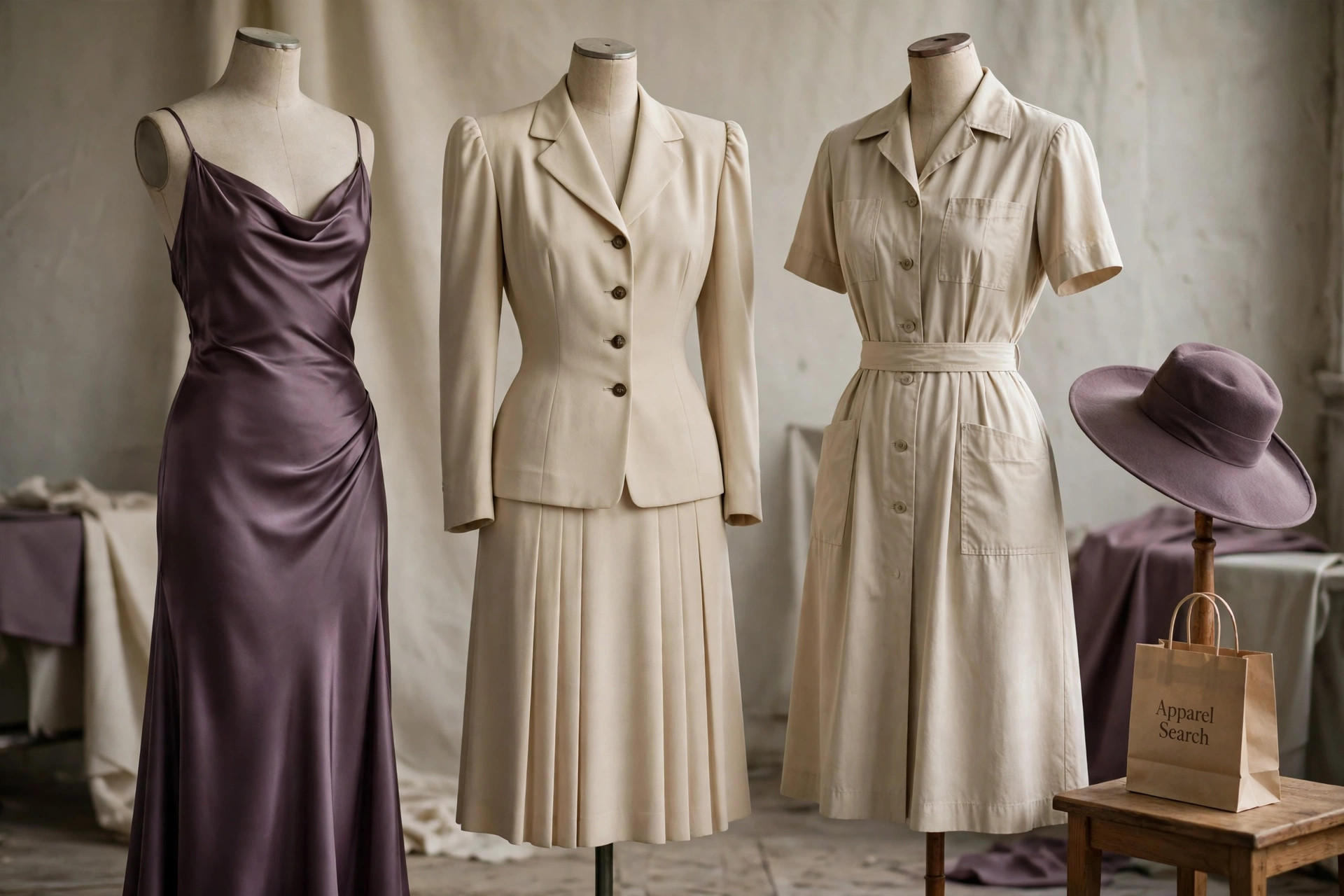
The 1930s reacted against the 1920s tube by rediscovering the body — gently. The waist returned to its natural place, hems dropped nearly to the ankle, and the era's defining technique, the bias cut, let woven silk fall in liquid folds that skimmed the hips without a corset in sight. Madeleine Vionnet's bias geometry and Hollywood's white satin gowns fixed the decade's image: long, pale, gleaming dresses with cowl necklines, bare backs and skirts that pooled as the wearer moved. Day dress was softer than the twenties too — printed tea dresses, flutter sleeves, and the first separates culture of blouses, skirts and knitted twinsets.
The Depression shaped the decade as firmly as the cinema did. Most women owned few dresses and remade them relentlessly; feed-sack prints, rayon and clever pattern drafting were the era's real fashion industry. The glamour and the economy are the same decade, and the history of Western fashion places both in the longer story.
The 1940s
Utility Shoulders and Make-Do Style
War rewrote the silhouette in a season. The 1940s look — broad, padded shoulders, a nipped natural waist, a straight skirt ending at the knee — was partly military influence and partly regulation: cloth was rationed in Britain under the Utility scheme and restricted in the United States, so yardage-hungry styles were designed out. Skirts lost their pleats and pockets, trousers lost their cuffs, and women gained, by necessity, a tailored sharpness that still reads as competence itself. Shoulder pads, borrowed from uniforms, became the decade's signature, balancing the knee-length skirt and giving even a simple dress a posture.
- The utility suit — a squared jacket and knee-length skirt, worn with a blouse and remade season after season.
- The shirtwaist dress — the decade's house-and-work staple, buttoned, belted and washable.
- Trousers — factory work made them respectable; wide-legged, high-waisted and worn with tucked blouses off duty.
- Seamed stockings — or painted seams — silk and then nylon went to war, and leg makeup with a drawn seam was the famous substitute.
- The turban, snood and headscarf — hair protection at work that became genuine style.
Then, in 1947, Paris answered rationing with deliberate extravagance — the cinched, full-skirted silhouette that opens the 1950s guide. The hinge between the two decades is the sharpest in the century.
Fabrics & Color
Rayon, Wool and Resourcefulness
Rayon was the thirties' democratic silk and the forties' workhorse, joined by workaday wool, gabardine and cotton prints. Thirties color ran pale and metallic for evening — ivory, oyster, ice blue, platinum — against rich day prints of flowers and geometrics. Forties palettes sobered: navy, black, brown, air-force blue and bottle green, brightened by red lipstick and the understanding that accessories — a hat, gloves, a good handbag — carried an outfit when new cloth could not.
The era's deepest lesson is construction quality. Utility-era garments were made to be altered, repaired and handed on, which is why so many survive in the vintage market in wearable condition, a point the women's vintage fashion guide develops for buyers.
The two decades also share a print culture worth noticing. Thirties day dresses bloomed with small florals, polka dots, plaids and novelty prints — cheerful cloth as a deliberate answer to hard times — and because dresses were remade and handed down, patterns were chosen to survive fashion rather than chase it. Forties prints shrank and sobered under dye and yardage restrictions, but the instinct held: a printed dress, a contrasting collar, a remade hem. Resourcefulness was not the opposite of style in these decades; it was the medium style worked in, and the best vintage from both eras still shows that care in every seam.
Wearing It Today
Thirties Drape, Forties Shoulders
The thirties survive in every bias-cut slip skirt and satin midi dress on the modern rack — the line is so flattering it never fully left. Wear it with the decade's own discipline: simple shoes, one piece of jewelry, hair waved or sleek. The forties return whenever tailoring sharpens: a padded-shoulder blazer and a knee-length pencil skirt is the 1940s silhouette verbatim, and it remains the fastest route to looking authoritative without effort.
Read backward to the 1920s guide for the silhouette both decades were reacting against, or forward to the 1950s, where the forties waist met the full skirt. The full row is indexed at the fashion by decade guide.
More to Explore
Good to Know
Common Questions
Why are the 1930s and 1940s in one guide?
Because their silhouettes answer each other directly. The thirties restored the waist and lengthened the line; the forties kept that waist, sharpened the shoulder and shortened the skirt under rationing. Together they form the bridge between the loose 1920s and the full-skirted 1950s, and most vintage wardrobes group them the same way.
What does bias cut mean?
Fabric cut on the diagonal — at 45 degrees to the weave — so that a woven cloth gains stretch and drape it does not have on the straight grain. Bias-cut silk clings and flows over the body without elastic or corsetry, which is why it defines 1930s evening dress. It uses more fabric and sags if hung, so bias garments are stored folded.
What was Utility clothing?
In wartime Britain, Utility was a government scheme that produced well-made, price-controlled clothing from rationed cloth, marked with the CC41 label. Patterns were designed to waste nothing: limited pleats, pockets and buttons, standardized quality. The scheme's discipline created the neat, tailored forties look — and garments so soundly made that they still circulate as vintage.
How can I wear 1940s style without looking severe?
Keep the tailoring, soften the trimmings. A strong-shouldered blazer over a printed tea dress, or a high-waisted wide trouser with a soft knit, borrows the decade's posture without its full uniform. The period itself did the same: wartime photographs are full of strict suits relieved by a scarf, a brooch or a flower — accessories were the era's sanctioned extravagance.
Search Apparel Search