Search Apparel Search
The Index
Every Decade Has a Silhouette
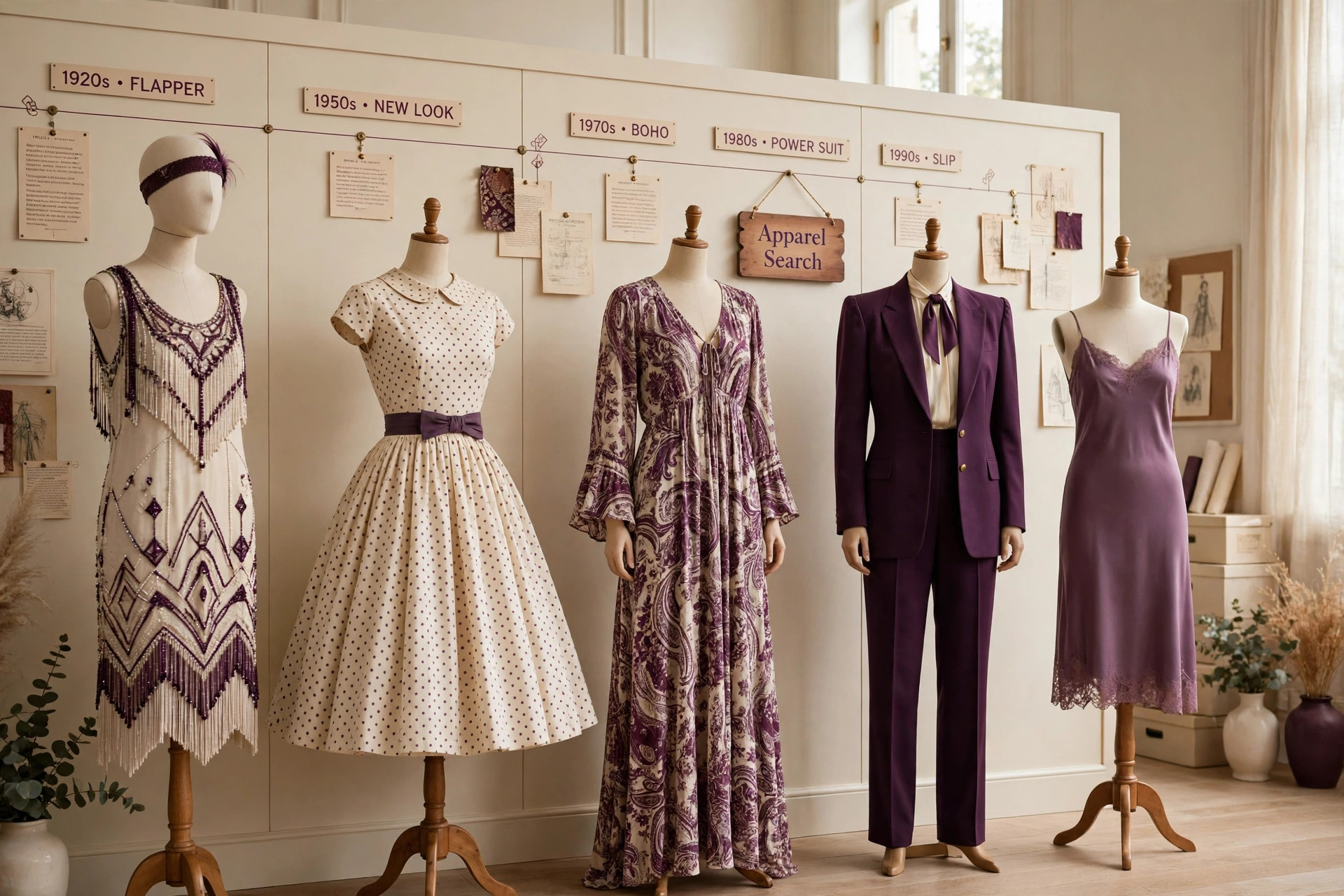
Fashion history is easiest to read ten years at a time. Each decade settles on a silhouette — a characteristic outline the clothes make on the body — and that outline is a direct answer to the world around it: the dropped waist of the 1920s belongs to a generation dancing after a war, the wide shoulders of the 1940s to utility tailoring, the tiny waist and full skirt of the 1950s to postwar abundance, the power shoulder of the 1980s to women entering boardrooms, and the deliberately undone slip dress of the 1990s to a generation rejecting all of it. Learn to spot the silhouette and you can date a garment at a glance, shop vintage with confidence, and borrow from any era without looking like you are wearing a costume.
This index gathers Apparel Search's women's fashion guides decade by decade, from the 1920s through the 1990s. Each guide covers the same ground in the same order — the signature silhouette, the key pieces, the fabrics and colors, and how the decade is worn today — so the decades can be compared side by side. Two of them, the 1960s and 1970s guides, are long-standing Apparel Search pages; the rest of the row is new, built to complete the set. Start with the decade you love, or read the row in order and watch hemlines, waists and shoulders argue with each other across seventy years.
Women's Guides
Women's Fashion, Decade by Decade
Fringed flapper dresses, cloche hats and straight, boyish lines — the decade that cut the corset out of women's lives.
1920s Women's Fashion GuideLong, liquid bias-cut gowns give way to wartime tailoring: padded shoulders, knee-length skirts and make-do ingenuity.
1930s & 1940s Women's Fashion GuideCinched waists, circle skirts and polished femininity — postwar fashion at its most deliberate and most photographed.
1950s Women's Fashion GuideMini skirts, shift dresses and space-age geometry collide with bell-bottoms and paisley at the decade's other end.
1960s Women's Fashion GuideFlowing peasant layers, wrap dresses, platform shoes and the first great denim decade — ease as a style statement.
1970s Women's Fashion GuideBig shoulders, bold color and boardroom tailoring, with punk leather and early streetwear pushing from the edges.
1980s Women's Fashion GuideSlip dresses, flannel and straight-leg denim: the decade that made understatement — and anti-fashion — fashionable.
1990s Women's Fashion GuideGo Deeper
Fashion History on Apparel Search
The decade guides above are about wearing the styles. Apparel Search also keeps a long-running fashion history library — decade histories, definition essays and term pages that trace how Western dress developed and what the period words actually mean. This is the shelf to browse next.
The Other Row
Men's Fashion by Decade
Men's fashion tells the same century in a quieter voice — the decades register in lapel widths, trouser cuts and the slow migration of sportswear into everyday dress. Apparel Search's men's decade guides run from the 1950s men's guide through the 1960s, 1970s, 1980s and 1990s men's guides, finishing with the 2000s. Read the men's and women's guides for the same decade together and the period snaps into focus: the 1950s hourglass answers the grey flannel suit, and 1990s minimalism turns out to have been unisex all along.
Why It Comes Back
Why Decades Repeat — and How to Borrow Without Costume
Fashion revives its decades on a rough twenty-to-thirty-year rhythm, driven by a simple mechanism: the generation that grew up watching a style becomes the generation designing, buying and photographing clothes, and it reaches for the shapes it first thought were beautiful — cleaned up, re-fabriced and mixed with whatever the present already wears. That is why the 1990s slip dress returned in the 2010s, why 1970s flares resurface every few summers, and why a 1950s full skirt can be reissued in technical fabric and read as entirely new.
Borrowing well is a matter of dosage. One decade signal at a time — a 1920s beaded clutch with a modern dress, 1970s flares with a plain knit, an 1980s shoulder on an otherwise simple suit — reads as style; head-to-toe period dress reads as costume, however beautiful the pieces are. The decade guides each end with a section on wearing their decade today, with the signals ranked from safest to boldest, and the women's vintage fashion guide covers the shopping itself: dating garments, checking condition, and sizing clothes cut for other eras' bodies.
More to Explore
Good to Know
Common Questions
How should I use these decade guides?
Start with the decade whose silhouette you already wear without realizing it — most wardrobes lean on one era's shapes — then read its guide for the key pieces and the details that make the reference read clearly. From there, the neighboring decades are the most useful reads: styles are usually a reaction to the decade before, so the 1960s explain the 1970s and the 1980s explain the 1990s.
Which decade is easiest to wear today?
The 1990s and 1970s ask the least of a modern wardrobe: slip dresses, straight-leg denim, flares and wrap silhouettes are already in the shops most seasons, so a few period-correct details complete the reference. The 1920s and 1950s are the most distinctive and the most fun, but their silhouettes — dropped waist, full hourglass — are deliberate statements that work best one piece at a time.
What is the difference between vintage and retro?
Vintage means the garment itself comes from the era — a genuine 1950s dress is vintage. Retro means a newer garment made in the style of an earlier era. The distinction matters for price, condition and care: true vintage needs checking for fabric age and period sizing, while retro pieces fit and wash like modern clothes. Both have their place, and the guides say which they are discussing.
Do decade styles really come back every twenty years or so?
Roughly, yes — the pattern is strong enough that designers plan around it. The revival is never a copy: the returning silhouette is rebuilt in current fabrics, adjusted to current bodies and mixed with the pieces people already own. That editing is what separates a revival from a costume, and it is why a decade can feel fresh twice in one lifetime.