Men's 1950s Fashion Guide
Postwar menswear ran on two rails — the grey flannel suit of the company man, and the jeans-and-leather uniform of the young rebel who wanted nothing to do with him.
Shop Men's 1950s-Style Clothing Now
Shop Men's 1950s-Style Clothing on Amazon Shop Men's 1950s-Style Clothing on eBayThe Amazon and eBay links on this page are affiliate links. If you make a purchase through them, Apparel Search may earn a commission.
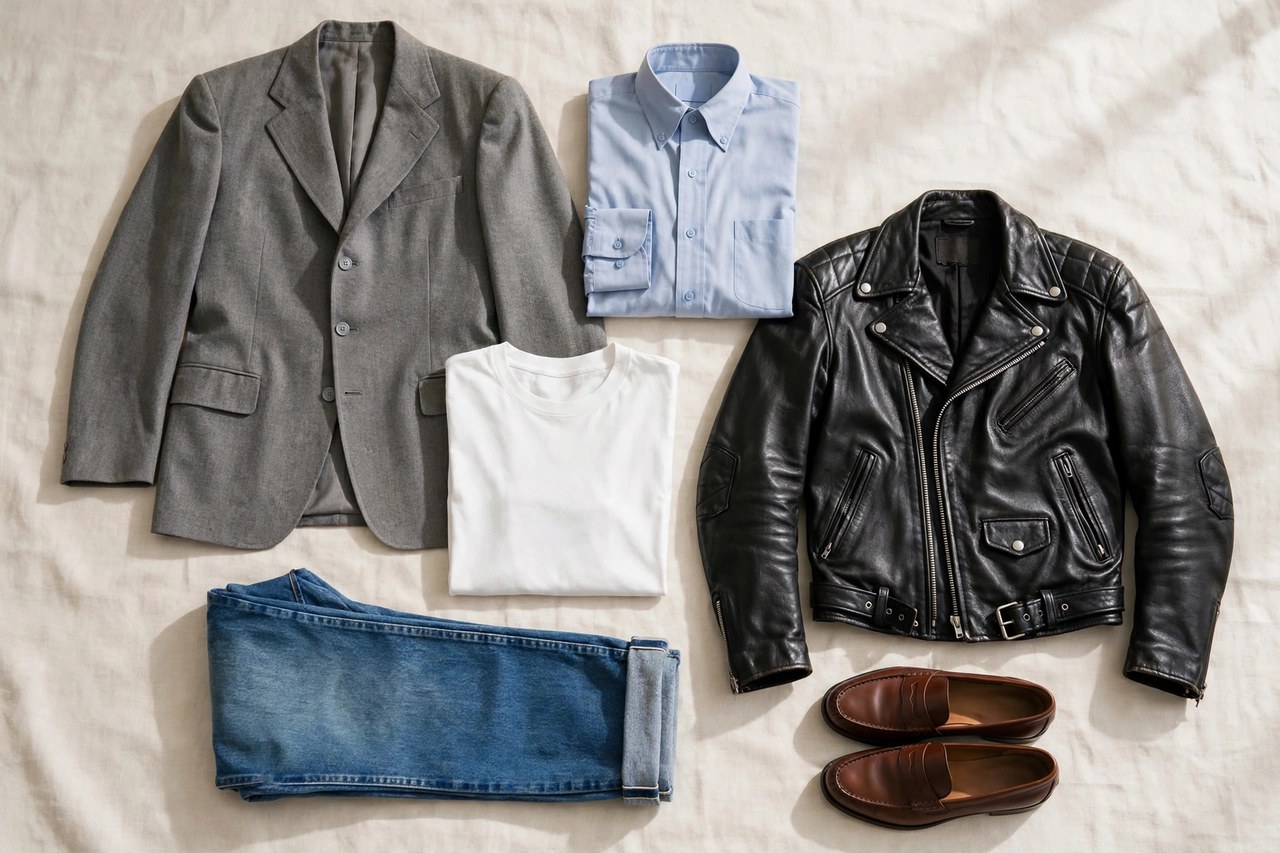
Men’s fashion in the 1950s was shaped by the years just before it. The decade opened with wartime rationing still in recent memory and a generation of young men returning to offices, universities and new suburbs — and it split, almost immediately, into two wardrobes that defined each other by opposition. One belonged to the organization man: the suit, the button-down shirt, the company career. The other belonged to his younger brother: jeans, a white t-shirt and a leather jacket, worn as a deliberate refusal of the first wardrobe’s rules. Most men of the era owned some of both, and the tension between them is the story of 1950s menswear.
Prosperity did quiet, steady work underneath both looks. Mass production made ready-to-wear suits genuinely good, college enrollment swelled the ranks of the campus style called Ivy League, and television carried a small set of faces — actors, singers, presidents — into every living room, standardizing what a well-dressed man was supposed to look like faster than any previous decade could have managed.
The Grey Flannel Suit and Ivy League Style
The business uniform of the decade was the grey flannel suit: a single-breasted jacket with soft, natural shoulders and narrow lapels, worn with pleated or flat-front trousers, a white or pale-blue shirt and a slim striped tie — the “repp” tie borrowed from British regimental stripes. Sloan Wilson’s 1955 novel The Man in the Gray Flannel Suit gave the look its permanent name, and its hero’s commute between suburb and Manhattan became the decade’s defining commute.
On campus, and increasingly off it, the same generation wore Ivy League style: Oxford-cloth button-down shirts, khaki chinos, crew-neck Shetland sweaters, penny loafers worn without socks in summer, and the sack suit with its undarted, three-button jacket. Ivy was the suit’s relaxed sibling — still tidy, still conservative, but built for lectures, convertibles and Saturday football rather than the boardroom. By mid-decade the Ivy look had escaped the Northeast colleges and become the default smart-casual wardrobe of young American men.
Rebel Style: Greasers, Rockers and Denim
Against all that neatness stood the greaser: cuffed blue jeans, a plain white t-shirt (sleeves sometimes rolled around a cigarette pack), engineer boots and a black leather motorcycle jacket, with hair sculpted into a pompadour. The uniform was assembled from workwear and surplus, and the movies made it mythic — Marlon Brando in The Wild One (1953) and James Dean in Rebel Without a Cause (1955) fixed the jeans-and-jacket silhouette as the permanent symbol of youthful defiance. Elvis Presley carried the same ingredients onto the stage and added flash: two-tone shoes, pegged trousers and shirts worn open at the collar.
Britain produced its own version in the Teddy Boys, who raided Edwardian tailoring for long drape jackets with velvet collars, worn with drainpipe trousers, brothel-creeper shoes and bootlace ties — proof that the decade’s rebellion was not always anti-tailoring; sometimes it was tailoring pushed to a theatrical extreme.
Leisure, Color and the New Synthetics
Away from the office, 1950s leisurewear loosened up considerably. Bowling shirts, camp-collar sport shirts, Hawaiian shirts on vacation, cardigans and polo shirts at the weekend, and Bermuda shorts with knee socks for the bold — color and pattern lived here, in direct proportion to their absence from the weekday suit. The decade’s fabric story made much of it possible: nylon, rayon, Dacron and other synthetics moved from novelty to staple, bringing wash-and-wear shirts, drip-dry trousers and bold printed resort shirts that natural fibers alone could not have delivered at the same prices.
Wearing the 1950s Today
The 1950s is one of the easiest decades to wear without costume effect, because so much of it never really left. A button-down Oxford, chinos and loafers are simply modern smart-casual; a white tee under an unzipped leather jacket still reads as intentional rather than retro. Vintage shopping rewards the decade: suits were built to a standard that survives, though period sizing runs slim — check actual garment measurements, not tag sizes. For a full period look, commit to the grooming as much as the garments: the decade’s silhouette assumed a clean, deliberate haircut.
Common Questions
What did men typically wear in the 1950s?
For work, a single-breasted suit with narrow lapels, a button-down or plain dress shirt and a slim tie; for leisure, chinos, cardigans, polo shirts and sport shirts. Younger men and rebels favored cuffed jeans, white t-shirts and leather jackets.
What is Ivy League style?
The campus-born American look of the 1950s: Oxford button-down shirts, khaki chinos, Shetland sweaters, penny loafers and the soft-shouldered sack suit. It began at Ivy League universities and became the decade's default smart-casual style.
Why did jeans become fashionable in the 1950s?
Jeans moved from workwear to symbol when film stars wore them as rebels: Marlon Brando in The Wild One and James Dean in Rebel Without a Cause made cuffed denim with a white t-shirt and leather jacket the uniform of youth defiance.
Men's Fashion by Decade
Six decades of menswear, one page each — follow the series from the grey flannel 1950s to the streetwear 2000s.
- Men's 1950s Fashion
- Men's 1960s Fashion
- Men's 1970s Fashion
- Men's 1980s Fashion
- Men's 1990s Fashion
- Men's 2000s Fashion
More to Explore
Looking for Men's Clothing Stores?
This guide is part of the Men's Fashion by Decade series in the Clothes Guide. To browse where to buy, visit our men's clothing store directory for vintage and vintage-style menswear.