Men's 1990s Fashion Guide
The anti-fashion decade — flannel and ripped denim at one end, baggy hip-hop at the other, and in the office, the quiet arrival of casual Friday.
Shop Men's 1990s-Style Clothing Now
Shop Men's 1990s-Style Clothing on Amazon Shop Men's 1990s-Style Clothing on eBayThe Amazon and eBay links on this page are affiliate links. If you make a purchase through them, Apparel Search may earn a commission.
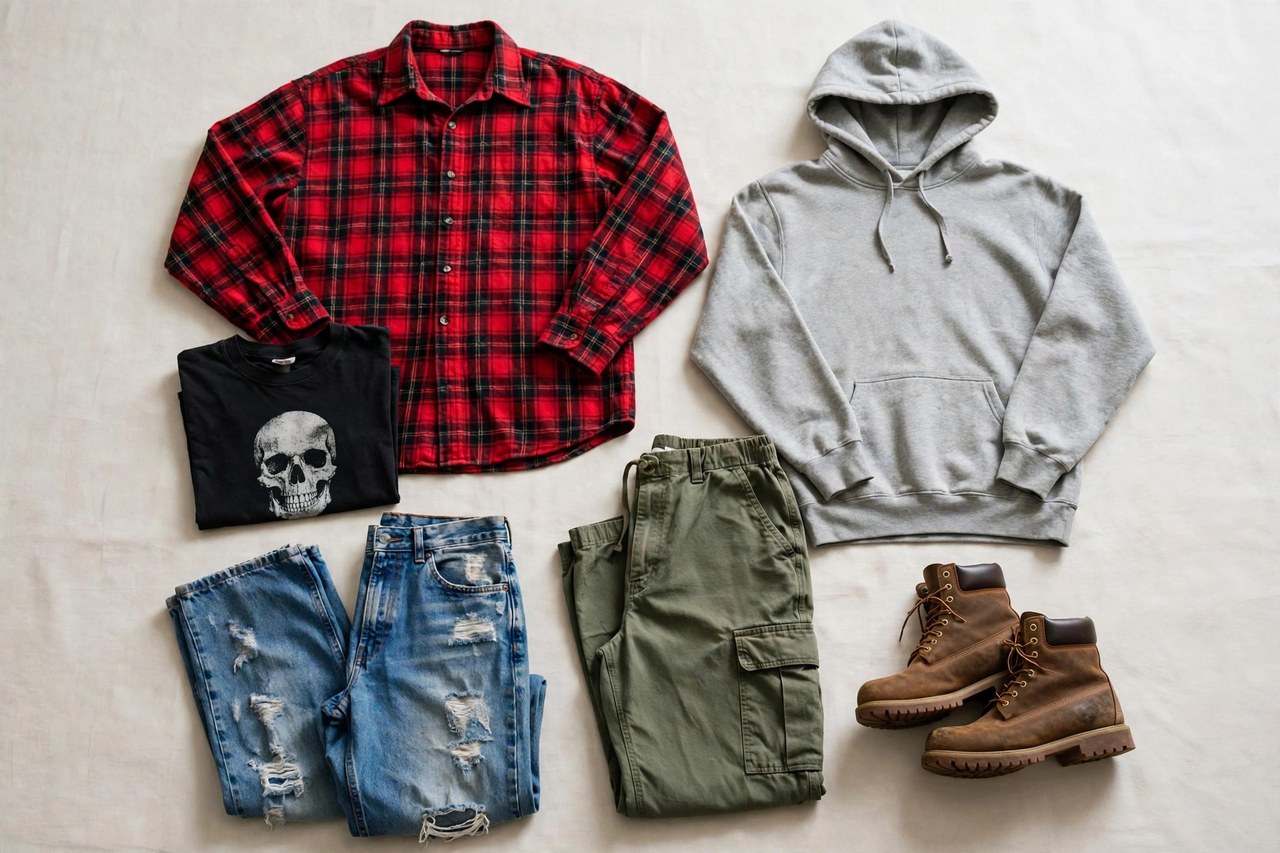
The 1990s dressed down on purpose. After a decade of power shoulders and logos, the new menswear ideal was to look as if you had not tried — an effect, of course, that took as much curation as trying ever had. Two great regional styles set the tone from opposite coasts of American music: Seattle’s grunge, built from thrift-store workwear, and New York hip-hop, which supersized everything it touched. Between them they made baggy the decade’s default silhouette, while the office quietly underwent its own revolution in the form of casual Friday.
By the decade’s end the pendulum was already swinging: minimalism had thinned the palette to black, grey and navy, and designers were experimenting with the slim fits that would take over the 2000s. The ’90s man could plausibly wear flannel, a tracksuit, a football jersey and a black turtleneck in the same month — and many did.
Grunge and Skate: The Thrift-Store Wardrobe
Grunge arrived from Seattle wearing the region’s working clothes: plaid flannel shirts (often over a band t-shirt), ripped and faded jeans, thermal layers, beanies and heavy boots such as Doc Martens. It was deliberately unpolished — second-hand where possible, oversized by default — and when the fashion industry inevitably bottled it in 1992–93, the original wearers noted the irony of designer-priced flannel. Alongside it, skate and surf style supplied the decade’s other casual uniform: baggy cargo trousers and shorts, hooded sweatshirts, logo t-shirts worn large, and chunky skate shoes — clothes built to move in, adopted by plenty of men who never stood on a board.
Hip-Hop and the Baggy Silhouette
Hip-hop took the oversized idea furthest and made it a system: jeans worn several sizes large and low, oversized sports jerseys and hockey shirts, Timberland boots, bucket hats and heavyweight hoodies, with designer labels — Tommy Hilfiger pre-eminently, and Black-owned labels such as Karl Kani, FUBU and Cross Colours — worn as visible proof of arrival. Where grunge bagginess looked accidental, hip-hop bagginess was precise: proportions, brands and freshness of sneakers were all judged, and the silhouette it built — big top, big trouser, immaculate footwear — still anchors streetwear today.
Minimalism and the Casual-Friday Office
The office, meanwhile, was changing underneath both movements. Designers such as Calvin Klein and Helmut Lang stripped menswear to a minimalist register — muted colors, clean lines, luxury fabrics without visible branding — and corporate America relaxed its dress code a day at a time, until “business casual” — khakis, a polo or open-collar shirt, loafers — became the working uniform for much of the decade. Tech culture added its own footnote: the black turtleneck, jeans and trainers of the Silicon Valley founder, a rejection of the suit that read, correctly, as its own kind of power.
Wearing the 1990s Today
The ’90s revival of recent years has been one of menswear’s strongest, and its pieces integrate easily: a flannel overshirt, straight or relaxed jeans, a hoodie under a coat, work boots. The rules are the decade’s own: fit is relaxed but not sloppy, and one baggy element at a time keeps the look intentional. Vintage hunting is rich here — single-stitch band tees, period denim and deadstock sneakers are the prizes — but inspect elastic, prints and boot soles, which age faster than the cotton and denim around them.
Common Questions
What did men wear in the 1990s?
Baggy and relaxed almost everywhere: flannel shirts and ripped jeans from grunge, oversized jerseys and Timberland boots from hip-hop, cargo pants and hoodies from skate style, and khakis with polo shirts in the newly casual office.
What is grunge fashion for men?
The Seattle-born anti-fashion look of the early 1990s: plaid flannel shirts, band t-shirts, ripped faded jeans, beanies and heavy boots - thrifted and oversized on purpose, as a rejection of 1980s polish.
What was the casual Friday revolution?
The 1990s relaxation of office dress codes, starting with one casual day a week and spreading until business casual - khakis, polo or open-collar shirts, loafers instead of suits - became the standard working wardrobe in many industries.
Men's Fashion by Decade
Six decades of menswear, one page each — follow the series from the grey flannel 1950s to the streetwear 2000s.
- Men's 1950s Fashion
- Men's 1960s Fashion
- Men's 1970s Fashion
- Men's 1980s Fashion
- Men's 1990s Fashion
- Men's 2000s Fashion
More to Explore
Looking for Men's Clothing Stores?
This guide is part of the Men's Fashion by Decade series in the Clothes Guide. To browse where to buy, visit our men's clothing store directory for vintage and vintage-style menswear.