Fichu
Clothing Definitions — definitions of garments and clothing terms from Apparel Search
Search Apparel Search
At a Glance
Definition: A fichu is a large square kerchief, folded into a triangle and worn across the front of an eighteenth-century bodice to fill in its low neckline.
Pronunciation: FEE-shoo
Category: Clothing Definitions
Word Origin
Fichu is French, from ficher — to thrust in, fix or throw on. The name describes the wearing of it: a cloth thrown over the shoulders and fixed at the front, pinned or tucked into the bodice.
A fichu is a large, square kerchief worn by women in the eighteenth century to fill in the low neckline of a bodice. The fichu was generally of linen fabric and was folded diagonally into a triangle and tied, pinned or tucked into the bodice in front. This page explains how the fichu was worn and arranged, why a modesty piece became a fashionable accessory in its own right, and how it relates to the kerchief and neckerchief.
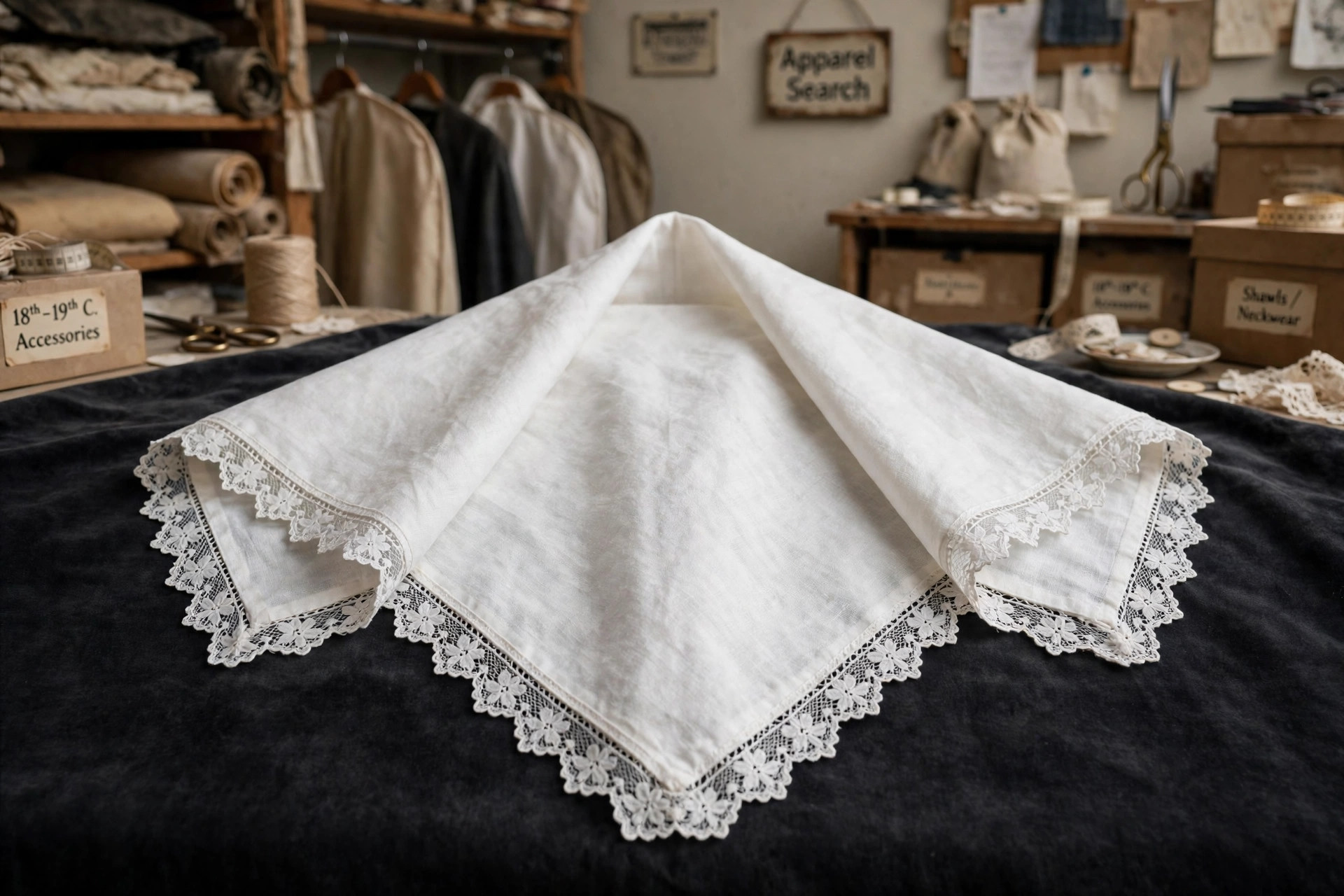
What a Fichu Is and How It Was Worn
The fichu starts as a single square of cloth, most often plain white linen, sometimes fine muslin or lace-edged lawn. Folded once on the diagonal it becomes a triangle; the long folded edge sits around the neck, the point falls at the front, and the ends are crossed over the chest and tied, pinned or tucked into the top of the bodice or the apron strings. The square itself was generous — large enough, once folded, to cover the chest from neck to waist. Arranged that way, one inexpensive, washable square filled the wide, low neckline that eighteenth-century dress required, and could be changed daily in a way the bodice itself could not.
The arrangement was adjustable, which was the point. Pulled high and pinned close, the fichu gave full daytime coverage; arranged in soft, low folds, it merely framed the neckline. Because it was a separate piece, it belonged to the wearer rather than to the dress: the same fichu could serve several bodices, and surviving examples show the pin marks, fold lines and small repairs of hard daily use. It belongs to the kerchief family — the head and neck cloths named by their shape and use — and its closest relative in the wardrobe was the neckerchief, worn tied around the neck rather than spread across the front.

From Modesty Piece to Fashion Accessory
Eighteenth-century bodices were cut low, and the fichu reconciled that fashion with standards of daytime modesty: one square of cloth, folded to a triangle, filled the opening and could be arranged plainly or elaborately. The simplest fichus were plain linen, worn daily by working women, for whom the piece was also practical — it protected the bodice from soil and the skin from sun. Fashionable versions added lace edges, embroidery and fine muslin, and were arranged in soft folds pinned at the front, at which point the modesty piece had become an ornament, framing the neckline it was meant to fill.
Portraits of the period show both extremes, from working women's plain tucked fichus to the gauzy, ruffled arrangements of fashionable dress in the decades covered by the 1700–1750 and 1750–1795 fashion periods. The fashionable fichu grew larger and softer as the century went on, its folds sometimes caught with a brooch, until by the 1780s the high, puffed arrangement had become a style in itself. A garment invented to hide a neckline ended by drawing the eye to it — a familiar pattern in dress history, and the reason the fichu is remembered as an accessory rather than as underwear.
The Fichu in Its Century — and After
The garment's references tell its story: Linda Baumgarten's What Clothes Reveal studies it in colonial and federal American dress, and the Cunningtons' Handbook of English Costume in the Eighteenth Century and Blanche Payne's History of Costume place it in the century's costume generally. Surviving fichus in museum collections, in linen, muslin and lace, are among the most useful evidence for how eighteenth-century necklines were actually worn day to day, because portraits show the arranged result while the cloth itself shows the pinning, tucking and folding that produced it.
The fichu faded with the high-waisted dress of the 1790s, whose necklines were filled differently, but its name survives in later fashion revivals whenever a soft triangular neck cloth is worn over a low neckline, and in historical costuming, where no eighteenth-century bodice is complete without one, and where getting its arrangement right is a standard test of period accuracy. It is also still confused with the shawl, the larger wrap it superficially resembles; the distinction in the box below — a neckline filler, not an outer wrap — is the one that keeps the term accurate. The eighteenth-century bodice it was designed for remains its defining context.
Not to Be Confused With
A fichu is often called a small shawl, but the two are worn differently. A shawl is a large wrap worn over the shoulders as an outer layer, for warmth or ceremony. A fichu is a single square of light cloth, folded to a triangle and tucked or pinned into the bodice front, whose whole job is to fill a neckline. It is also more specific than a neckerchief, which is any kerchief worn around the neck: the fichu is the neckerchief's formal, neckline-filling cousin.
Common Questions
What is a fichu?
A fichu is a large, square kerchief worn by women in the 18th century to fill in the low neckline of a bodice, generally of linen, folded diagonally into a triangle.
How was a fichu worn?
The fichu was folded diagonally into a triangle and tied, pinned, or tucked into the bodice in front, filling the neckline.
How does a fichu differ from a neckerchief?
A neckerchief is a kerchief worn around the neck generally. The fichu was specifically the large square kerchief arranged across the front to fill the low neckline of an eighteenth-century bodice.