Tunisian Crochet
Fabric Definitions — fabric and textile definitions from Apparel Search
Search Apparel Search
At a Glance
Definition: Tunisian crochet, also known as Afghan crochet, is a crochet technique worked with an elongated hook with a stopper on the handle end, in which each row is worked in two halves without turning, producing a dense fabric with a definite front and back.
Also known as: Afghan crochet
Category: Fabric Definitions
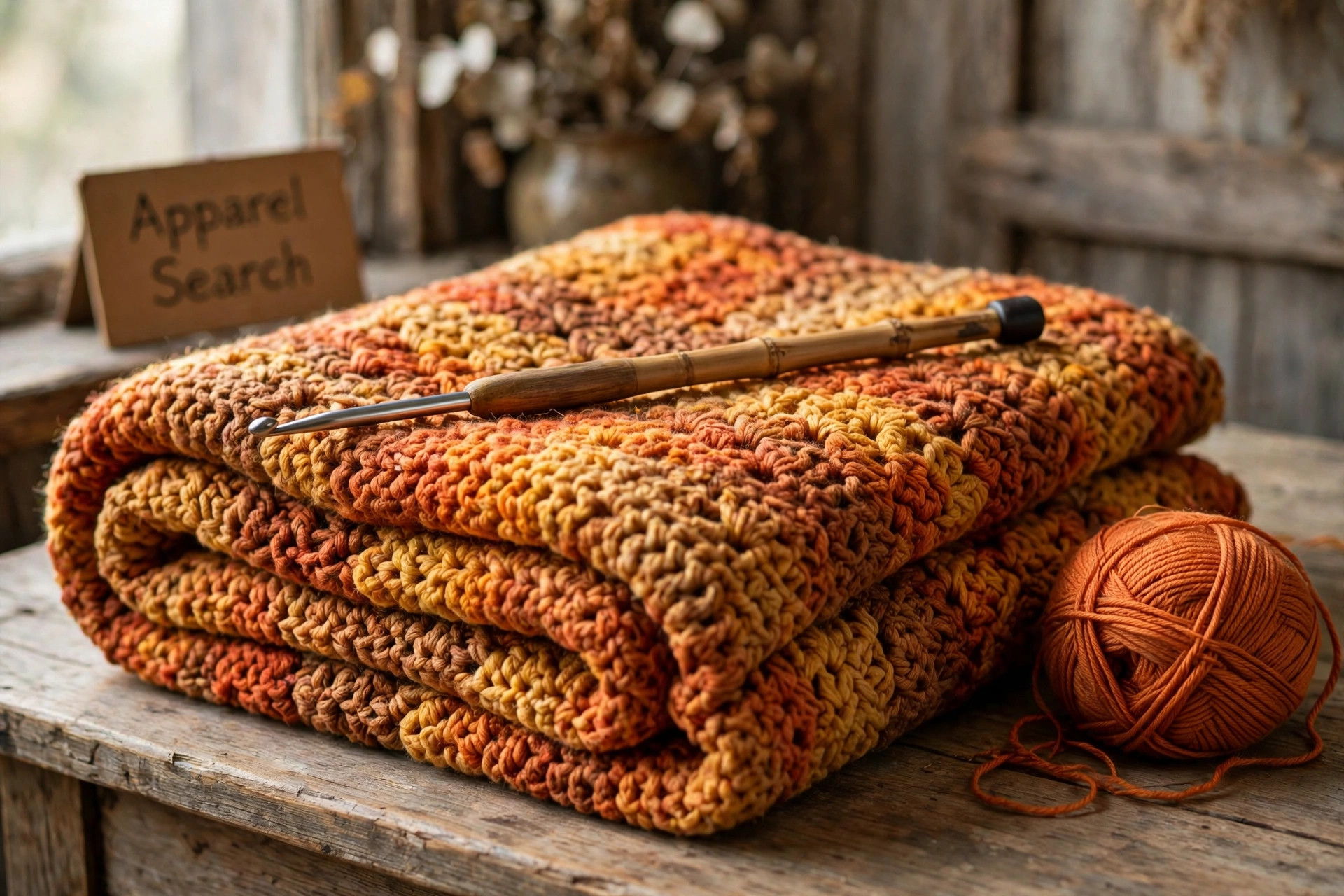
Tunisian crochet, also known as Afghan crochet, uses an elongated hook with a stopper on the handle end, called an Afghan hook. In Afghan crochet, each row is worked in two halves: the first half is worked from right to left and the second half from left to right, and the work is never turned. The technique creates a dense fabric with a definite front and back side, and it is ideal as a base for cross-stitch.
How a Row Is Worked
After the starting chain is completed, the first row is worked by inserting the hook in the chain, pulling a loop from the free end of the yarn, and inserting the hook in the next chain without working the loop off the hook. At the end of the row, there are as many loops on the hook as there are stitches across. In the second half of the row, the loops are worked off the hook. Because the whole row of loops must rest on the hook at once, the elongated Afghan hook — with its stopper keeping the loops from sliding off — is essential equipment, where an ordinary crochet hook is too short for a wide piece.
The rules are few but absolute: the work is never turned, so the same face always faces the maker, pattern counting is always read in the same orientation, and the rhythm — collect loops across, work them back across — carries the whole technique. The finished cloth can be edged with ordinary crochet to stabilise its borders.
The Fabric It Makes
Tunisian crochet sits between crochet and knitting in character: like knitting, it holds a full row of live stitches at once; like crochet, it uses a single hook and builds fabric row by row. The result is a dense, slightly firm, two-sided cloth with a distinct front — a grid of vertical bars — and a back that shows the return pass. That front grid is what makes the fabric ideal as a base for cross-stitch, which can be worked over it stitch by stitch, and the density gives afghans — the blankets that give Afghan crochet its name — their weight, warmth and stable rectangular shape. Finished pieces include blankets, garments, bags and home textiles.
See also the wider crochet family: filet crochet, broomstick lace and hairpin lace, each of which substitutes a tool or a manipulation for the standard hook and stitch.
Common Questions
How is a Tunisian crochet row worked?
In two halves, without turning the work. After the starting chain, the first half is worked from right to left by inserting the hook in each chain and pulling up a loop without working it off, so the end of the row holds as many loops on the hook as there are stitches across. The second half, worked from left to right, works the loops off the hook.
Why does Tunisian crochet need a special hook?
Because the whole row of loops must rest on the hook at once. The elongated hook with a stopper on the handle end — the Afghan hook — holds all those loops without them sliding off, which a standard short crochet hook cannot do for a wide piece.
Why is Tunisian crochet good for afghans and cross-stitch?
It creates a dense fabric with a definite front and back side. The front presents a regular grid that cross-stitch can be worked over stitch by stitch, and the density gives afghans weight, warmth and a firm, stable shape.