Crochet Hook
Miscellaneous Definitions — the hooked needle that makes crochet stitches, from Apparel Search
Search Apparel Search
At a Glance
Definition: A crochet hook is a type of needle, usually with a hook at one end, used to draw thread through knotted loops — and only one hook is needed to make crochet stitches.
Category: Miscellaneous Definitions
A crochet hook is the single tool of crochet: a type of needle, usually with a hook at one end, that draws thread through knotted loops to build fabric stitch by stitch. Only one crochet hook is needed to make crochet stitches, which sets the craft apart from knitting and its two needles. The hook's earliest use appears to have been in the late 1700s or early 1800s, and its basic form has changed little since. This page covers how the hook does its work, how its sizes are measured and matched to thread, what hooks are made of, and the two special forms — the long Tunisian crochet hook and the double-ended cro-hook.
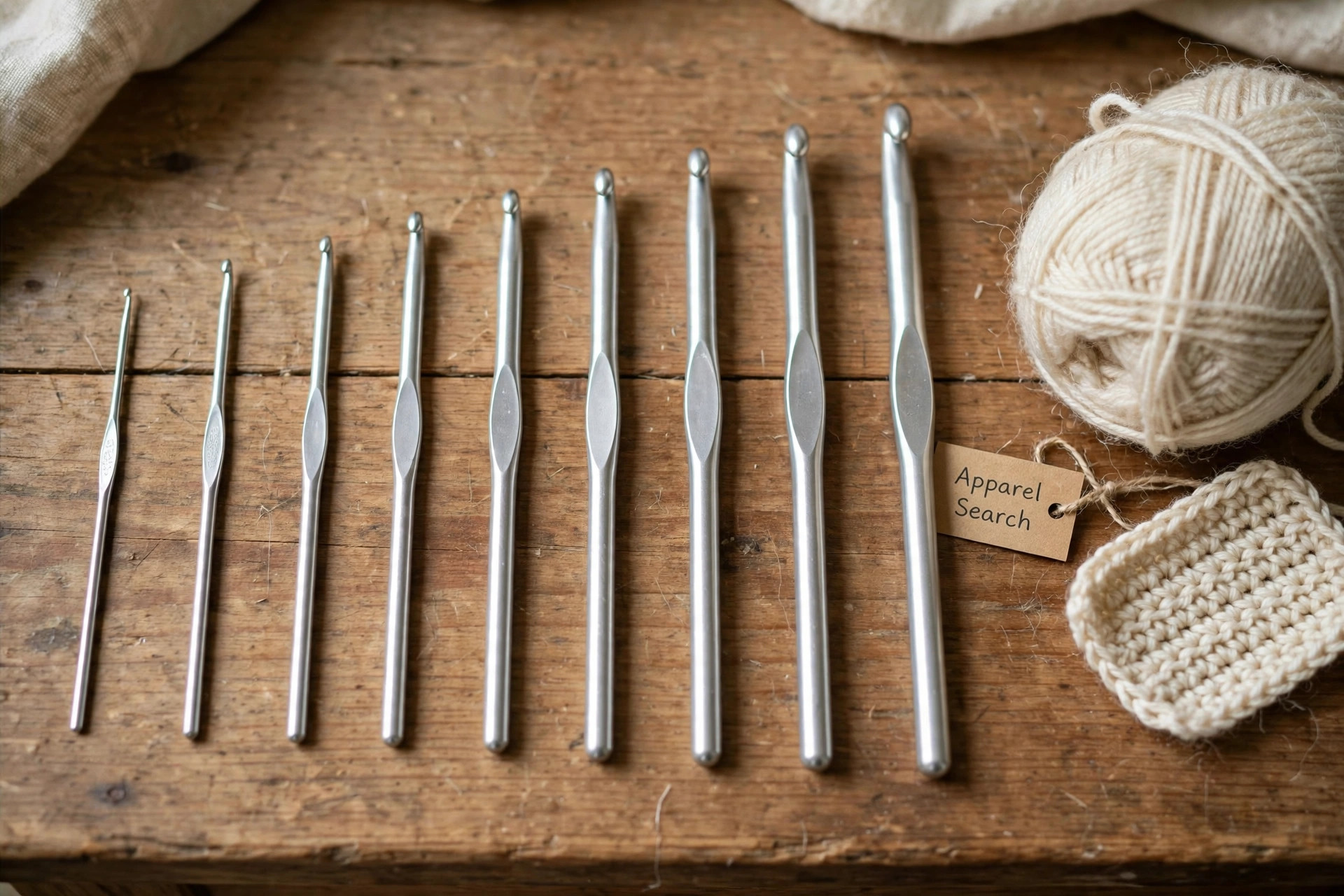
One Hook, Drawing Thread Through Loops
The hooked end is the working feature of the tool. It catches the thread and draws it through loops already held on the hook, building knotted loops one at a time into a fabric. The point slips into a stitch without splitting the thread, the throat catches the strand, and the shaft holds each new loop at a consistent size, which is what keeps the finished work even. Because the single hook finishes each stitch as it goes, only the loop currently being worked stays fully open — a dropped crochet stitch does not unravel a whole row the way dropped knitting can, and crochet can be shaped freely in rows, in rounds or spirals, as edging, and in combined stitch patterns.
The starting point for learning the tool is the single crochet stitch, one of the most important stitches a beginner needs to know. A majority of crochet patterns and projects incorporate single crochet stitches, and once it is learned there are countless ways to use it: worked in rows, in rounds or spirals, as edging, in different parts of the stitch for different effects, and combined with other stitches in endless variations. Variations in the hook itself serve comfort and control rather than changing the stitch. Hooks can have decorative handles, the handle may be shaped to fit the hand for easier use during long sessions, and some hooks pair a wooden or plastic handle with a metal hook inserted into it, combining a warm, grippable handle with a smooth, precise working end.

Sizes, Materials and the Tunisian Form
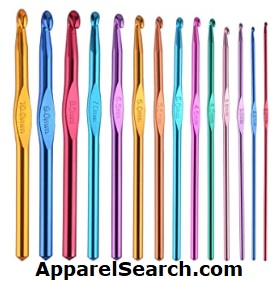
Hook size governs stitch size, and stitch size governs the finished fabric. Hooks come in various sizes, measured in millimetres or fractions of an inch, according to the thickness of the needle. Several systems of letters and/or numbers describe the sizing of crochet hooks, so a pattern may name the same tool by a letter, a number and a millimetre measure — checking the millimetre size is the safest way to match a hook bought under a different system. The size of the hook is usually matched with an appropriate ply or thickness of thread: a large hook with fine thread makes an open, lacy fabric, a small hook with thick thread makes a dense, stiff fabric that is hard to work, and the matched middle ground gives the drape the pattern intends.
Materials change how a hook behaves in the hand and in the yarn. Hooks can be made of wood, plastic, casein (milk protein) or metal. Metal is smooth and durable and slides easily through tight stitches; wood is light and warm, with a little more grip on slippery thread; plastic is inexpensive and light, well suited to large hooks; and casein is a traditional smooth material made from milk protein. One alternative form stands apart: the Tunisian crochet hook, which is much longer than a regular crochet hook in order to accommodate the multiple loops used in Tunisian crochet, where a whole row of loops is held on the shaft at once. Related techniques such as filet crochet still use the standard single hook — it is the stitch pattern, not the tool, that changes.
Not to Be Confused With
Not to be confused with the cro-hook. A regular crochet hook has a hook at one end only. A cro-hook is a type of crochet needle with a hook at each end, used to make double-sided crochet pieces — the double-ended relative of the standard hook described here.
Common Questions
What is a crochet hook?
A crochet hook is a type of needle, usually with a hook at one end, used to draw thread through knotted loops. Only one crochet hook is needed to make crochet stitches, unlike knitting, which uses two needles.
How are crochet hooks sized?
Hooks come in various sizes measured in millimetres or fractions of an inch, according to the thickness of the needle. Several systems of letters and/or numbers describe hook sizing, and the hook size is usually matched with an appropriate ply or thickness of thread.
What are crochet hooks made of?
Hooks can be made of wood, plastic, casein, which is a milk protein, or metal. They can have decorative handles, handles shaped to fit the hand, or a metal hook inserted into a wooden or plastic handle.