Deerstalker
Hat & Headwear Definitions — hats, caps, helmets and headwear terms from Apparel Search
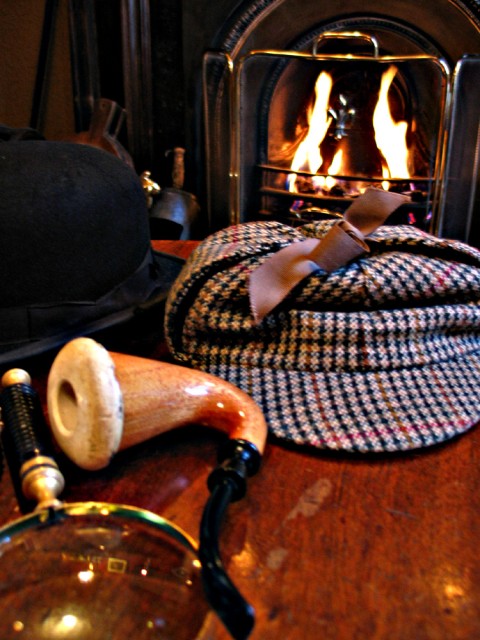
A deerstalker is a type of hat typically worn in rural areas, often for hunting, and, because of its popular association with Sherlock Holmes, it is also a stereotypical hat of a detective. Its main feature is a set of four flexible brim flaps positioned at the back, front and sides of the hat, which can be adjusted up or down to suit the needs of the wearer depending on the weather, most commonly with the front and back flaps down and the side flaps folded up and tied into place.
A deerstalker is a type of hat that is typically worn in rural areas, often for hunting. Because the hat's popular association with Sherlock Holmes, it is also a stereotypical hat of a detective.
Its main feature is the set of four flexible brim flaps that are position back, forth and the sides of the hat. They can be adjusted up or down to suit the needs of the wearer depending on the weather. The most common arrangement is the front and back flaps being down while the side ones are folded up and tied into place.
The most famous wearer of this kind of hat is the fictional character Sherlock Holmes, who is typically depicted favoring this hat. However, uninformed depictions which have Holmes wearing this hat in the city fail to realize that the fashion conscious Holmes in the original stories would never do that. This is because this kind of hat was restricted to the country and was considered a fashion faux pas to wear one in an urban setting. It would be the modern day equivalent of wearing hunting orange clothes as casual wear in an urban area which is generally considered inappropriately out of place.
| The above article is licensed under the GNU Free Documentation License. From Wikipedia, the free encyclopedia https://en.wikipedia.org/wiki/deerstalker 6/11/05 |
|
|
|
Four Flaps, Adjusted to the Weather
Most hats offer one brim, fixed in place. The deerstalker offers four, and the wearer decides what to do with each of them. The flaps at the back, front and sides are flexible, so they can be positioned up or down to suit the needs of the wearer depending on the weather, and that adjustability is the whole design. On a wet, windy day in the field, flaps down shed rain and shelter the neck, forehead and ears. In milder weather, or when the wearer needs to hear clearly and move without rustling cloth around the ears, the side flaps fold up and tie into place, which is why the most common arrangement — front and back flaps down, side flaps folded up and tied — is a compromise between protection and awareness. For a hunting hat, that compromise makes practical sense. Hunting is rural work done outdoors for hours, in changing conditions, by someone who needs shade for the eyes, a dry neck, and unobstructed hearing at the same time. A rigid hat can give only one of those settings. The deerstalker's tied, folded and lowered flaps give several, changed in seconds without tools, pockets or spare parts. Read the hat that way and its odd silhouette stops looking like a costume: the flaps are equipment, positioned where weather actually arrives, at the front, the back and the sides of the head.
The same flexibility explains why the hat stayed a country hat. A garment whose parts visibly tie up, fold down and flap about belongs to fields, woods and moors, where function outranks polish. In town dress, by contrast, a hat was expected to hold one clean, settled shape. The deerstalker's movable brim announced the countryside every time it was worn, and no amount of neat tying could disguise that its purpose was weather and work rather than city formality.
Sherlock Holmes and the Country Rule
The deerstalker's fame comes from a single fictional wearer. Sherlock Holmes is typically depicted favouring this hat, and because of that popular association the deerstalker became the stereotypical hat of a detective — the silhouette alone, in a cartoon or a costume, now announces detection before a word is spoken. The association carries a famous mistake inside it. Depictions that show Holmes wearing the hat in the city miss a point of dress that the stories themselves respect: the fashion-conscious Holmes would never wear a deerstalker in town, because this kind of hat was restricted to the country and was considered a fashion faux pas in an urban setting. The modern comparison makes the rule plain. Wearing a deerstalker as city dress would be the equivalent of wearing hunting orange clothes as casual wear in an urban area, generally considered inappropriately out of place — not because the garment is bad, but because its setting is wrong. Work clothes carry their place with them.
That distinction is worth keeping when the hat is worn or bought today. As a detective costume, the deerstalker works anywhere, because the audience is reading the Holmes reference, not judging rural dress. As a serious outdoor hat, it belongs where it began, in rural areas and for country pursuits such as hunting, where adjusting the flaps to the weather is a real benefit rather than a visual quirk. Worn with that understanding, the hat is honest on both counts: a practical, adaptable piece of country headwear that borrowed, through one great fictional detective, a second career as the most recognisable detective hat in the world.
Understanding the deerstalker also means understanding how dress codes worked when it was everyday wear. Clothing announced where a person was going and what would be done there, and a hunting hat in a city street broke that announcement in a visible way. That is why the comparison with hunting orange is so exact: blaze orange is excellent clothing in the field, where being seen is safety, and entirely wrong as casual urban wear, where it shouts the countryside at everyone who passes. The deerstalker carried the same message in cloth form. Its tied-up side flaps, in the most common arrangement, were a working adjustment, and working adjustments belonged on rural ground.
For a modern wearer, the hat therefore offers two distinct pleasures that should not be confused. Worn for country pursuits, it is a genuinely adjustable shelter for the head: lower the front flap against low sun or driving weather, lower the back flap to protect the neck, tie the side flaps up when listening matters, and change the arrangement as the day changes. Worn as the detective's hat, it is a quotation, and quotations work best when they are knowing — the wearer who understands that Holmes himself kept the hat for the country is wearing the reference more accurately than the wearer who pictures it on a London street. Either way, the four flexible flaps remain the point of the design, and a deerstalker whose flaps cannot be raised, lowered and tied has lost the feature that made it a deerstalker in the first place.
Common Questions
What is the main feature of a deerstalker?
Its main feature is the set of four flexible brim flaps positioned at the back, front and sides of the hat. They can be adjusted up or down to suit the wearer depending on the weather.
How are deerstalker flaps usually worn?
The most common arrangement is the front and back flaps down while the side ones are folded up and tied into place. That gives shade and weather protection front and back while leaving the ears and sides clear.
Why should Sherlock Holmes not wear a deerstalker in the city?
The hat was restricted to the country, and wearing one in an urban setting was considered a fashion faux pas. The fashion-conscious Holmes would never do that, just as wearing hunting orange as casual wear in a city is considered inappropriately out of place today.