Welsh Hat
Hat & Headwear Definitions — hats, caps, helmets and headwear terms from Apparel Search
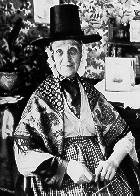
The Welsh hat worn by women as part of Welsh national costume is a tall stovepipe-style hat. It is still worn by women, and particularly schoolgirls, in Wales on St David's Day, but rarely on other occasions. It is a legacy of 18th-century dress, and the covering is usually of black felt, normally worn with a lace cap underneath showing under the brim.
 The Welsh hat worn
by women as part of Welsh
national
costume is a
tall stovepipe-style
hat.
It is still worn by women,
and particularly schoolgirls,
in Wales on St David's Day,
but rarely on other occasions.
It is a legacy of 18th century
dress. The hat is normally
worn with a
lace
cap underneath, showing
under the brim, or may have
lace attached to the brim.
The covering is usually
of black
felt.
Legend has it that the women's hats were a deciding factor in terminating the attempted invasion of Britain by Napoleonic forces in 1797. The French soldiers are said to have mistaken the women, seen at a distance in their red shawls and Welsh hats, for a detatchment of British "redcoats", whose uniform included tall black hats.
There is an "alternative" women's hat for those who consider the traditional Welsh hat unflattering, in the form of a "cocklewoman's hat", a flat straw hat tied with ribbons.
A derived meaning of Welsh hat is an ancillary stack, usually black in color and slightly conical, attached to the funnel of a ship to ensure cleaner disposal of exhaust from the engines. This arrangement was used in several passenger liners by the Orient Line in the 1950s.
| The above article is licensed under the GNU Free Documentation License. From Wikipedia, the free encyclopedia https://en.wikipedia.org/wiki/welsh_hat 6/4/05 |
|
A Tall Black Hat at the Centre of Welsh National Costume
The Welsh hat is worn by women as part of Welsh national costume, and it is the most immediately recognisable piece of that costume. It is a tall stovepipe-style hat, which means the crown rises high and straight, in the manner of a stovepipe or a top hat, rather than sitting low and soft on the head. The covering is usually of black felt, so the standard picture is a high black hat worn over the rest of the costume. It is normally worn with a lace cap underneath, showing under the brim, or may have lace attached to the brim, and that white lace edge against the black felt is part of the hat's correct presentation, softening the base of the tall crown and linking the hat to the cap worn beneath it.
The hat is a legacy of 18th-century dress, a survival rather than a modern invention. National costume commonly preserves the respectable dress of an earlier century, and the Welsh hat follows that pattern: a form that was once ordinary tall-hatted dress for women became, as everyday fashion moved on, the fixed headwear of the traditional outfit. It is still worn by women, and particularly schoolgirls, in Wales on St David's Day, but rarely on other occasions. That single-day wearing is characteristic of national costume in modern life: the full outfit, hat included, is kept complete and correct, and brought out for the national celebration rather than adapted for daily use. Anyone describing or assembling the costume should treat the hat, the lace cap beneath it and the black felt covering as one arrangement, not as separate optional pieces.
The 1797 Legend and the Cocklewoman's Alternative
A famous story attaches to the hat. Legend has it that the women's hats were a deciding factor in terminating the attempted invasion of Britain by Napoleonic forces in 1797. The French soldiers are said to have mistaken the women, seen at a distance in their red shawls and Welsh hats, for a detachment of British redcoats, whose uniform included tall black hats. The story is presented as legend, and it should be repeated as legend, but its logic rests on the hat's real features: a tall black hat is readable at a great distance, and a group of women in tall black hats and red shawls could, from far off, present the colours and silhouette of soldiers. The tale survives because the hat is so distinctive that it can carry a story of mistaken identity on its outline alone.
Not every wearer finds the tall hat flattering, and the costume has an answer for that. There is an alternative women's hat for those who consider the traditional Welsh hat unflattering, in the form of a cocklewoman's hat, a flat straw hat tied with ribbons. The contrast between the two is complete: tall against flat, black felt against straw, lace cap beneath against ribbons tying the hat on. Offering both within the tradition acknowledges that national costume is worn by real people of different tastes, while keeping the tall stovepipe-style hat as the standard form. The name Welsh hat also has a derived meaning far from costume: an ancillary stack, usually black in colour and slightly conical, attached to the funnel of a ship to ensure cleaner disposal of exhaust from the engines, used in several passenger liners by the Orient Line in the 1950s, a transfer of the name from one tall black shape to another.
Common Questions
What does the Welsh hat look like?
The Welsh hat is a tall stovepipe-style hat, usually covered in black felt. It is normally worn with a lace cap underneath, showing under the brim, or may have lace attached to the brim.
When is the Welsh hat worn?
It is worn by women as part of Welsh national costume, and is still worn by women, and particularly schoolgirls, in Wales on St David's Day, but rarely on other occasions.
What is the alternative to the Welsh hat?
For those who consider the traditional Welsh hat unflattering, there is an alternative women's hat in the form of a cocklewoman's hat, a flat straw hat tied with ribbons.