Gable Hood
Hat & Headwear Definitions — the pointed English headdress of about 1500 to 1550, from Apparel Search
Search Apparel Search
At a Glance
Definition: A gable hood is an English woman's headdress of about 1500 to 1550, so called because its pointed shape resembles the gable of a house, with decorated side panels called lappets and a veil at the back.
Also known as: English hood; gable headdress
Category: Hat & Headwear Definitions
Word Origin
The hood is so called because its pointed shape resembles the gable of a house — the triangular end wall that carries a pitched roof. The steep point over the forehead echoes that triangular end, which gives the headdress its architectural name.
A gable hood, also called an English hood or gable headdress, is an English woman's headdress of about 1500 to 1550. Some garments are named for their maker and some for their place; this one is named for a building, because its pointed shape resembles the gable of a house. It began as a simple pointed hood with decorated side panels called lappets and a veil at the back, and over time became a complex construct with a box-shaped back and two tube-shaped hanging veils. This page covers the point that gives the hood its name, the lappets and veils that make up its parts, and how the fashion developed within its fifty-year span.
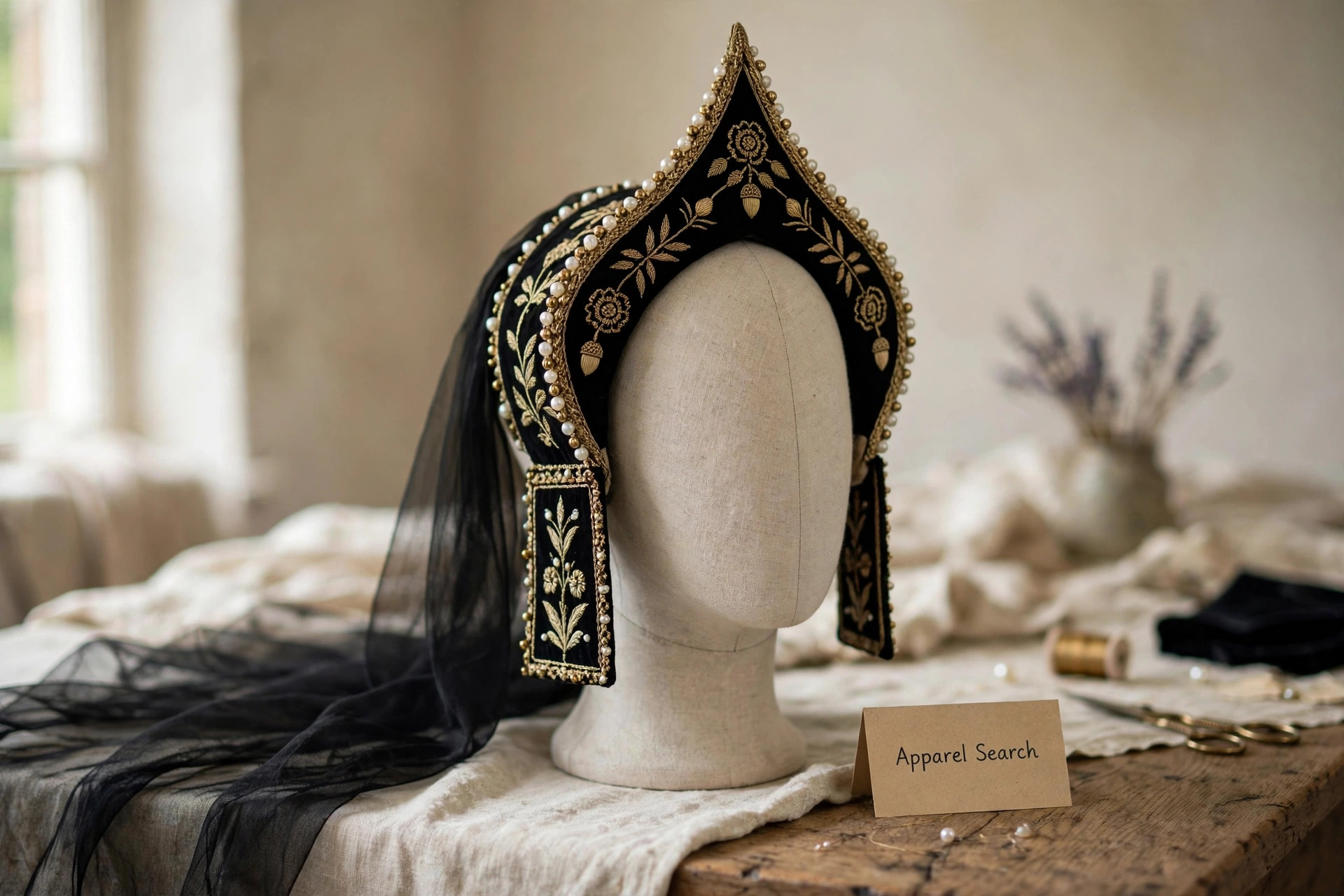
Named for a Roof: The Pointed Front
The first thing a viewer sees is the point: a steep, clean point rising over the wearer's forehead, with the sides falling away from it like roof slopes. The dates frame a short, distinct fashion — about 1500 to 1550, half a century in which English court and gentry dress had a recognisable silhouette of its own, and the gable hood is one of its defining pieces. In its earlier form the construction was comparatively simple: a pointed hood with decorated side panels called lappets and a veil at the back.
Even in that simple form, the elements that would later be elaborated are all present — the point that gives the name, side panels that invite decoration and carry it down beside the face, and a veil that finishes the back. A headdress of this kind does several kinds of work at once: it covers the hair, as the dress of the period required; it frames the face within a formal, architectural outline; and its decorated lappets place visible ornament exactly where eyes rest, at either side of the face.
From Simple Hood to Complex Construct
Over time, within its fifty-year span, the gable hood became a complex construct. The back changed character entirely, becoming box-shaped, and the single veil at the back gave way to two tube-shaped hanging veils set at 90-degree angles. That geometry matters: two veils hanging at right angles do not fall like ordinary cloth — they project, turn and hold corners, so the headdress reads as built rather than draped, a small piece of architecture worn on the head, true to its gable name from front to back.
The final step turned construction into variety. The hanging veils and lappets could be pinned up in a variety of ways to make complex headdresses, so a single hood was not a single look. Pinning a veil up changes the outline at the back; arranging the lappets changes the framing at the sides; combining the choices produces headdresses considerably more elaborate than the pointed hood the fashion started from. The wearer, or the attendant dressing her, was effectively assembling the day's headdress from the hood's parts.
Reading the Hood Today
That development — from simple pointed hood to pinned, box-backed construct between about 1500 and 1550 — is a compact lesson in how fashions evolve without changing their name. The gable point stayed, because the point was the identity of the piece; everything behind and beside it grew more elaborate, because elaboration is what a mature fashion does with a settled silhouette. A surviving dated image, a gable hood of about 1543, falls near the end of the period and shows the headdress in its developed form. For students of English dress the hood is a useful marker precisely because its span is bounded: a pointed, gabled headdress with lappets and a veil points to England in those decades, and the more box-shaped and intricately pinned the back, the later within the period the example is likely to sit.
For costume makers the practical consequence is that a gable hood cannot be improvised from a plain hood. The point must read as a gable, the lappets must carry decoration down the sides of the face, the back must be built rather than draped, and the veils must hang in their tube shapes or be pinned up with visible intention. The gable hood is not a simple hood worn for warmth or covering — its purpose is formal and visual, and its richness was always in its architecture first and its materials second.
Common Questions
Why is it called a gable hood?
It is so called because its pointed shape resembles the gable of a house. The steep point over the forehead echoes the triangular end of a roof, which gives the headdress its architectural name.
What are lappets on a gable hood?
Lappets are the decorated side panels of the hood. They were part of the hood from its simpler form, a pointed hood with decorated lappets and a veil at the back.
How did the gable hood change over time?
It became a complex construct with a box-shaped back and two tube-shaped hanging veils at 90-degree angles. The hanging veils and lappets could be pinned up in a variety of ways to make complex headdresses.