Dobby Loom
Miscellaneous Definitions — the loom that selects its harnesses by pegged chain or computer program, from Apparel Search
Search Apparel Search
At a Glance
Definition: A dobby loom is a loom in which each harness can be selected without using treadles: a manual dobby selects harnesses with pegs inserted in a chain of bars or lags, and a computer-assisted dobby selects them with a computer program.
Category: Miscellaneous Definitions
A dobby loom is a loom in which each harness can be selected without using treadles. A manual dobby uses a chain of bars or lags, each of which has pegs inserted, and the pegs select the harness to be moved. A computer-assisted dobby loom uses a computer program to select which harness is to be moved, and the harnesses are lifted or sunk by leg power on a dobby pedal or by electric or other power sources. This page covers how the pegged chain and the program do the selecting, why a dobby allows a huge variety of weave structures a treadle loom cannot reach, and where the dobby sits between the treadle handloom and the Jacquard loom.
Selecting Harnesses by Pegs or by Program
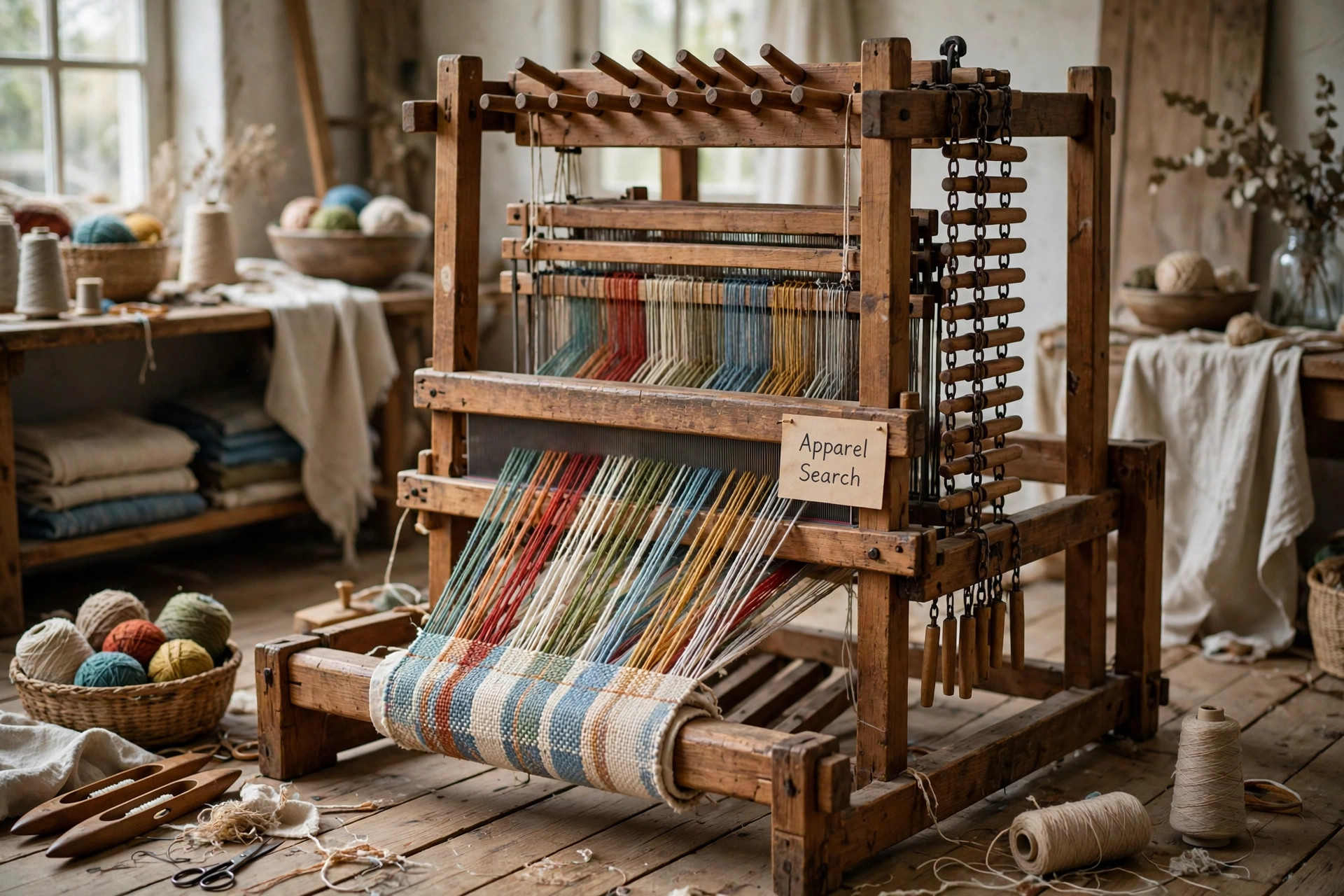
Weaving any patterned cloth is a problem of selection: on each pass of the shuttle, some warp threads must be lifted and others left down, and the sequence of selections across many passes is the weave structure. A dobby loom solves the selection problem with a mechanism instead of the weaver's feet. In a dobby loom each harness, the frame holding a set of warp threads, can be selected without using treadles. A manual dobby uses a chain of bars or lags, each of which has pegs inserted, and the pegs select the harness to be moved: as the chain advances bar by bar, each bar reads as one step of the pattern, and its peg pattern tells the loom which harnesses to raise for that step.
A computer-assisted dobby loom replaces the pegged chain with a computer program to select which harness is to be moved, but the idea is identical: a stored sequence of selections executed one step at a time. In either case the harnesses are lifted or sunk by either leg power on a dobby pedal or by electric or other power sources. That division of labour is the dobby's real innovation. The weaver supplies rhythm and power and watches the cloth, while the mechanism supplies memory — a long, exact sequence of harness selections that no weaver could hold in mind or execute with feet alone. Changing a pattern on a manual dobby means re-pegging the chain, and on a computer dobby means loading a different program, so the loom can move between weave structures without being re-threaded, as long as the warp threading itself supports the new design.
Why a Dobby Out-Weaves a Treadle Loom
The contrast is with the treadle handloom, where the harnesses are attached by cords to a limited number of different treadles to select and move the harnesses. A floorloom is limited in the amount of treadles it can use within the loom frame: a normal eight-harness floorloom has ten or twelve treadles, and each treadle produces one fixed combination of raised harnesses. The number of treadles therefore caps the number of distinct steps a repeating pattern can have, and complex structures quickly exhaust the weaver's feet and the frame's space.
A dobby need only add bars to the dobby chain to enlarge the loom's weave capacity. A dobby device mounted on the same loom will use a chain of bars ranging from twelve to seventy, and the average dobby chain will have approximately fifty bars, each bar a pattern step, so long and varied sequences become practical. Dobby looms therefore allow a huge variety of weave structures which a treadle loom might not, due to the lack of treadles: small geometric patterns, extended twills, spot weaves and textured fabrics, all built from harness combinations repeated over dozens of steps. The contrast with the power loom is one of purpose rather than selection: power describes where the loom's energy comes from, while dobby describes how its harnesses are chosen.
From Dobby to Jacquard
The dobby sits in a family of selection mechanisms. A Jacquard loom is an example of an adaptation from a dobby loom in the direction of total control: a Jacquard device mounted atop a loom will lift the individual heddles and warp threads, and the individual heddles and warp threads can be controlled by a computer or a series of punched cards which select them to rise or fall. Power is usually supplied to the loom to move the many heddles involved.
Where the dobby selects whole harnesses, the Jacquard selects individual threads, which is why Jacquard weaves pictures and dobby weaves structures. Between the treadle loom's feet, the dobby's pegged chain and program, and the Jacquard's per-thread control, weaving history is largely a history of giving the loom a better and longer memory — and every step of it shows in the fabrics woven from fibers on such looms.
Common Questions
What is a dobby loom?
A dobby loom is a loom in which each harness can be selected without using treadles. A manual dobby selects harnesses with pegs inserted in a chain of bars or lags, while a computer-assisted dobby uses a computer program to select which harness is to be moved.
How does a dobby loom differ from a treadle loom?
On a treadle handloom the harnesses are attached by cords to a limited number of treadles that select and move them. A dobby need only add bars to the dobby chain to enlarge the loom's weave capacity, so dobby looms allow a huge variety of weave structures a treadle loom might not.
How many bars does a dobby chain have?
A dobby device mounted on a floorloom will use a chain of bars ranging from twelve to seventy, compared with the ten or twelve treadles of a normal eight-harness floorloom. The average dobby chain will have approximately fifty bars.