Halterneck
Miscellaneous Definitions — the neckline held up by a single strap around the neck, from Apparel Search
Search Apparel Search
At a Glance
Definition: A halterneck is a style of women's clothing held up by a single strap around the back of the neck instead of straps over each shoulder, found on dresses and on the separate top called a halter top.
Category: Miscellaneous Definitions
Word Origin
The term halter comes from the German word for "holder," as in Büstenhalter, which literally means "busts-holder" and is equivalent to "brassiere."
Halterneck refers to a type of women's clothing with a single strap around the back of the neck instead of straps over each shoulder. This can refer either to a dress or to a separate shirt, called a halter top — a type of sleeveless shirt similar to a tank top, by the American English definition. Halterneck garments are generally considered more provocative because they leave the back free, exposing the shoulder blades. The halterneck is one of the classic necklines: where most sleeveless garments hang from two shoulder points, the halter hangs from one point at the neck, and everything that distinguishes it — the bare shoulders, the open back, the tie on a bathing suit, the strapless bra beneath — follows from that strap's placement. This page covers the construction, the effect, and what is worn with it.
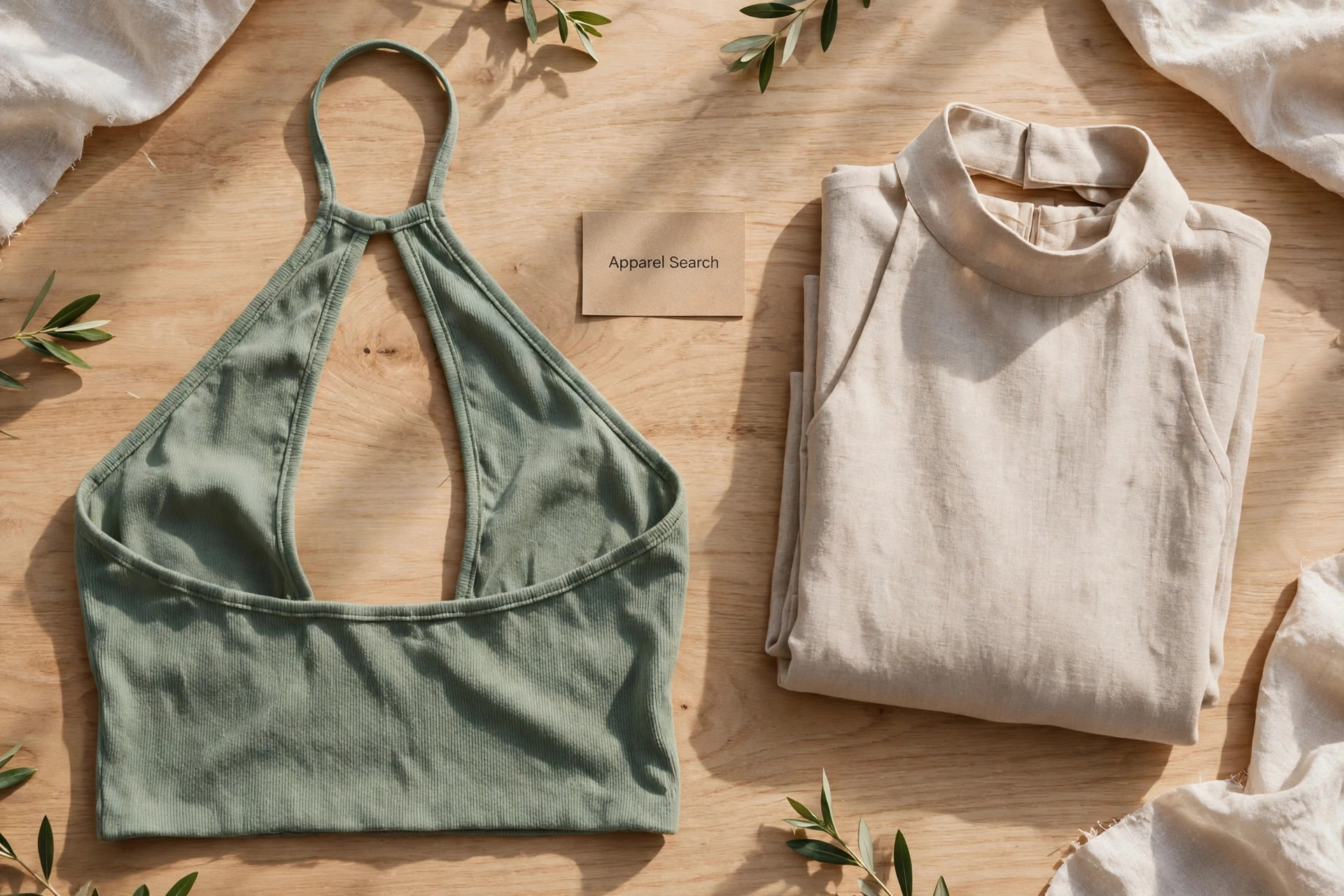
Supported From the Neck, Not the Shoulders
Most sleeveless garments are held up from the shoulders, two straps passing over two shoulder points — the tank top with its two straps, or the spaghetti strap with two thin ones. A halterneck changes the support to a single point: the garment's front is suspended from a strap that passes around the back of the neck, and the shoulders carry nothing at all. That one construction choice produces the halterneck's whole appearance. The shoulder line is completely bare from neck to arm, the upper chest is framed by the converging lines of the strap, and the garment is secured by a strap that may be a continuation of the bodice fabric, a separate band, or ties.
The definition covers two garments. It can refer to a dress — a halterneck dress whose skirt hangs from a neck-strapped bodice — or to a separate shirt called a halter top, a type of sleeveless shirt similar to a tank top. The difference from the tank top is precisely the support: a tank top's straps rest on the shoulders and cross the back, while the halter top's single strap circles the neck and leaves the back open. In fabric and cut the two tops may be nearly identical from the front; from the back, and in how they are held up, they are different garments.

The Open Back and What Goes Underneath
The style's effect is a direct consequence of its structure. Halterneck garments are generally considered more provocative because they leave the back free, exposing the shoulder blades. A conventional strap crosses the back as well as the shoulder, dividing it; the halter strap goes around the neck and the bodice meets, if it meets at all, low on the back, so the back and shoulder blades are presented as one open expanse. That openness is why the halterneck is a warm-weather and evening form: it suits heat, it shows the shoulders and back as the garment's main feature, and it leaves room for up-swept hair and jewelry that ordinary straps would cross.
The same openness governs what can be worn beneath it, since there is nowhere for conventional understructure to hide. If a bra is worn with a halter top, it is generally strapless, as to avoid exposing the back straps of a typical bra. A halter-specific bra with its own neck strap is the other solution, mirroring the outer garment's support — a garment named for holding, held up by a holder around the neck.
Ties and Bathing Suits
Some garments with halternecks may tie at the back of the neck, as is often seen in bathing suits. The tie is the adjustable version of the halter strap: it lets the wearer set the lift and tension of the front herself, it unties for sunbathing without strap marks, and it makes one size of swim top fit a wider range of bodies than a fixed strap would. In swimwear the halter is among the standard bikini-top constructions for exactly those reasons — support from the neck, an open back, and adjustability in a garment with no other fastenings to adjust.
In dresses and tops the strap is more often sewn closed or fastened with a small button or hook, since a tied knot at the nape can press uncomfortably when the wearer leans back against a chair — a consideration a swimsuit, worn reclining rather than sitting in chairs, does not have to weigh as heavily. Whether tied, buttoned or sewn, the strap remains the definition: a halterneck is identified, named and worn by its single strap around the neck.
Common Questions
What is a halterneck?
Halterneck refers to a type of women's clothing with a single strap around the back of the neck instead of straps over each shoulder. It can refer either to a dress or to a separate shirt called a halter top, a sleeveless shirt similar to a tank top.
What do you wear under a halterneck?
If a bra is worn with a halter top, it is generally strapless, so as to avoid exposing the back straps of a typical bra. The halterneck leaves the back and shoulders bare, so ordinary shoulder straps would show.
Why do bathing suits use halternecks?
Some garments with halternecks tie at the back of the neck, as is often seen in bathing suits. The tie lets the wearer adjust the lift and tension of the front, and unties for sunbathing without strap marks.
Where does the word halter come from?
The term halter comes from the German word for holder, as in Büstenhalter, which literally means busts-holder and is equivalent to brassiere. The name describes the strap that holds the garment up from around the neck.