Chain Stitch
Sewing Definitions — the looped stitch that sews fast from a single thread, in seams and in embroidery, from Apparel Search
Search Apparel Search
At a Glance
Definition: Chain stitch is a stitch in sewing and embroidery made as a series of looped stitches that form a chain, used both decoratively, as an embroidery stitch, and constructively, to join fabric.
Category: Sewing Definitions
Chain stitch is a stitch in sewing and embroidery: a series of looped stitches that form a chain. It can be used decoratively or constructively — as embroidery it builds bold lines and filled shapes, and as a machine stitch it joins seams quickly from a single thread. The comparison that defines it is with the lockstitch: a chain stitch is formed from loops, so if a loop is broken and the end pulled, the stitching can unravel along the seam, while a lockstitch, locked between two threads, does not unravel easily. This page covers how the loop is formed by hand and by machine, the stretch and the unravelling that follow from its structure, and its long life as an embroidery stitch.
A Stitch Made of Loops
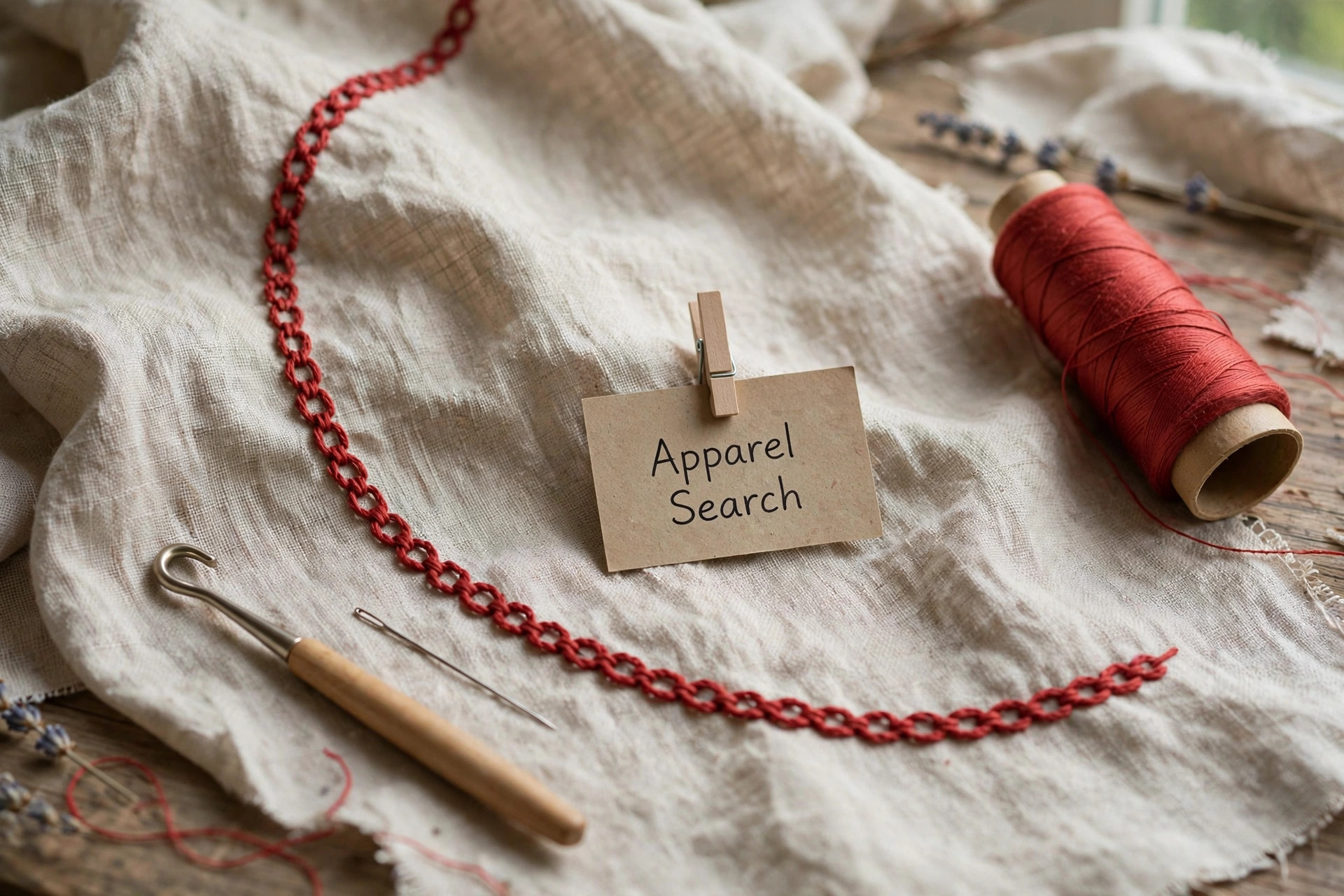
Chain stitch is built on a single repeated action: the thread is drawn through the fabric into a loop, and the next stitch passes through that loop before forming a loop of its own. Hand embroiderers work it with a needle, bringing the thread up, laying a loop on the surface and securing it with a small stitch through its own end, again and again, producing a line that looks like the links of a small chain lying on the cloth. The line has a raised, corded quality that makes it effective for outlines, stems, lettering and, worked in close rows, for filling shapes with texture.
Machine chain stitch follows the same logic with a different mechanism. A looper beneath the fabric catches the needle thread and holds its loop open so the next needle penetration passes through it. Only one thread is needed, fed from a large cone rather than a small bobbin, which is one reason chain stitch machines are valued in factories: they run for long periods without stopping to change a bobbin, and they sew fast. Early sewing machine history is largely a chain stitch history, from the crochet-like hooked needle experiments to Barthelemy Thimonnier's 1830 patented machine, of which 80 were installed in a Paris factory to stitch soldiers' clothing.
Strength, Stretch and Unravelling
The loop structure gives chain stitch two practical characters. First, it has a degree of give: the loops can flex slightly, so chain-stitched seams tolerate a little stretch, a quality used in some knitwear and in the waistband and outseam stitching of jeans, where the roping effect of chain-stitched hems is prized. Second, it can fail all at once. Because each stitch depends on the loop before it, a broken thread and a pull on the loose end can unzip an entire seam, a weakness the lockstitch does not share.
Manufacturers treat that weakness as a feature where opening is the point. Chain stitch closes the tops of feed, flour and cement sacks precisely because a single pull opens them cleanly. In garment production it is also used for temporary construction stitching that will later be removed. Where permanence is essential, chain stitch seams are secured at the ends, and quality garments reserve chain stitch for seams under low stress or where its appearance and speed justify it, keeping lockstitch for the structural joins in the fabric.
Chain Stitch in Embroidery
As decoration, chain stitch is among the oldest and most widespread embroidery stitches, worked in wool, silk and cotton — fiber of every kind — across many traditions, from crewel work to tambour embroidery, where a hook replaces the needle and the chain is formed from beneath the fabric at great speed. Its loops catch light along a line, giving embroidered outlines a soft shadow that a flat stitch lacks.
Variations widen the family: lazy daisy builds single detached chain loops into flower petals, and feathered, twisted and cable chain stitches alter the angle and crossing of the loops while keeping the same looped construction that gives the stitch its name. Whether the chain is sewn by a factory machine or embroidered by hand, the structure is the same — each loop held by the next — and so are its virtues of speed and texture and its one standing weakness, that a pulled end can run the whole line back.
Not to Be Confused With
Not to be confused with lockstitch. Chain stitch is formed from one thread looped through itself, stitch holding stitch in a chain, so if a loop breaks and the loose end is pulled the stitching can unravel along the whole seam. A lockstitch interlocks two separate threads — needle thread and bobbin thread — inside the fabric, and does not unravel easily. Chain stitch is faster and needs no bobbin; lockstitch is the more secure, structural stitch.
Common Questions
What is chain stitch?
Chain stitch is a sewing and embroidery stitch in which a series of looped stitches forms a chain. It can be used decoratively, as an embroidery stitch, or constructively, to join fabric.
How does chain stitch differ from lockstitch?
Chain stitch is formed from one thread looped through itself, so it can unravel if an end is pulled. Lockstitch interlocks two separate threads inside the fabric and does not unravel easily.
Where is machine chain stitch used?
Machine chain stitch is used where speed and thread economy matter, and where easy removal can be an advantage, such as closing feed and flour sacks and basting-like temporary seams in garment production.
Why does a chain stitch machine need no bobbin?
Only one thread is needed, fed from a large cone: a looper beneath the fabric catches the needle thread and holds its loop open so the next needle penetration passes through it. With no bobbin to change, the machine runs for long periods without stopping.