Lockstitch
Sewing Definitions — the two-thread machine stitch that locks in the fabric and does not unravel, from Apparel Search
Search Apparel Search
At a Glance
Definition: The lockstitch is the mechanical stitch most commonly made by a sewing machine, formed when an upper thread and a lower thread wound onto a bobbin lock together in the hole in the fabric through which they pass.
Also known as: Single needle stitching (on dress shirt labels)
Category: Sewing Definitions
The lockstitch is the mechanical stitch most commonly made by a sewing machine. Most home sewing machines are lockstitch machines, although sergers have entered the home market as well. The lockstitch uses two threads, an upper thread and a lower thread wound onto a bobbin. The two threads lock together in the hole in the fabric through which they pass, which is how the stitch gets its name. Unlike chain stitch, lockstitch does not unravel easily, making it difficult to remove. The term single needle stitching on dress shirt labels refers to lockstitch. Two other common kinds of mechanical stitches are overlock and chain stitch. This page covers how the machine forms the stitch, why it holds, where it is used, and its short history. See also the sewing definition, the fabric definition and the fiber definition.
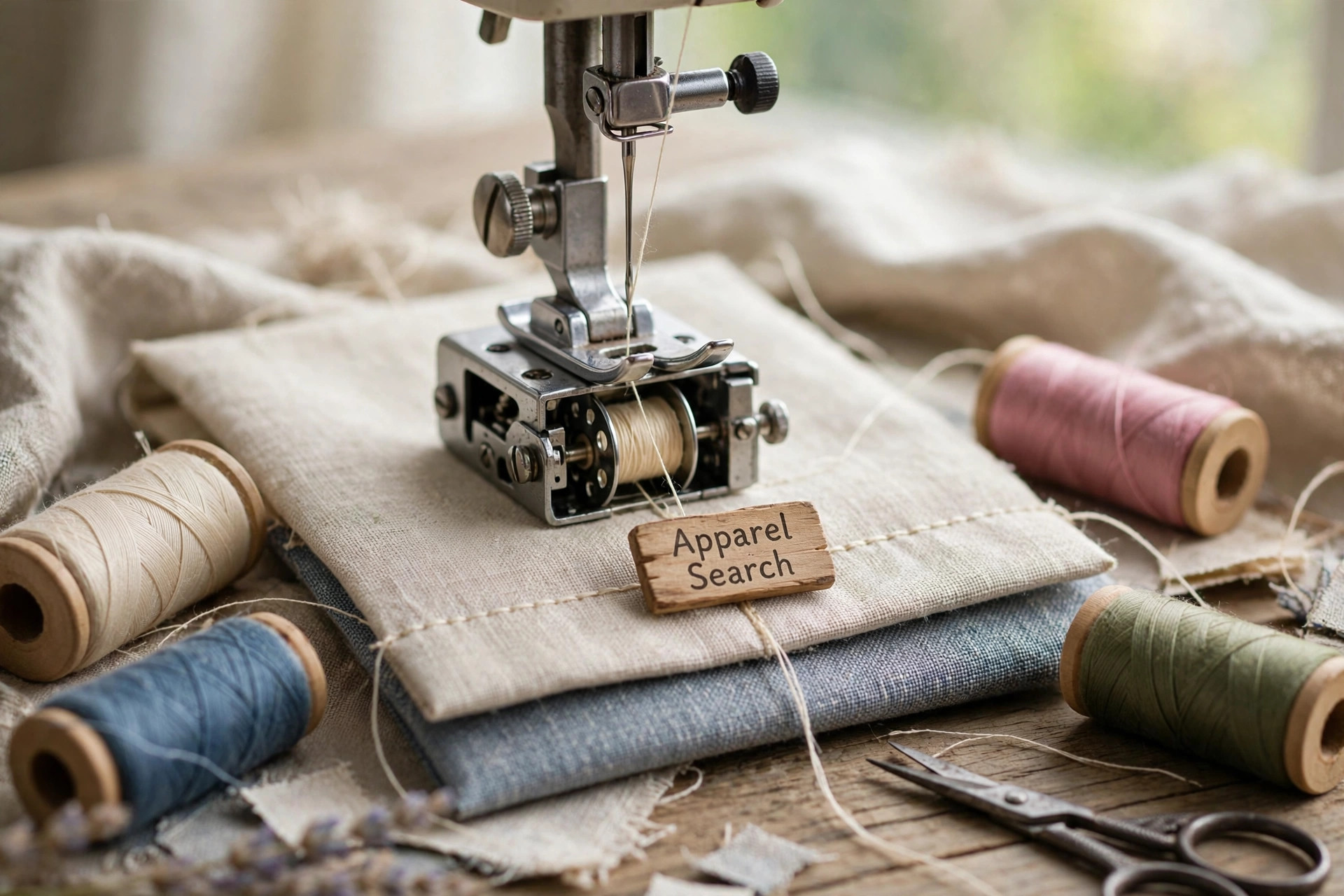
Two Threads, Locked in the Fabric
The upper thread runs from a spool kept on a spindle on top of or next to the machine, through a tension mechanism and a retracting arm, and finally through the hole in the needle. The lower thread is wound onto a bobbin, which is inserted into a case in the lower section of the machine. Neither thread passes right through and out the other side; instead they meet and lock in the middle of the fabric layers, so a balanced lockstitch looks the same on both sides of the seam.
To make one stitch, the machine lowers the needle through the cloth into the lower section, where a hook catches the upper thread at the point just before it goes through the needle. The hook mechanism loops the upper thread entirely around the bobbin case, so that it has made one wrap of the bobbin thread. Then the retracting arm pulls the excess upper thread back to the top of the machine and the feed dogs pull the cloth back one stitch length.
That symmetry is the test of a well-set machine. If the upper tension is too tight, the lock is pulled to the top surface and bobbin thread shows; too loose, and loops of upper thread appear underneath. Correct tension hides the knot of the lock inside the fabric, where it is protected from abrasion. Stitch length, controlled by the feed dogs pulling the cloth back one stitch length after each penetration, is matched to the fabric: short stitches for fine or weak fabrics and curves, longer for heavy materials and topstitching.
Why Lockstitch Does Not Unravel
Lockstitch is so named because the two threads, upper and lower, "lock" together in the hole in the fabric through which they pass. Its great virtue is security. Because every stitch locks independently, cutting the thread in the middle of a seam does not free its neighbours, and unpicking a lockstitch seam is slow work with a seam ripper, stitch by stitch. Unlike chain stitch, lockstitch does not unravel easily, making it difficult to remove.
The costs of the lockstitch are bobbin capacity and a lack of stretch. The bobbin holds a limited length of thread, so long production seams require bobbin changes, and the tight interlock gives a seam almost no elasticity, so lockstitch seams on stretch fabrics are worked with a slight zigzag or on specialised machines when the seam itself must stretch.
In the Factory, at Home, and on the Label
The lockstitch is the stitch the modern garment industry is built on. Of a typical garment factory's sewing machines, half might be lockstitch machines, and the other half divided between overlock machines, chain stitch machines, and various other specialized machines. Most home sewing machines are lockstitch machines, although sergers have entered the home market in the past ten years or so.
Overlock stitching, the serger's stitch, wraps thread around the fabric edge to finish it against fraying and is normally used alongside lockstitch rather than instead of it: lockstitch joins the seam, overlock neatening protects its edges. The quality signal survives on labels: the term single needle stitching, often found on dress shirt labels, refers to lockstitch, as opposed to chain stitch which unravels easily and is usually used on lower quality garments.
A Short History in the Machine
The lockstitch machine was the breakthrough that made machine sewing practical. Walter Hunt first developed a lockstitch machine in 1834 using an eye-pointed needle carrying the upper thread and a shuttle carrying the lower thread, but did not patent it. Elias Howe patented his version in 1846 and eventually won the right to claim royalties from manufacturers using his patent. Isaac Singer's improvements — a vertical needle, a presser foot to hold the cloth and a basic tensioning system — turned the lockstitch principle into the recognisable sewing machine, and the same two-thread lock remains the default stitch of home and factory machines today.
Not to Be Confused With
Not to be confused with chain stitch. A lockstitch interlocks two threads — an upper thread and a bobbin thread — inside the fabric at every stitch, so each stitch is secured independently and the seam does not unravel easily. A chain stitch is formed from looped thread that can be pulled out from the end and unravels easily, which is why it is usually used on lower quality garments. See the chain stitch definition.
Common Questions
What is a lockstitch?
A lockstitch is the mechanical stitch most commonly made by a sewing machine, formed when an upper thread and a lower bobbin thread lock together in the hole in the fabric through which they pass.
How does a machine form a lockstitch?
The needle lowers through the cloth, a hook catches the upper thread just before it goes through the needle and loops it entirely around the bobbin case, wrapping it once around the bobbin thread; the retracting arm then pulls the excess upper thread back and the feed dogs advance the cloth one stitch length.
Why does lockstitch not unravel?
The two threads interlock inside the fabric at every stitch, so each stitch is secured independently. Unlike chain stitch, a lockstitch seam does not run back and unravel when one thread is pulled.
What does single needle stitching mean on a shirt label?
The term single needle stitching, often found on dress shirt labels, refers to lockstitch — tailoring done on single-needle lockstitch machines, as opposed to chain stitch, which unravels easily and is usually used on lower quality garments.