Overlock Stitch
Sewing Definitions — the looper stitch that seams, trims and finishes an edge in one pass, from Apparel Search
Search Apparel Search
At a Glance
Definition: An overlock stitch is the stitch of an overlock sewing machine, which sews and hems a seam and cuts off the leftover cloth in one operation, its loopers wrapping thread around the cut edge.
Category: Sewing Definitions
An overlock sewing machine sews and hems seams and cuts off the leftover cloth in one operation. As the fabric feeds through, loopers wrap thread around the cut edge while needles stitch the seam, and a knife trims the excess just ahead of the stitching, so the finished seam is joined, neatened and trimmed at once. A coverlock can do hems in the middle of a cloth by having the detachable knife removed. Overlock stitching is the standard edge finish of modern ready-to-wear clothing, most visible inside T-shirts and knit garments. For other sewing-machine stitches see lockstitch. This page covers how the stitch is formed, its work in the factory and at home, and the coverlock variation. See also the sewing definition, sewing machinery, the fabric definition and the fiber definition.
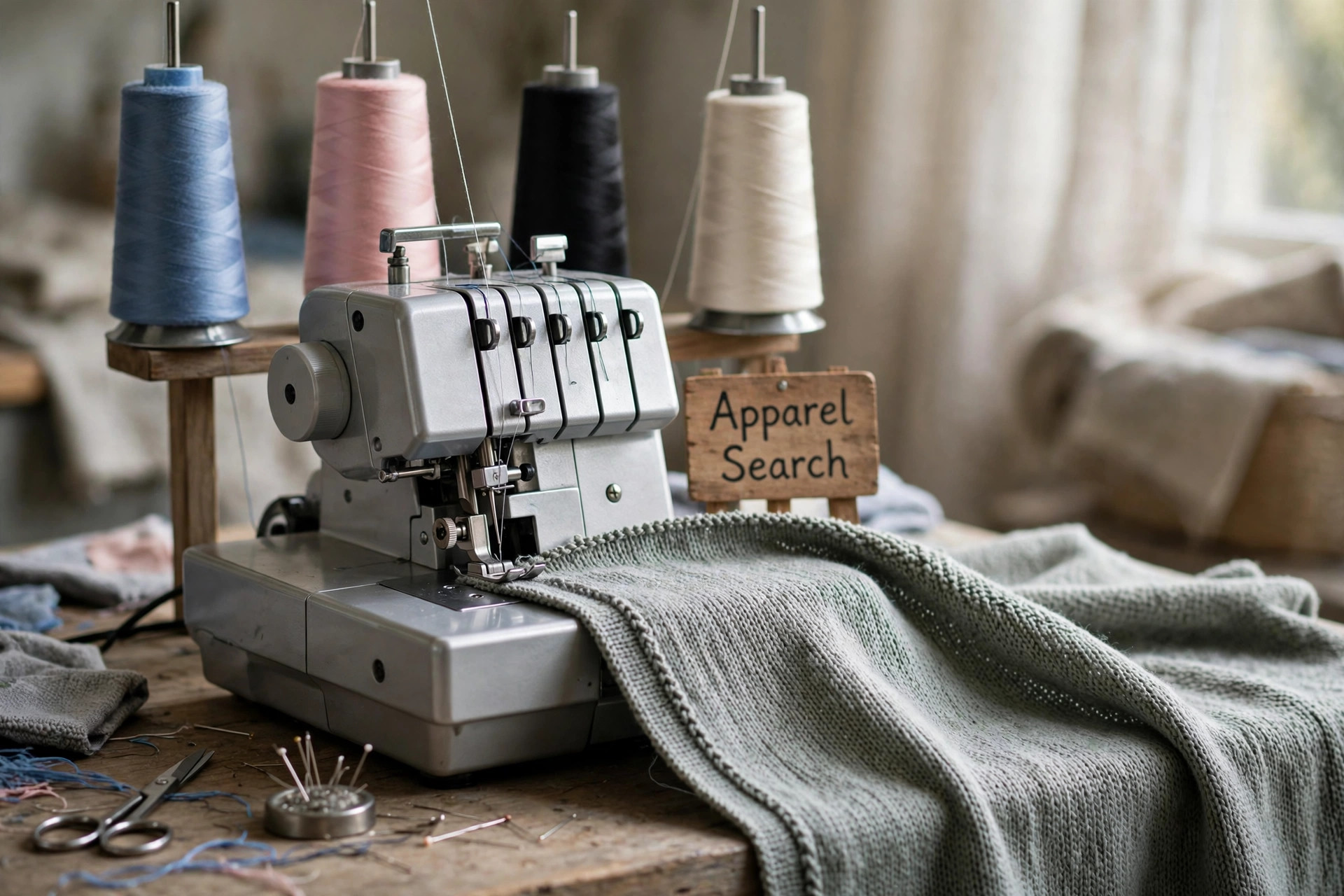
Seaming, Trimming and Finishing in One Pass
The overlock machine, widely known in home sewing as a serger, does three jobs simultaneously that a lockstitch machine does separately or not at all. Fabric enters under the presser foot; a knife, positioned just before the needles, trims the edge to a clean, exact line; needles and loopers then form stitches that pass through the fabric and loop around its freshly cut edge. The seam that emerges is joined, its allowance is trimmed to a uniform width, and its raw edge is wrapped in thread so it cannot fray. Inside almost any modern T-shirt, sweatshirt or pair of leggings, that wrapped, slightly springy seam is overlock work.
Loopers, Thread Counts and Built-In Stretch
The stitch is formed mainly by loopers rather than a bobbin. Overlock machines have no bobbin; instead, upper and lower loopers carry threads around the edge and interloop them with the needle threads. Machines are described by their thread count: a three-thread overlock gives a standard edge finish, a four-thread adds a second needle for a stronger seam with a safety stitch line, and simpler two-thread and rolled-hem settings produce narrow finishes for lightweight fabrics and decorative edges.
Because the threads loop rather than lock tightly, an overlock seam has built-in stretch, which is why overlock became the standard construction stitch for knitwear: the seam can extend and recover with the fabric instead of snapping its stitches. That is the core contrast with lockstitch, which interlocks two threads inside the fabric to join a seam and does not finish the raw edge.
Overlock in the Factory and at Home
In garment factories the overlock machine is a production staple, dividing work with the lockstitch machine roughly evenly across a typical factory floor. Lockstitch handles flat, precise seams and topstitching; overlock handles the fast joining and finishing of panels, especially in knits and in the inside seams of woven garments, where a separate seam and a separate edge finish would double the handling. Specialised overlock variants attach elastic, sew mock safety stitches on shirts and jeans, and finish the edges of everything from lingerie to upholstery.
Home sewers adopted the overlocker, as the serger, later, and it changed home dressmaking in one specific way: knit fabrics became easy to sew professionally. A home overlock machine seams, trims and finishes a jersey seam in seconds, with the same inside appearance as bought clothing. Threading several loopers is more involved than threading a lockstitch machine, and the knife that makes the finish so neat also removes any margin for error, since excess cloth is cut away as the seam is sewn. Patterns for overlock construction therefore allow narrower seam allowances than lockstitch patterns.
The Coverlock Variation
The coverlock extends the family from edges to hems. A coverlock can do hems in the middle of a cloth, away from any edge, by having the detachable knife removed: nothing needs trimming in the middle of a hem, so the machine simply lays its covering stitches, the parallel lines of topstitching with looper thread beneath that finish the hems of T-shirts and activewear. Combination machines switch between overlock and coverlock functions. Together, overlock and lockstitch account for the great majority of seams in modern clothing.
Common Questions
What does an overlock machine do?
An overlock sewing machine sews a seam, hems it and cuts off the leftover cloth in one pass. Its loopers wrap thread around the trimmed edge so the seam is joined and finished against fraying at the same time.
What is a coverlock?
A coverlock is a related machine that can do hems in the middle of a cloth, away from the edge, by having the detachable knife removed so nothing is trimmed while the hem is stitched.
How does overlock differ from lockstitch?
Lockstitch interlocks two threads inside the fabric to join a seam and does not finish the raw edge. Overlock uses loopers and several threads to stitch over the edge itself, trimming and enclosing it, and its looped structure gives seams some stretch.
Why is overlock the standard stitch for knitwear?
Because the threads loop rather than lock tightly, an overlock seam has built-in stretch: it can extend and recover with a knit fabric instead of snapping its stitches, while its wrapped edge cannot fray.