Distribution
Shipping & Freight Definitions — the marketing-mix decisions that get a product to the customer, from channel choice to filling the pipeline, from Apparel Search
Search Apparel Search
At a Glance
Definition: Distribution is one of the four parts of the marketing mix, alongside product management, pricing and promotion; it deals with logistics — how to get the product or service to the customer.
Category: Miscellaneous Definitions
Distribution is one of the four aspects of marketing. The other three parts of the marketing mix are product management, pricing and promotion. Distribution deals with logistics: how to get the product or service to the customer. That short definition opens into a long list of decisions — what kind of channel to use, whether to sell through a retailer or through wholesale, how widely the product should be available, who should control the channel, and what it costs to keep stock on shelves and in channel warehouses. This page works through those questions, with clothing as the working example, and ends with the physical side: moving and holding the goods themselves.
The Questions Every Distribution Plan Must Answer
A business planning distribution must decide what kind of distribution channel to use, and whether the product should be sold through a retailer or distributed through wholesale. It must consider whether multi-level marketing channels should be used, and how long the channel should be — how many members stand between maker and buyer. It must decide where the product or service should be available, and when it should be available, and whether distribution should be exclusive, selective or extensive. Behind those market-facing choices sit organisational ones: who should control the channel, whether channel relationships should be informal or contractual, whether channel members should share advertising, and whether electronic methods of distribution should be used.
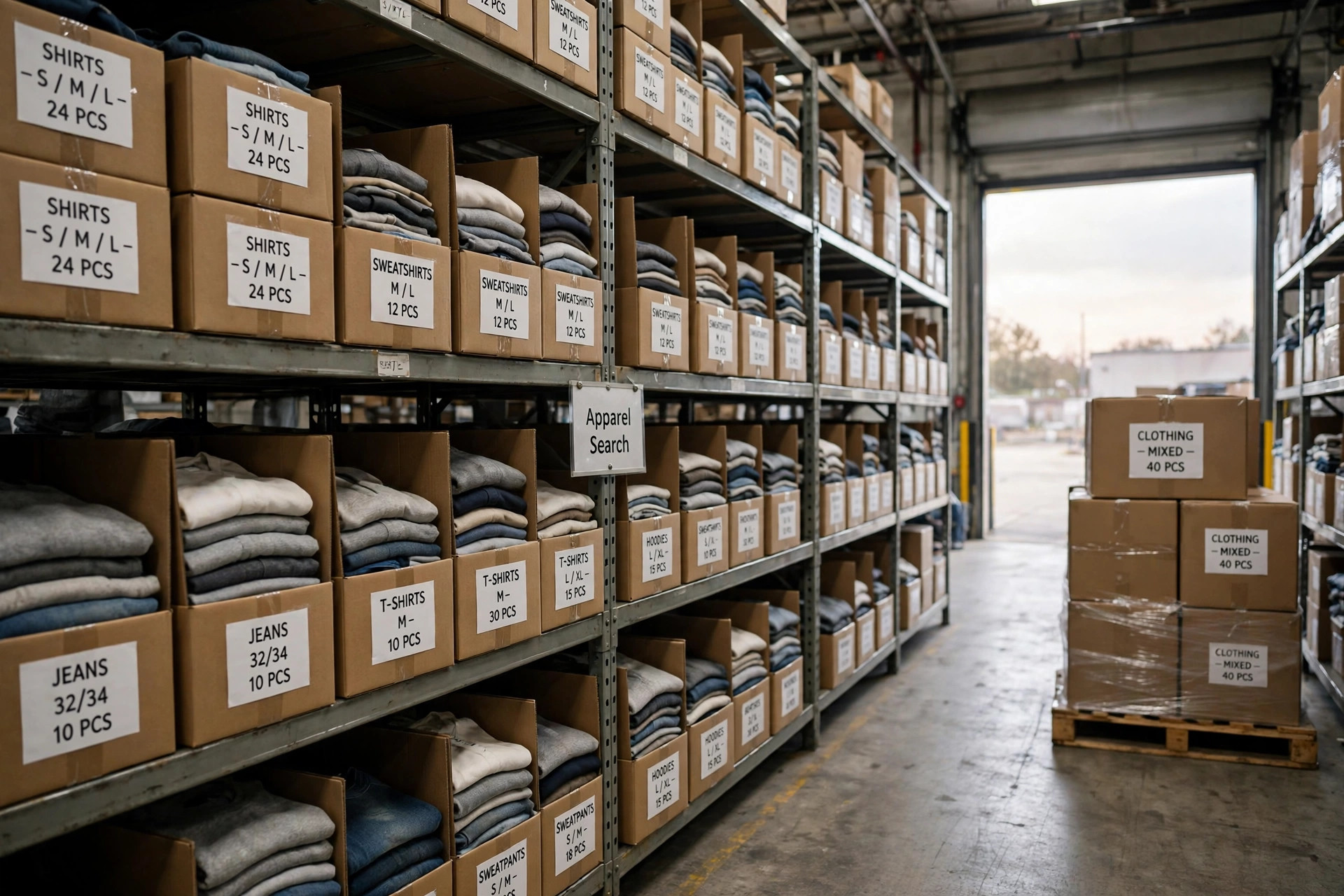
Finally there are the physical distribution and logistical issues: garments, like any goods, must be stored, moved and replenished, whether they travel by ship or by road. A business must weigh what it will cost to keep an inventory of products on store shelves and in channel warehouses — referred to as filling the pipeline — so stock is present when a customer is ready to buy, without tying up more money in inventory than the sales justify. The movement side of the same system is covered under supply chain and cross docking.
Choosing a Distribution Channel for Clothing
A clothing brand makes the same channel decisions in a very concrete form. Selling through a retailer puts the garment in front of shoppers who already trust that store, but the retailer controls the shelf, the presentation and much of the customer relationship. Selling through wholesale adds an intermediary who can place the line with many retailers at once, widening reach while adding another margin to the final price. A short channel, with few members between maker and buyer, keeps more control and more margin with the brand but requires the brand to handle sales, warehousing and delivery itself. A longer channel spreads that work across specialists, which can be the only practical way for a small label to reach stores in several regions.
Availability decisions are just as important as channel length. Exclusive distribution, where only one retailer in an area carries a line, protects a premium image and gives that retailer a reason to promote the brand. Selective distribution uses a limited number of outlets that fit the brand. Extensive distribution puts the product in as many suitable outlets as possible, which suits everyday basics where convenience drives the purchase. None of these is automatically better: the right choice depends on whether the garment is bought on image, on fit and service, or on simple availability and price.
Who Controls the Channel, and How Members Work Together
Every channel needs a channel captain — the member who controls the channel and coordinates the others. In apparel that role often falls to a large retailer that can set delivery windows, packaging rules and replenishment terms, or to a strong brand whose name draws shoppers into any store that carries it. Control matters because the members have different interests: a retailer wants stock that turns quickly, a wholesaler wants volume, and a maker wants its full range represented, not only the best sellers.
Whether relationships are informal or contractual changes how those interests are handled. An informal arrangement is flexible and fast to change, but it leaves questions of returns, markdown support and exclusivity unanswered until a dispute arises. A contract can settle delivery standards, payment terms and who pays for shared advertising. Co-op ads, where channel members share advertising, are a common middle ground: the brand supplies images and part of the cost, the retailer supplies local reach, and both benefit from a campaign neither would fund as effectively alone. Clear agreements on these points keep a working channel from breaking down over a single late or incomplete delivery.
Physical Distribution, Inventory and Electronic Channels
Physical distribution is where a good channel plan can still fail. Garments must be stored, picked, packed and moved so that the right sizes and colours arrive at the right store at the right time, often through a distribution center that receives, sorts and despatches stock for many outlets. Seasonal fashion makes that timing sharp: a delivery that misses its selling window may only be saleable at a markdown. Warehouses in the channel hold buffer stock, but every carton held is money tied up in inventory, which is why the cost of filling the pipeline has to be weighed against the cost of empty shelves and lost sales.
Electronic methods of distribution add a direct route alongside stores. A brand can sell from its own website, supply online retailers, or use electronic ordering to replenish stores faster and with fewer errors. Electronic sales also generate information about which sizes, colours and styles are actually selling, which improves the next round of production and allocation decisions. For apparel businesses the strongest systems usually combine both routes: stores provide fitting, service and immediate purchase, while electronic distribution extends reach, fills gaps in local stock and keeps the pipeline visible from factory to final customer.
Common Questions
What are the four parts of the marketing mix?
Distribution is one of the four aspects of marketing, and the other three parts of the marketing mix are product management, pricing and promotion. Distribution is the part that deals with logistics and with how the product or service reaches the customer.
What does exclusive, selective and extensive distribution mean?
Exclusive distribution means only one retailer in an area carries a line, selective distribution uses a limited number of outlets that fit the brand, and extensive distribution puts the product in as many suitable outlets as possible. The choice, along with where and when the product is available and how long the channel is, determines how widely customers can find and buy it.
What is filling the pipeline in distribution?
Filling the pipeline refers to keeping an inventory of products on store shelves and in channel warehouses. It is one of the physical distribution and logistical issues a business must deal with, including what it will cost to hold that stock through the channel.
What is a channel captain?
The channel captain is the member who controls the channel and coordinates the others. In apparel that is often a large retailer that can set delivery windows and replenishment terms, or a strong brand whose name draws shoppers into the stores that carry it.