Women's Design Examples 2
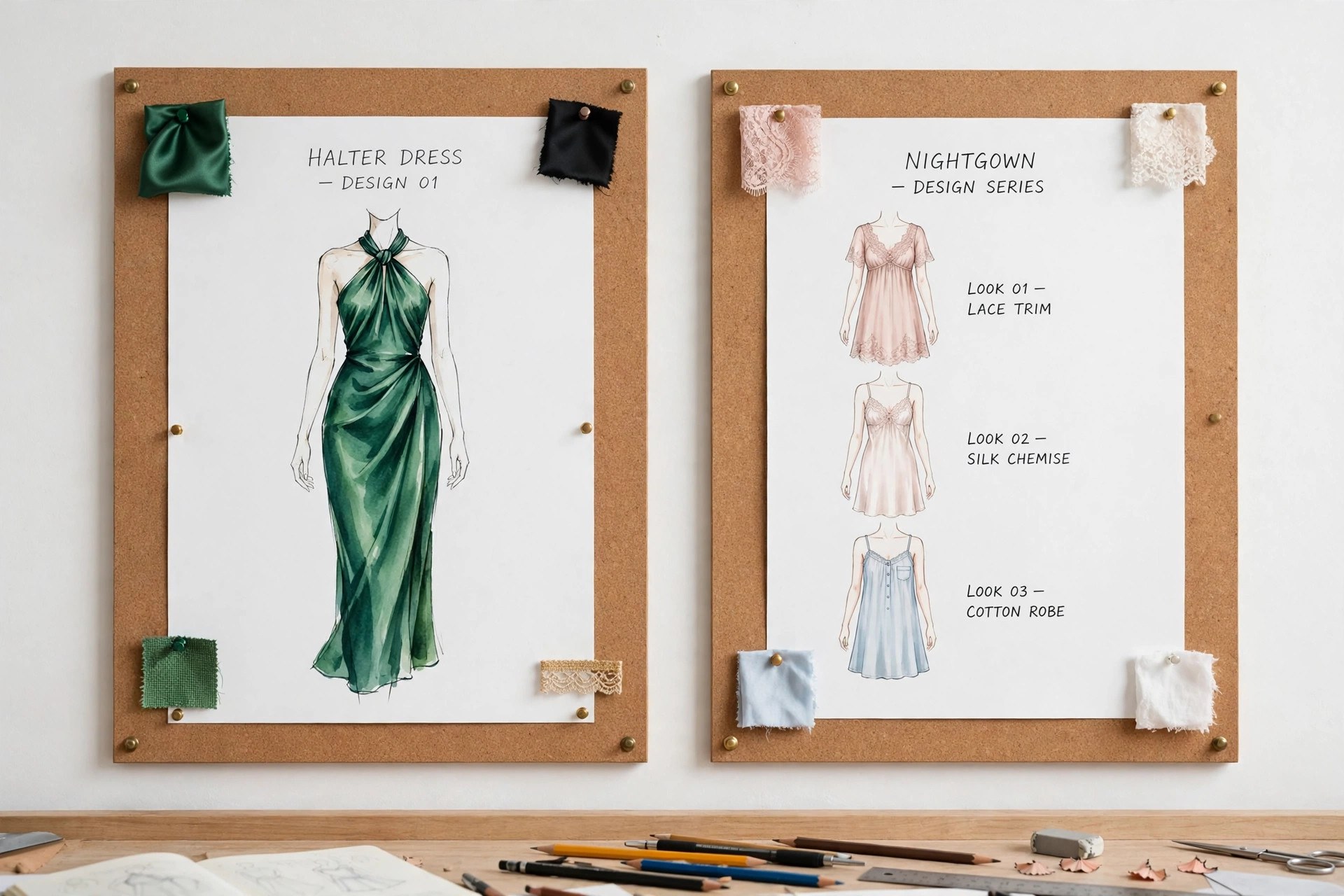
A few examples more: the second set of women’s design artwork from the Apparel Search Design Studio — a halter dress and nightgowns, each drawn as a finished presentation piece and shown full size on its own page.
The Examples
Two finished pieces of women’s design artwork make up this second set of examples. Each opens on its own page at full size.
Halter Dress
A full-size halter dress design artwork: the dress drawn complete, so its neckline, fit and styling can be judged as a finished presentation piece.
Nightgown
A full-size nightgown design artwork: sleepwear styles drawn as finished garments, with their necklines, lengths and trims readable at working size.
A Few Examples, Shown at Full Size
Example pages exist because design artwork cannot be judged from a thumbnail. A presentation drawing carries its value in its finish: the fall of a skirt, the set of a neckline, the way trims and details are placed. Reduced to a small preview, all of that flattens into a vague shape, and one studio’s work looks much like another’s. So each example in this set is shown the way it was made to be seen — complete, on its own page, at full size — and this index page does the one job an index should do, which is to put the two examples directly in front of the reader at the top.
The two pieces were chosen to show range rather than repetition. The Halter Dress is occasion dressing: a single striking garment whose whole effect rests on its neckline and fit. The Nightgown artwork is sleepwear: softer garments, drawn as a group of styles, where comfort, fabric and trim carry the design. A studio that can present both ends of a women’s wardrobe — the dress a customer wears out and the garments she wears at home — can be briefed on a whole season instead of a single category.
What a Finished Example Shows
A finished example shows more than a garment idea. It shows the hand of the studio: consistent line, believable fabric behavior, styling that supports the garment instead of decorating over it, and the small decisions — a strap’s width, a hem’s depth, a trim’s placement — already resolved on the page. Those resolved details are what a client is really buying, because they are what separate a presentation that can go straight into a range plan, a catalog or a sales meeting from a sketch that still needs a designer in the room to explain it.
Examples also set the terms of a commission honestly. A company planning women’s styles can point to the piece closest to the work it needs — a single hero garment like the halter dress, or a grouped set of related styles like the nightgowns — and the conversation about scope begins from finished work rather than from descriptions. The main Women’s Fashion Design page sets out the services behind the artwork, including the technical drawings and renderings that turn a presentation piece into a producible garment, and the Women’s Fashion glossary entry covers the terminology the examples use.
The Studio Behind the Examples
Both examples come from the Apparel Search Design Studio, the design arm of Apparel Search, whose work covers women’s, men’s and children’s clothing and the graphics the garment industry runs on — labels, hangtags, prints, patterns and presentation boards alongside the garment artwork itself. The studio hub page gathers the whole service, and the women’s landing page gathers the women’s side of it: service menu, further examples and the route to service details and pricing.
Read together, the two sets of examples make one point from four pieces of artwork: presentation drawing is a production skill, not only an artistic one. The drawings are made to be scanned, printed, pinned to boards and worked from, at the sizes the industry actually uses. That is why they are shown here at full size, in the open, rather than described — the artwork is the evidence, and it is left to speak at the size it was drawn.
The first set of examples, sampled on the women’s landing page, shows the studio’s illustration range in a different way again: a black-and-white ensemble, a handpainted piece and a bag illustration, each a thumbnail that opens at full size. Between the two sets, a prospective client can see garment presentation, textile painting and accessory illustration side by side, which is the realistic shape of a women’s design commission.
Common Questions
Which examples are in this second set?
Two pieces of women's design artwork: a halter dress, shown full size on its own page, and nightgowns - a grouped set of sleepwear styles, also shown full size on its own page.
Why does each example have its own page?
Presentation artwork is judged by its finish - line, fabric behavior and detail placement - which a small thumbnail flattens. Each example is therefore shown complete and at full size.
Where are the studio's women's services described?
On the Women's Fashion Design page, which lists the partial service menu - technical drawings and renderings, conceptboards and product art direction - and routes to full service details and pricing.
More to Explore
The examples and the pages behind them:
Looking for Design Services?
The Apparel Search Design Studio is a full-service fashion industry design resource. This page indexes its second set of women’s examples; the Women’s Fashion Design page lists the services behind the artwork, and the Recent Projects page shows other finished studio work.