Apparel Search Consumer Guides
Dresses for Tall Women
Waist placement for a long torso, hem lengths in inches, and maxis that are actually maxi.
A dress is a single garment asked to fit two bodies at once: the torso above the waist and the legs below it. On a tall frame those two halves are both longer than the standard pattern assumes, which is why dresses are the category tall women find least forgiving — and why the fix is so satisfying when the proportions are right. This guide, part of our tall women's fashion guide, takes the two specifications in order: where the waist sits, and where the hem lands.
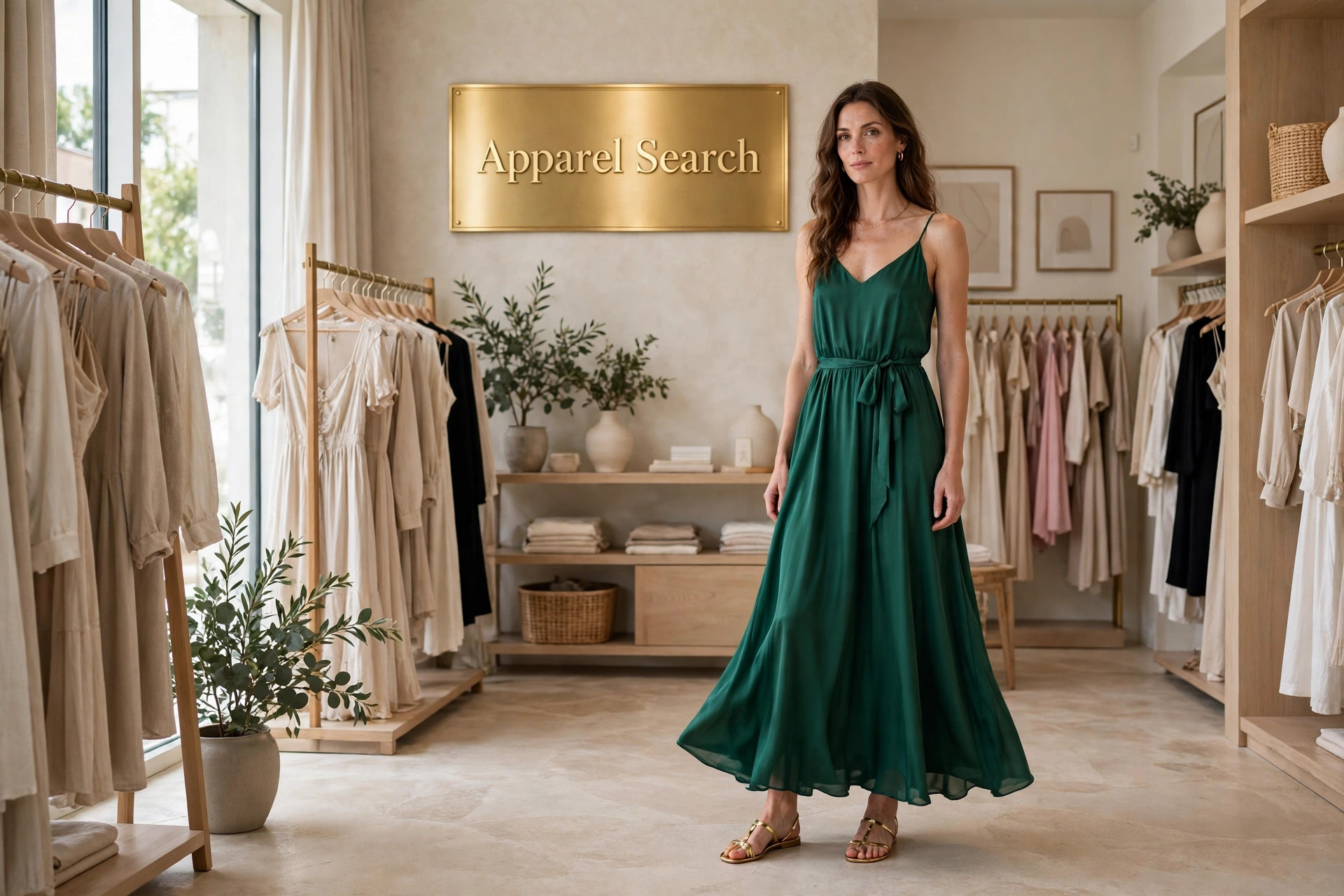
Waist Placement: The Torso Question
Every fitted dress is built around a waist seam positioned for a standard back length — roughly 16 to 17 inches from neck to waist. A tall torso commonly measures 18 to 19. The difference sounds small and looks enormous: the dress's narrowest point rides up to the ribcage, the skirt begins too early and ends too soon, and a belt, if the dress has one, circles the wrong landmark entirely. Fit-and-flare styles show it most; wrap dresses forgive it best, because their waist is tied where you choose it. When a size chart offers a back-waist or shoulder-to-waist measurement, that number — not the size letter — is the one that predicts your dress.
Styles sort themselves by how much the waist position matters. Shift, trapeze and column dresses carry no fixed waist and fit tall torsos gracefully off the rack. Empire lines are designed to sit high, so a small rise in placement is invisible. Sheath and fit-and-flare dresses are engineered around the waist seam and are the strongest argument for genuine tall ranges, where the whole bodice is lengthened rather than the skirt alone. Our women's dresses guide covers the silhouettes in full detail.
Hem Lengths: Read Inches, Not Names
Mini, midi and maxi are not measurements; they are intentions, calibrated on a model of standard height. A maxi drafted to sweep the floor at 5'6" finishes at the ankle of a woman of 5'10" — a perfectly nice length that is not the dress she ordered. A midi designed for mid-calf lands at her knee. The defense is arithmetic: most good size charts state the garment's length in inches, measured from the highest point of the shoulder or the back neck. Decide the hem position you want — floor, ankle, mid-calf, knee — measure from your own shoulder to that point on your leg, and buy the dress whose stated length meets your number.
As working figures: a true floor-length maxi on a tall frame generally needs 60 inches or more of garment length; an ankle-length dress, about 56 to 58; a genuine mid-calf midi, 47 to 50. When a dress you love runs a few inches short of its promise, wear the result deliberately — an ankle-length "maxi" styled as an ankle dress, with the shoes chosen for it, reads as intention rather than error.
Details That Scale
Length hides in the details as well. Sleeve lengths on dresses follow the same standard arm as everything else, so check them on three-quarter and long-sleeved styles. Buttons, pockets and design lines are placed by the torso: a hip pocket that sits at your waist is the pattern confessing its proportions. Necklines drop differently on a longer frame, generally to your advantage. And prints scale up gracefully on tall figures — a larger motif that would overwhelm a smaller frame sits in proportion on yours, one of the genuine pleasures of the tall silhouette.
The Two-Measurement Rule
For any dress bought online, take two numbers from the size chart before the size itself: back-waist length (does the bodice match your torso?) and total garment length (does the hem land where its name claims?). A dress that passes both tests almost never disappoints; a dress that fails either will not be saved by sizing up.
Shop Dresses for Tall Women on Amazon
Ready to shop? Product links are kept in one place on the Apparel Search shopping guide:
Shop Clothing on AmazonThis link opens the Apparel Search shopping guide for Amazon, where the product links are kept in one place.
Common Questions
Why do dress waists always sit too high on me?
Because the bodice is patterned to a standard back-waist length of about 16–17 inches, and a tall torso is commonly 18–19 inches. The waist seam lands where the pattern put it — above your natural waist. Tall ranges lengthen the bodice itself; wrap, shift and empire styles are the standard-size designs that work around the issue.
How long should a maxi dress be for a tall woman?
For a true floor-sweeping maxi, look for a stated garment length of about 60 inches or more, measured from the back neck or shoulder point. Ankle length is roughly 56–58 inches. Always compare the chart's length figure to a measurement from your own shoulder to the point where you want the hem.
Which dress styles suit tall women best?
Any style whose proportions you can verify: column and shift dresses (no fixed waist to miss), wrap dresses (the waist ties where you place it), and genuine tall-range fitted dresses. Long lines, larger-scale prints and strong vertical details all sit in natural proportion on a tall frame.
Can a tailor lengthen a dress that is too short?
Only by the hem allowance, usually one to two inches, and sometimes by adding a contrasting band or lace trim at the hem as a design feature. Waist placement cannot be moved at all. Dresses are the category where buying the tall specification beats altering the standard one.
Back to the Tall Women's Fashion Guide
Inseams, rises, torso and sleeve — dressing tall by specification, not by luck.