Apparel Search Consumer Guides
Tall Women's Jeans & Pants
Inseams of 32 inches and beyond, rises that keep up, and knees that break where knees are.
Jeans and trousers are where tall dressing is won or lost, because bottoms are the one category where length is a printed number rather than a hope. This guide — part of our tall women's fashion guide — covers the three specifications that decide everything: the inseam, the rise that must grow with it, and the knee placement most shoppers never think to check. Get those three right and the rest of the fit conversation is just style.
Inseams: The Number That Matters
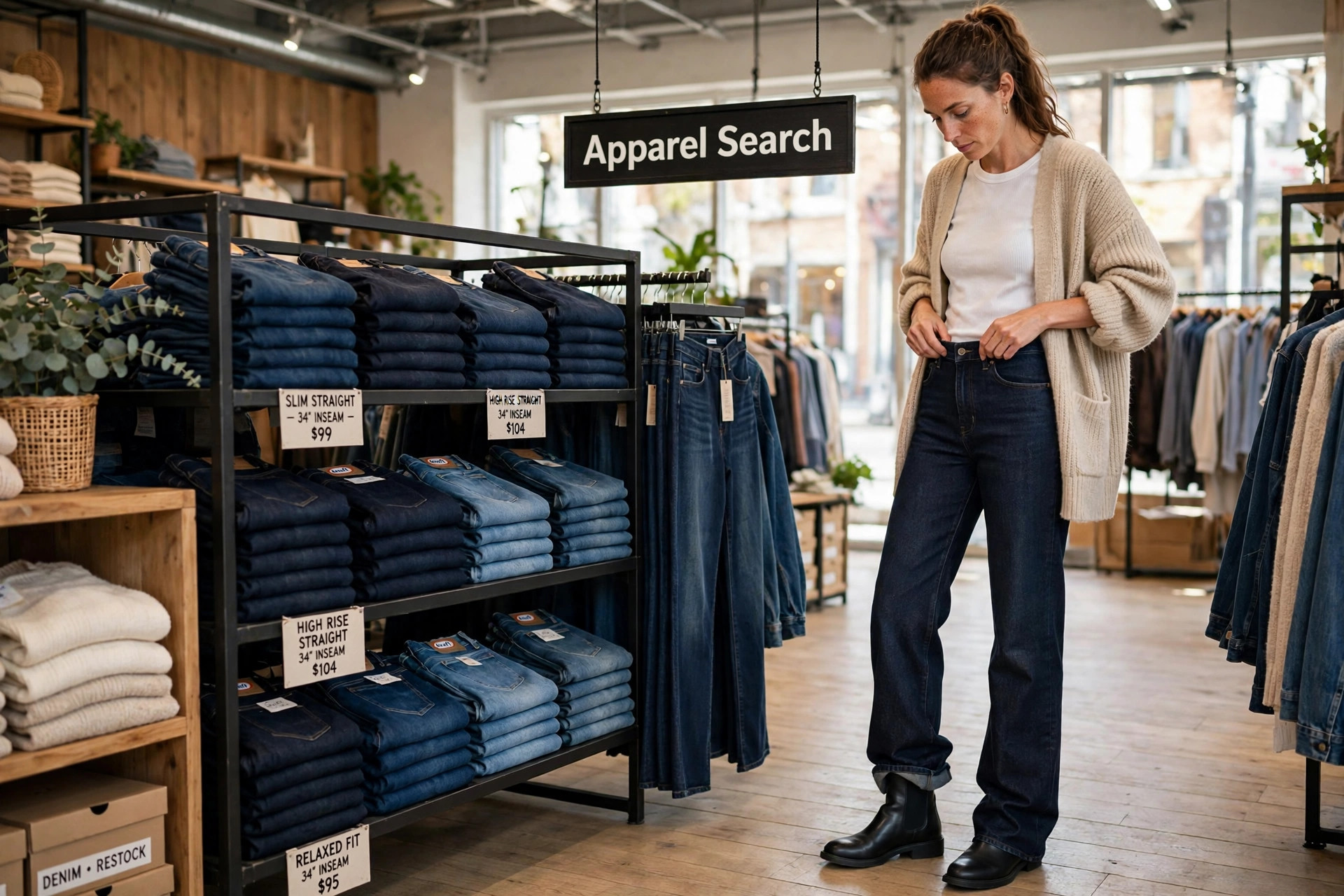
The inseam is the measurement from the crotch seam to the hem, and it is the most honest number in women's clothing. Standard women's trousers are commonly cut at 30 to 32 inches. Tall ranges run 34 to 36 inches, and some reach 38. For a full-length trouser that breaks over a shoe, most tall women need at least a 34; for wide-leg and flared styles, which are designed to pool near the floor, 35 to 36 is the realistic starting point. Our women's jeans guide covers cuts, rises and washes in full; the tall shopper's addition is simply to shop the inseam column of the size chart before the style pages.
Two cautions belong with the number. First, inseam labels are nominal: two brands' "34" can differ by half an inch, so measure a pair you own that fits the way you like and treat that as your personal standard. Second, shrinkage is theft: an unwashed 34 can become a 33, which on a tall leg is the difference between full-length and accidental-cropped. Buy with a half inch of grace where the style allows it.
Rise: The Measurement That Must Grow Too
Rise is the distance from the front waistband, through the crotch, to the back waistband — and it is the silent partner of the inseam. When a brand merely adds inches to the leg of a standard pattern, the rise stays standard, and the result is a trouser whose waistband sits lower than designed, whose seat pulls, and which feels wrong in a way shoppers blame on their bodies. True tall patterns add roughly half an inch to an inch of rise alongside the inseam. When you compare two pairs with the same inseam, choose the one whose rise reaches your natural waist without strain: that is the pair that will stay comfortable past the first hour.
Where the Knee Break Lands
Trousers are shaped at the knee — a subtle crease, taper or flare positioned for a standard leg. On a longer leg, that shaping arrives early: the crease sits above the knee, a flare starts its sweep too high, and bootcut hems swing at the wrong point. There is no label for knee placement, so judge it standing in front of a mirror: the narrowest or shaped point of the leg should coincide with your actual knee. Straight-leg and wide-leg cuts are the most forgiving, because their lines do not hinge on one shaped point; strongly engineered styles — sculpted skinnies, dramatic flares — are where tall ranges earn their keep. Our women's pants guide walks through the main trouser families and their fits.
Three Checks Before You Commit
- The shoe test. Try bottoms with the shoes you will actually wear. A full-length hem should graze the top of the shoe or break once, softly — not hover above the ankle unless cropped is the intent.
- The sit test. Sit, cross your legs, and bend. The waistband should stay at your waist and the hem should not climb halfway up your calf; movement is where an undersized rise announces itself.
- The intention test. Decide what the length is for. An intentional crop that ends at the narrow of the ankle looks designed; a full-length trouser that ends an inch higher looks borrowed. Both are the same measurement on different garments — only one of them was chosen.
Build the rotation around two or three proven specifications rather than a drawer of near misses: one dark straight jean, one tailored trouser, one wide-leg or flare, each in a verified inseam from a brand whose tall pattern you have tested. Once your numbers are proven, reordering is arithmetic instead of gambling.
Shop Tall Women's Jeans & Pants on Amazon
Ready to shop? Product links are kept in one place on the Apparel Search shopping guide:
Shop Clothing on AmazonThis link opens the Apparel Search shopping guide for Amazon, where the product links are kept in one place.
Common Questions
What inseam do tall women need?
For full-length trousers, most tall women need a 34-inch inseam at minimum, with 35–36 inches for wide-leg and flared styles that are meant to reach the floor. Ankle and cropped styles need proportionally less. The reliable method is to measure the inseam of a pair you own that ends exactly where you like, and shop by that number.
Why do my tall jeans still feel wrong if the inseam is right?
Usually the rise. A long inseam added to a standard-rise pattern leaves the waistband sitting low and the seat pulling. True tall patterns lengthen the rise by about half an inch to an inch as well. Compare the front rise measurement, not just the inseam, when a pair feels off.
Are 'long' jeans the same as tall jeans?
Not quite. 'Long' usually means a standard pattern with a longer inseam — often 34 instead of 32 — while a tall range re-proportions rise and knee placement too. Long versions are a good solution when your only issue is hem length; if rise and knee shaping also miss, look for a genuine tall range.
Can a tailor fix trousers that are too short?
Only within the hem allowance. Most trousers carry one to two inches of hem fabric; letting it all down gains length but can leave a crease line, and jeans with finished hems gain almost nothing. A tailor can do a great deal for waist and taper fit, but inseam has to be bought, not altered in.
Back to the Tall Women's Fashion Guide
Inseams, rises, torso and sleeve — dressing tall by specification, not by luck.