Fashion Designer Lessons
Methods to educate fashion illustrators and designers, in person and online.
Design skill is learned in layers: how to draw the figure, how to drape and pattern a garment, how to sew it, and increasingly, how to do all of that in software. This page collects fashion designer lessons — methods to educate fashion illustrators and designers — led by two online programs that teach working skills lesson by lesson.
Formal education sits alongside the lessons: learn about fashion design schools in the education section, find the best fashion design schools around the world, and locate fashion design classes for high school students. Lessons suit self-directed learners and working designers; schools suit students who want a full program.
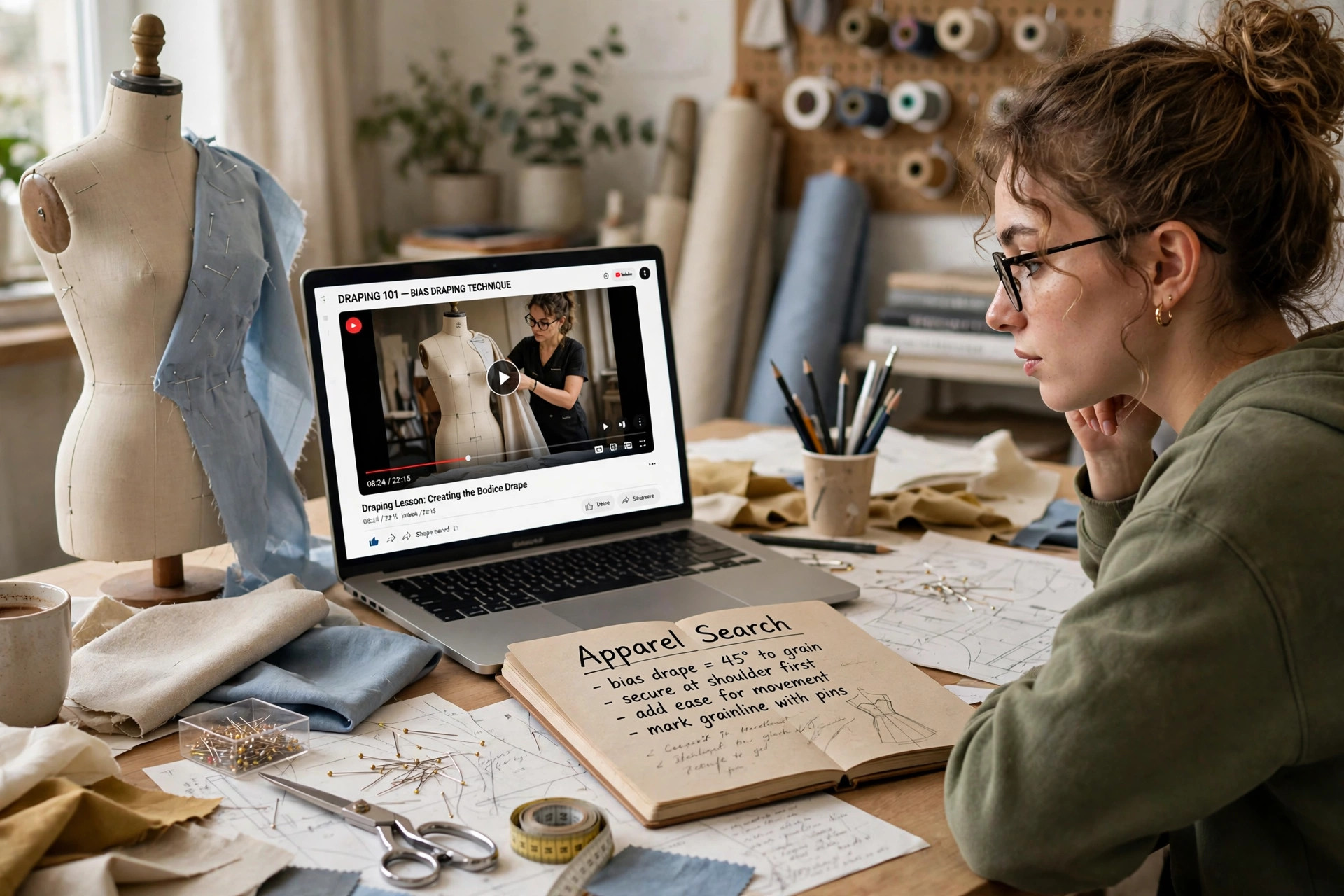
Online Fashion Design Lessons
University of Fashion
University of Fashion is an online library of fashion design video lessons. Taught by fashion school professors and industry professionals, the site offers hundreds of on-demand video tutorials across disciplines including draping, pattern making, sewing, fashion art, knits, childrenswear, CAD, and fashion business.
383 Digital Fashion Design Academy
383 Digital Fashion Design Academy provides online courses in fashion design software. Run by Mikelle Drew-Pellum, a Fashion Institute of Technology professor with over 20 years of industry experience, the academy teaches practical methods for Adobe Illustrator, Photoshop, CLO, and Browzwear tailored to fashion designers.
What the Lessons Cover
The discipline list reads like a design office's workflow. Draping and pattern making turn an idea into a shape; sewing turns the shape into a garment; fashion art presents it; CAD lessons move the same work onto the computer; and fashion business lessons cover the commercial side — costing, lines and selling. A student can enter at the weak point: an illustrator who cannot pattern, a pattern maker who cannot yet work digitally, or a designer who needs the business layer.
Lessons also differ in how they teach. A video library lets a student pause, rewind and repeat a draping demonstration until the hand understands it, and learn in the order a project demands — the pattern lesson this week, the CAD lesson when a job requires it. A structured course adds sequence and accountability: exercises build on each other, and an instructor's method replaces trial and error. Many designers combine both, taking a course for the foundation skill and returning to a lesson library whenever a new technique — a sleeve type, a knit construction, a 3D workflow — appears in their work.
Software lessons deserve a special note, because the tool now shapes the job. A designer fluent in Illustrator produces flats a factory can sew from; a designer fluent in a 3D program such as CLO can show fit and drape before a sample exists. That is why academies teach the programs as fashion courses, not generic computer classes — every exercise is a garment, a print or a tech pack. Readers weighing a career change can pair the lessons with the Visual Merchandiser Job Description and the other job descriptions in the employment section to see how the skills map to real roles.
Common Questions
Can fashion design be learned online?
Yes. Online libraries now teach the core disciplines — draping, pattern making, sewing, fashion art, knits, childrenswear, CAD and fashion business — through video lessons taught by fashion school professors and industry professionals, and academies teach the design software itself course by course.
What software do online fashion courses teach?
383 Digital Fashion Design Academy, for example, teaches practical methods for Adobe Illustrator, Photoshop, CLO and Browzwear, tailored to fashion designers — the tools used for flats, presentation, and 3D garment visualization.
How do lessons compare with fashion school?
Lessons and courses build specific skills on your own schedule and suit working designers adding a tool or technique. A degree program adds structure, critique, facilities and credentials; the fashion design schools directories linked below help compare the best fashion schools around the world and classes for high school students.