Donna Karan Profiles
The life behind the wardrobe system — New York, Anne Klein, 1985 and DKNY.
Donna Karan is an American fashion designer and the creator of the Donna Karan New York and DKNY clothing labels. Born Donna Faske in New York in 1948, she started early: in 1962 she dropped out of school and started selling clothes at a neighbourhood boutique, and in 1966 she enrolled at the prestigious Parsons School of Design. This profiles page tells her story in order — the boutique counter, the Anne Klein design room, the succession of 1974, and the label of her own that followed in 1985. Of all the pages in this series, this is the one the others depend on.
She married Mark Karan and had a daughter, Gabrielle, nicknamed Gabby; she was divorced in 1983 and married her childhood sweetheart, the sculptor Stephan Weiss. The career, though, begins in earnest in 1968, when she took a summer job with the designer Anne Klein — and was fired a couple of months later, because, as she put it, she was so good that Anne Klein felt insecure with her in the design room. Karan's talent then drew the attention of Patti Cappalli of the label Addenda, under whose tutelage she developed as a designer for 18 months. The biography searches in the references gather the wider coverage; her official website is also linked there.
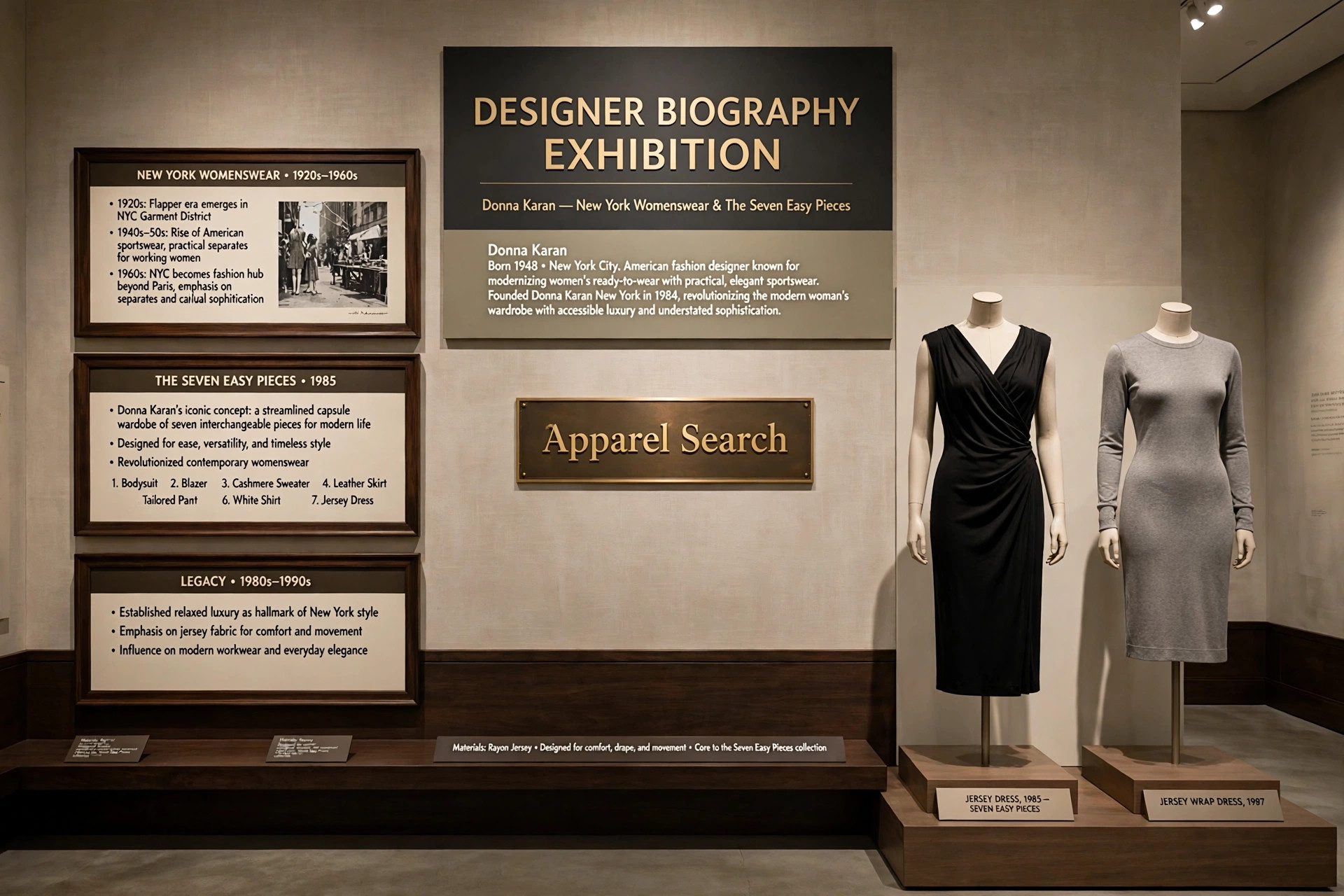
Illustrative image created for this guide — an artistic impression, not this designer's own garments.
News, Photos & VideoCollectionsFall FashionsFashion WeekFootwearNewsProfilesRunwaySpring FashionsSunglassesWomenswear
Anne Klein and the 1974 Succession
In 1970 Donna Karan returned to Anne Klein. In 1974 Anne Klein died of cancer, and Karan completed her unfinished collection — a young designer finishing a famous house's season under the worst possible circumstances, and succeeding. Donna Karan and her Parsons classmate Dell'Olio then made Anne Klein into one of the biggest and most profitable designer sportswear companies in the USA, a decade-long apprenticeship in exactly the discipline her own label would be built on: complete wardrobes of interchangeable, wearable pieces for women with working lives.
In 1985 Donna Karan went solo, and started her own label, the Donna Karan Collection. In 1988 she started a second line, DKNY — Donna Karan New York — taking the same wardrobe thinking to a younger, more accessible register. The collections, fall, spring and womenswear pages in this series file the clothing record of those labels; the footwear and sunglasses pages file the product strands that completed the system.
Chairwoman, Designer and the LVMH Years
In 1997, Donna Karan quit as chief executive of the company, but continued to act as chairwoman and designer in charge of the Donna Karan line. In November 2000, the LVMH fashion group completed the acquisition of both Gabrielle Studio — the company that owned the Donna Karan brand, named after Karan's daughter — and Donna Karan International Inc., for about $400 million and $240 million respectively. LVMH subsequently rearranged the portfolio, discontinuing Donna Karan New York for men and the Signature lines for men and women.
From 2002 on, most of the collection was designed by Peter Speliopoulos, a former Cerruti designer, with Karan contributing subtleties and entire new creations, while the DKNY line was designed by Jane Chung, who had been with Donna Karan since the Anne Klein days. Read with the collections page, the profile completes its arc: the boutique salesgirl of 1962 became the designer who defined how American working women dressed — and built the company that LVMH paid hundreds of millions to own.
Photos

Common Questions
Who is Donna Karan?
Donna Karan, born Donna Faske in New York in 1948, is an American fashion designer and the creator of the Donna Karan New York and DKNY clothing labels, known for building a complete wardrobe system for working women.
How did Donna Karan become a designer?
She enrolled at the Parsons School of Design in 1966, took a summer job with Anne Klein in 1968 and returned to the house in 1970; when Anne Klein died in 1974, Karan completed her unfinished collection and, with her Parsons classmate Dell'Olio, made Anne Klein one of the biggest designer sportswear companies in the USA.
When did she start her own label?
She went solo in 1985 with the Donna Karan Collection, added the DKNY line in 1988, stepped down as chief executive in 1997 while continuing as chairwoman and designer in charge, and saw LVMH complete its acquisition of the brand's owner and of Donna Karan International in November 2000.