Isaac Mizrahi Profiles
The life behind the bright glamour — Brooklyn, couture, Target, and television.
Isaac Mizrahi (born October 14, 1961, in Brooklyn, New York) is the American designer who brought couture polish to American sportswear in the late 1980s, then carried designer fashion to a mass audience with his Target collection. No designer of his generation has had more distinct careers: couturier, documentary star, mass-market pioneer, creative director, television personality and cabaret performer. This profiles page tells them in order: the Parsons training and the 1987 label, the couture decade, and the second act that reached far more wardrobes than the first. Of all the pages in this series, this is the one the others depend on.
The biography searches in the references gather the wider career coverage, and the designer's official website is linked there as well. The collections, runway and news pages in this series file the fashion work the career produced.
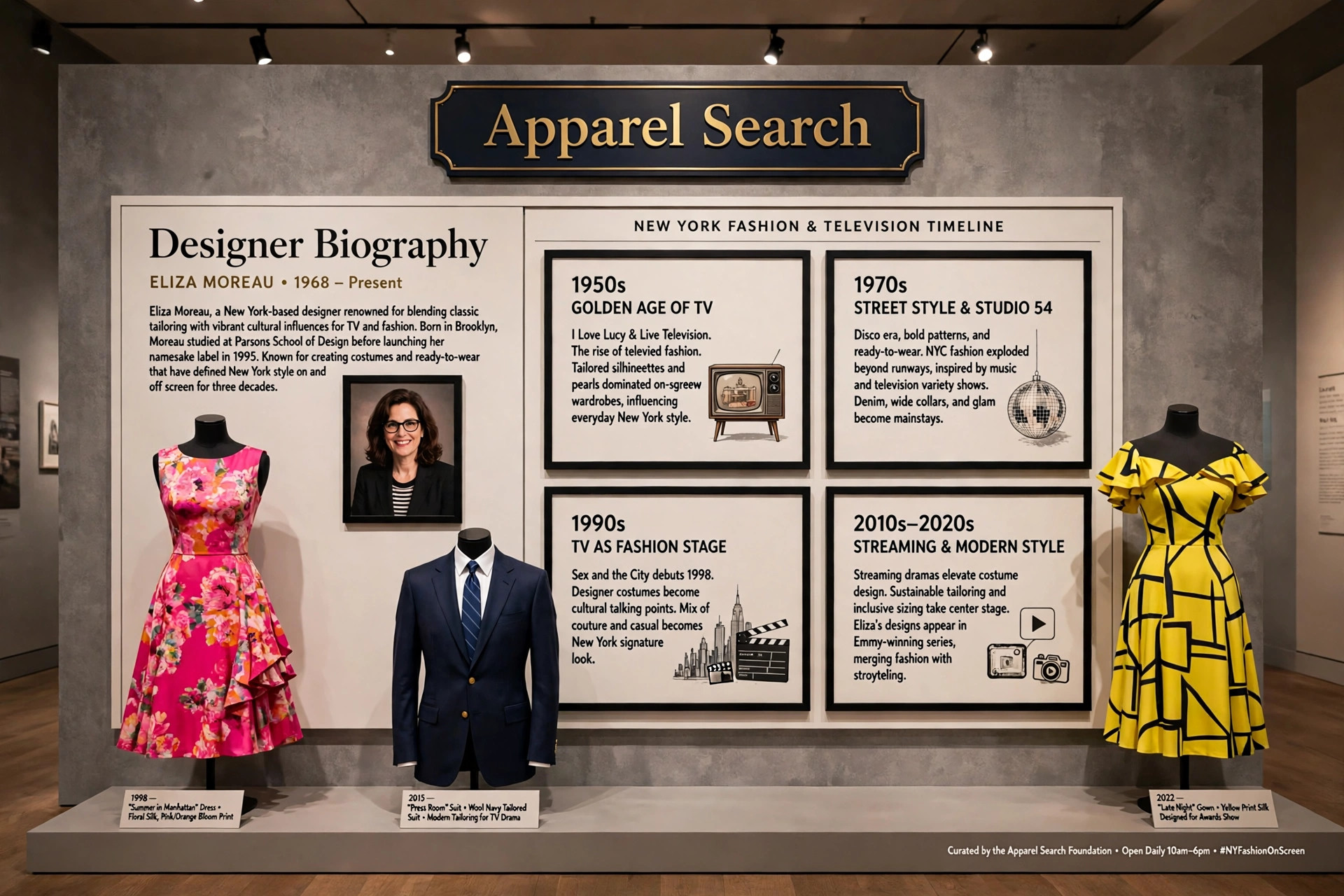
Illustrative image created for this guide — an artistic impression, not this designer's own garments.
News, Photos & VideoCollectionsFall FashionsFashion WeekNewsProfilesRunwaySpring Fashions
Brooklyn, Parsons and the 1987 Label
Mizrahi grew up in Brooklyn in a family connected to the clothing business — his father made children's clothes — and studied fashion at Parsons School of Design. His apprenticeships were in the heart of American sportswear: Perry Ellis, Jeffrey Banks and Calvin Klein, three houses that between them defined how America dressed for work and weekends. When he launched his own label in 1987, he took that sportswear grammar — the T-shirt, the khaki, the twinset — and finished it like couture.
The industry noticed immediately. He won the CFDA's Perry Ellis Award for new talent and then Designer of the Year in 1988 and again in 1989, and his shows — ballgowns worn with T-shirts, evening clothes in Day-Glo color — made him the most talked-about young designer in New York. The 1995 documentary Unzipped, which followed him through a collection's creation, turned the talk into fame: Mizrahi the performer, funny and confessional on camera, became as famous as Mizrahi the designer.
Target, Liz Claiborne and the Second Act
The couture economics of the 1990s were unforgiving, and in 1998 he closed his house. The second act proved larger than the first: in 2002 he launched a designer collection for Target, at mass-market prices, and it ran until 2008 as one of the most successful designer collaborations ever mounted — proof that the glamour did not depend on the price tag. In 2008 he became creative director of Liz Claiborne, and he launched a line on QVC that carried his name into millions of homes.
In 2011 he sold his brand to Xcel Brands, remaining its public face. Television judging, books, a memoir and a long-running cabaret act complete the portrait. Read with the collections page, the profile completes its arc: a designer whose real subject was never exclusivity but enthusiasm — the belief that glamour is a way of finishing ordinary clothes, available at any price.
Common Questions
Who is Isaac Mizrahi?
Isaac Mizrahi, born in Brooklyn, New York, on October 14, 1961, is an American fashion designer who launched his own label in 1987, won CFDA Designer of the Year awards in 1988 and 1989, and later carried designer fashion to a mass audience at Target.
What is the film Unzipped about?
Unzipped (1995) is the documentary, directed by Douglas Keeve, that followed Mizrahi through the creation of his fall 1994 collection; it became one of the best-known fashion documentaries and fixed his public image as fashion's most exuberant talker.
What did Isaac Mizrahi do at Target?
From 2002 to 2008 he designed a hugely successful collection for Target — designer clothes at mass-market prices — which proved a couturier could dress a mass audience and reshaped how the industry thought about designer collaborations.