Fashion Museums of the World · Kyoto
Kyoto Costume Institute
The Kyoto Costume Institute holds one of the world's great collections of Western dress — some 13,000 garments from the 17th century to today — and you cannot simply walk in and see it. In the institute's own words, it “does not contain a permanent exhibition gallery and the collection is not on public view.” This is a guide to that paradox: a museum the public mostly meets on tour, in books and online, and why it matters anyway.
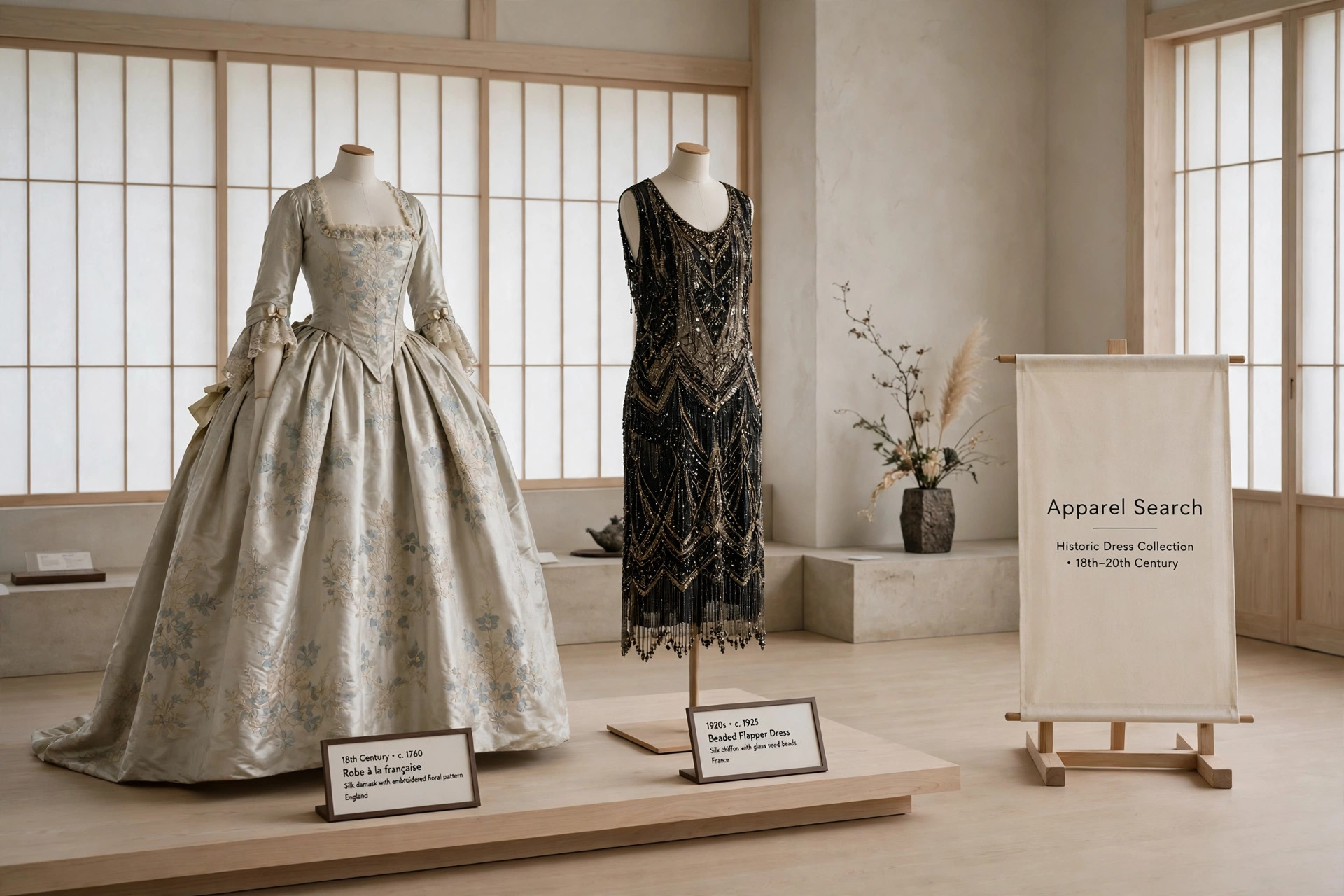
Museum Label
- Institution
- The Kyoto Costume Institute (KCI) — a public-interest foundation for the study of Western dress
- Home
- 103 Shichi-jo Goshonouchi Minamimachi, Shimogyo-ku, Kyoto, in the Wacoal building
- Founded
- 1 April 1978, by Koichi Tsukamoto with the support of the Wacoal Corporation
- Collection
- Some 13,000 items of Western clothing and 20,000 documents, 17th century to the present (the institute's figures)
- Curator Emeritus
- Akiko Fukai, the institute's longtime director and chief curator
- Known for
- Landmark touring exhibitions — Japonism in Fashion, Future Beauty — and the Taschen history of its collection; research, not a walk-in museum
The Institution
A Research Institute First, a Museum Second
Start with the institute's own warning, because it is the most honest sentence on any page in this series. Of its Kyoto home, the Kyoto Costume Institute states: “The KCI does not contain a permanent exhibition gallery and the collection is not on public view.” There is no walk-in museum of thirteen thousand garments waiting for you in Kyoto. What the public meets instead is the collection on the move — in small, periodic selections at the institute's own KCI Gallery, in large touring exhibitions at art museums around the world, in loans to other institutions, in books, and in a digital archive. This guide is a guide to a collection you mostly cannot walk into — and to why it is one of the most influential fashion collections on earth anyway.
The KCI is, in law and in spirit, a research foundation: a non-profit institute, reorganised in 2009 as a public-interest incorporated foundation, whose stated work is to collect, conserve, research and display Western-style clothing. Its research treats dress as evidence. Throughout history, the institute notes, clothing and people's lifestyles have been closely interlinked, so it examines how clothing changed within its social and historical contexts — fashion studied from an interdisciplinary academic viewpoint, with a constant eye on new social trends. The garments are the primary sources; the exhibitions and publications are the findings.
Why Western dress, and why Kyoto? The founder's reasoning was practical as much as scholarly. Postwar Japanese fashion, Koichi Tsukamoto observed, had developed dramatically — but its stylistic notions were mostly imported. For Japanese fashion to truly lead the world, he argued, Japan had to understand the entire history of the clothing it had adopted, under the maxim he made the institute's mission: “Discover the new in the old.” And the work belonged in Kyoto — the former capital, the city of the kimono — precisely because a culture with so deep a dress tradition of its own was the right place from which to study another's.
The standing that followed is a matter of record. The institute's garments are lent to exhibitions at institutions that include the Victoria and Albert Museum in London, the Metropolitan Museum of Art in New York and the Paris fashion museum at the Louvre; its curators, led for decades by Akiko Fukai, are among the most cited voices in fashion scholarship; and designers — the constituency Tsukamoto built it for — use its study facilities and its collection as a working reference. A museum's influence is usually measured in visitors. The KCI's is measured in exhibitions, books and other museums' galleries.
History in Brief
Born from an Exhibition: 1973 to 1978
The KCI begins with a show it did not organise. In 1973 the Metropolitan Museum of Art in New York mounted The 10's, the 20's, the 30's: Inventive Clothes, 1909–1939. Koichi Tsukamoto — founder and president of the Wacoal Corporation, one of Japan's leading lingerie makers, and vice-chairman of the Kyoto Chamber of Commerce and Industry — was, in the institute's own account, greatly fascinated by it. With the designer Issey Miyake, he brought the exhibition to the National Museum of Modern Art, Kyoto in 1975: the first full-scale fashion exhibition held at a national art museum in Japan, and a popular success that raised awareness of fashion as a subject worthy of a museum.
Tsukamoto drew the institutional conclusion. In April 1978 — formally, 1 April 1978 — the Kyoto Costume Institute was established under the auspices of the Wacoal Corporation and with the authorisation of Japan's Agency for Cultural Affairs, to collect, conserve, research and display Western-style clothes. Tsukamoto insisted the word “Kyoto” stand in the name, for the city's history as capital and its association with the kimono. The connection to New York was built in from the start: in August 1978 the first KCI museum mannequin was developed in conjunction with the Costume Institute at the Metropolitan Museum of Art — the department whose exhibition had started everything, and whose own guide opens this series.
The decades since have been accumulation and output in parallel. The institute's first exhibition, The Evolution of Fashion, was held at the National Museum of Modern Art, Kyoto in 1980; its biannual bulletin DRESSTUDY began in 1982 and ran until 2015, when a successor bulletin, Fashion Talks…, replaced it. The collection passed 10,000 pieces in September 1999. In November 2002 the institute published with Taschen the volume that carried its holdings worldwide — Fashion: A History from the 18th Century to the 20th Century, five hundred photographs of its garments on its custom mannequins. The research programme those objects support is the subject of the next two sections.
The Collection
Thirteen Thousand Garments, Kept Like a Library
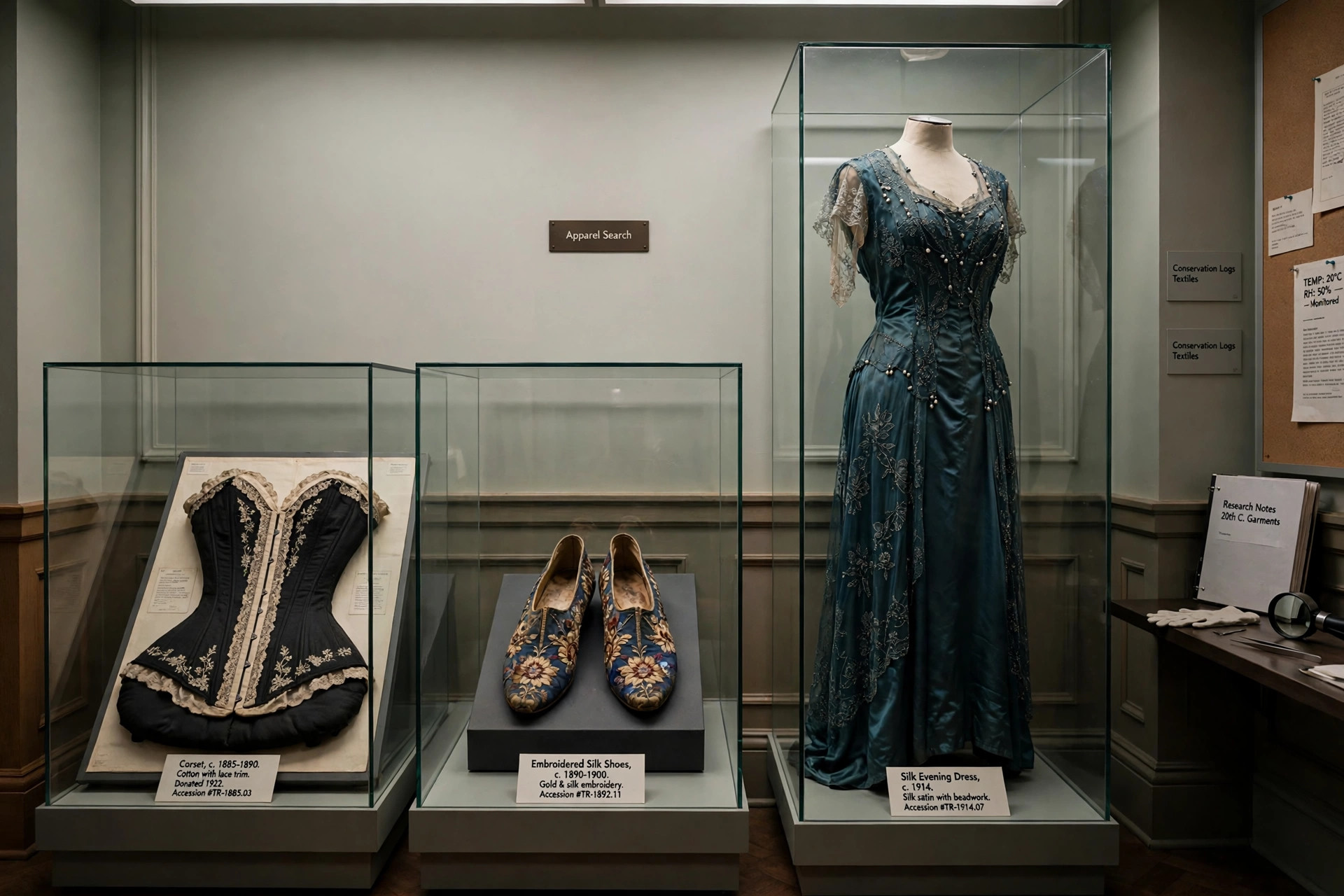
The collection, by the institute's current count, comprises some 13,000 items of clothing and 20,000 documents, spanning the 17th century to the present day. Its principle is the authentic sample: outstanding examples of Western clothing, collected together with the undergarments that shaped them, the accessories that completed them, and the documents that explain their background. A KCI dress is therefore rarely alone in the catalogue — it sits among the corsetry that gave it its silhouette, the shoes and fans that accompanied it, and the paper record of its world.
The undergarments are a signature strength, and they trace directly to the founder's business: Wacoal made foundation garments, and the institute has always understood that Western dress is engineered from the skin out. Its small Kyoto selections return to the theme repeatedly — one recent selection was devoted entirely to undergarments from the 1830s to the 1920s, eighteen corsets among them — and historians of dress value the holdings precisely because so many museums collected the gown and discarded the structure beneath it.
Two further strengths define the collection's character. The institute is acclaimed, in its own summary, for items that bear witness to how substantially Western clothing was influenced by Japanese culture and aesthetics — the Japonisme holdings — and by Japanese designers. And the contemporary collection is fed by the industry itself: donations have come from houses including Chanel, Christian Dior and Louis Vuitton, and the Japanese house Comme des Garçons alone gifted approximately 1,000 items. The archive of Western dress in Kyoto is, in part, a gift from Paris.
None of it lives in gallery conditions. The collection is stored in a climate-controlled environment held at a constant 20°C and 50 percent relative humidity, protected against mould, insects and ultraviolet light; when a garment travels, conservation specialists first repair and reinforce it to withstand exhibition. Display itself is a craft the institute helped define — the KCI mannequin, developed with the Met in its founding year, was created so historic garments could be shown with the posture and silhouette they were cut for, a standard its famous Taschen photographs made familiar worldwide.
Where You Actually See It
The Collection Travels: Exhibitions as the Public Gallery
If the collection has no permanent gallery, its exhibitions are its gallery — mounted with partner museums, above all the National Museum of Modern Art, Kyoto, and then toured. The pattern was set early and has never changed: research first, exhibition as the published result, catalogue as the permanent record. The landmark projects:
| Exhibition | Years | What it did |
|---|---|---|
| Revolution in Fashion 1715–1815 | 1989 | Announced the KCI's 18th-century strength in Kyoto; a Paris version followed at the Louvre's fashion museum in 1991–92. |
| Japonism in Fashion | 1994–2003 | The signature thesis — Japan's influence on Western dress — shown in Kyoto, then Paris (Palais Galliera), Los Angeles, Brooklyn and New Zealand. |
| Visions of the Body | 1999 | Fashion examined through the body it shapes and displays, in Kyoto and Tokyo. |
| Fashion in Colors: Viktor & Rolf & KCI | 2004–2006 | Colour as the argument, built with a living design duo; Kyoto and Tokyo, then the Cooper Hewitt in New York. |
| Future Beauty: 30 Years of Japanese Fashion | 2010–2015 | The first comprehensive survey of avant-garde Japanese fashion, curated by Akiko Fukai: the Barbican in London, then Munich, Tokyo, Seattle, Salem and Brisbane. |
| Dress Code: Are You Playing Fashion? | 2019–2021 | Fashion as a social game with rules to follow or break; Kyoto, Kumamoto, Tokyo and the Bundeskunsthalle in Bonn. |
| Love Fashion: In Search of Myself | 2024–2025 | The current-generation statement, with the National Museum of Modern Art, Kyoto, then Kumamoto and Tokyo. |
The touring continues: Art Deco and Fashion, centred on the KCI collection, ran at the Mitsubishi Ichigokan Museum in Tokyo from October 2025 to January 2026. Alongside its own productions, the institute lends actively to other museums' exhibitions — which is why a visitor to a fashion show in London, New York or Paris may be looking at Kyoto's garments without ever seeing the institute's name on the building.
The Kyoto Base
A Small Gallery, a Study Room and a Very Large Store
The institute works from its headquarters at 103 Shichi-jo Goshonouchi Minamimachi, in Kyoto's Shimogyo ward, in the Wacoal building — offices, conservation and climate-controlled storage, and one small public room. That room is the KCI Gallery: just 86 square metres, in which the institute presents selected items from the collection in small periodic exhibitions. The selections are numbered like journal issues and argued like them — recent examples include Details of Dress, twenty-one pieces of 18th-century aristocratic dress and accessories, from shoes and pockets to stomachers, fans and aprons, and Active Women: Dressing for the 1920s. Between selections, the gallery may be closed: there is, by design, nothing permanent to fall back on.
For researchers, the real public interface is the KCI Study Room, where the collection database — visual and textual information on all 13,000-plus items — can be consulted by reservation. From home, the KCI Digital Archives on the institute's website present roughly 400 items in chronological order, and the institute's stories on Google Arts & Culture carry individual garments further still. Add the Taschen volume, in print in several languages, and the paradox resolves: measured by garments a curious person can actually study, this closed collection is one of the most open in the world.
A collection that sleeps in the dark in Kyoto wakes up, a few hundred garments at a time, in the great museums of the world.
Visiting
Visiting — and Meeting the Collection Where It Travels
Plan a Kyoto visit around the institute the way the institute itself works: check first, travel second. The KCI's own website carries the current KCI Gallery selection — worth the trip across town when one is running, and the only part of the collection on view in Kyoto outside a partner exhibition — together with news of touring exhibitions, including the recurring large collaborations with the National Museum of Modern Art, Kyoto. If a KCI exhibition is running anywhere on your itinerary, in Japan or abroad, that exhibition, not the headquarters, is the visit.
Everyone else meets the collection remotely, and should: browse the Digital Archives online before you go anywhere, read the Taschen history for the garments' stories, and — if you design or research — apply for the Study Room, where the full database of the collection is open by reservation. What you should not do is arrive at the address in Shimogyo ward expecting galleries of dress. The institute tells you so itself, in the sentence this guide began with — and a fashion culture that produced so much of what the world wears can afford to take it at its word.
Exhibitions change and galleries are rehung, so the details here describe the Kyoto Costume Institute as documented for this guide — the institute's own site always carries the latest version.
Common Questions
Common Questions
Can I visit the Kyoto Costume Institute's collection in Kyoto?
Not as a walk-in museum. In the institute's own words, the KCI does not contain a permanent exhibition gallery and the collection is not on public view. What you can see in Kyoto is the KCI Gallery, a small room of 86 square metres where selected items from the collection are shown in periodic small exhibitions — and it may be closed between selections. Check the institute's website before going.
Why does a Kyoto institute collect Western dress?
Because of how modern Japanese fashion began. The institute's founder, Koichi Tsukamoto of the Wacoal Corporation, argued that postwar Japanese fashion had developed using mostly imported stylistic ideas, and that for Japanese fashion to lead the world it had to understand the entire history of the clothing it had adopted — his maxim was to discover the new in the old. Kyoto, the historic capital and the city of the kimono, was chosen as the place to do that studying.
How big is the Kyoto Costume Institute collection?
By the institute's current count, some 13,000 items of clothing and 20,000 documents, spanning Western dress from the 17th century to the present day. Alongside the garments themselves, the institute collects the undergarments that shaped them and the accessories and documents that explain them. Houses including Chanel, Christian Dior and Louis Vuitton have donated pieces, and Comme des Garçons alone gifted approximately 1,000 items.
Where can I see KCI garments in person?
At the institute's own touring exhibitions, which are its public gallery. Landmark productions such as Japonism in Fashion and Future Beauty: 30 Years of Japanese Fashion have been shown in Kyoto, Tokyo, Paris, London, New York, Los Angeles and beyond, and new collaborations continue — Art Deco and Fashion, centred on the collection, ran in Tokyo into January 2026. KCI garments also appear on loan in other museums' exhibitions worldwide.
How can I explore the collection from home?
Through the KCI Digital Archives on the institute's website, which present visual and textual information on roughly 400 items in chronological order, and through its stories on Google Arts and Culture. The collection's garments are also published in the Taschen volume Fashion: A History from the 18th Century to the 20th Century. Researchers can go further in person: the KCI Study Room in Kyoto opens the database of all 13,000-plus items by reservation.
In This Series
Every guide in Fashion Museums of the World, from the section hub.
Museums & Exhibitions on Apparel Search
The site's existing museum coverage, including the term guide this series grows from.
Related on Apparel Search
The industry the institute serves, and the New York department whose exhibition inspired its founding.
Search Apparel Search