Fashion Museums of the World · New York
The Costume Institute at the Met
On the ground floor of the Metropolitan Museum of Art sits the most influential fashion department on earth: a collection of more than 33,000 garments and accessories spanning seven centuries, a spring exhibition that has become fashion's biggest stage, and a single fundraising party — the Met Gala — that pays for all of it. This is the flagship guide in our tour of the world's fashion museums.
Museum Label
- Institution
- The Costume Institute — the fashion department of the Metropolitan Museum of Art
- Home
- The Met Fifth Avenue, 1000 Fifth Avenue, New York
- Founded
- 1937, as the independent Museum of Costume Art; a Met curatorial department since 1959
- Collection
- More than 33,000 objects of fashionable dress, from the 15th century to the present (the Met's figure)
- Curator in Charge
- Andrew Bolton, Wendy Yu Curator in Charge
- Known for
- The spring exhibition and the Costume Institute Benefit — the Met Gala — that funds the department
The Institution
A Museum of Clothes Inside a Museum of Everything
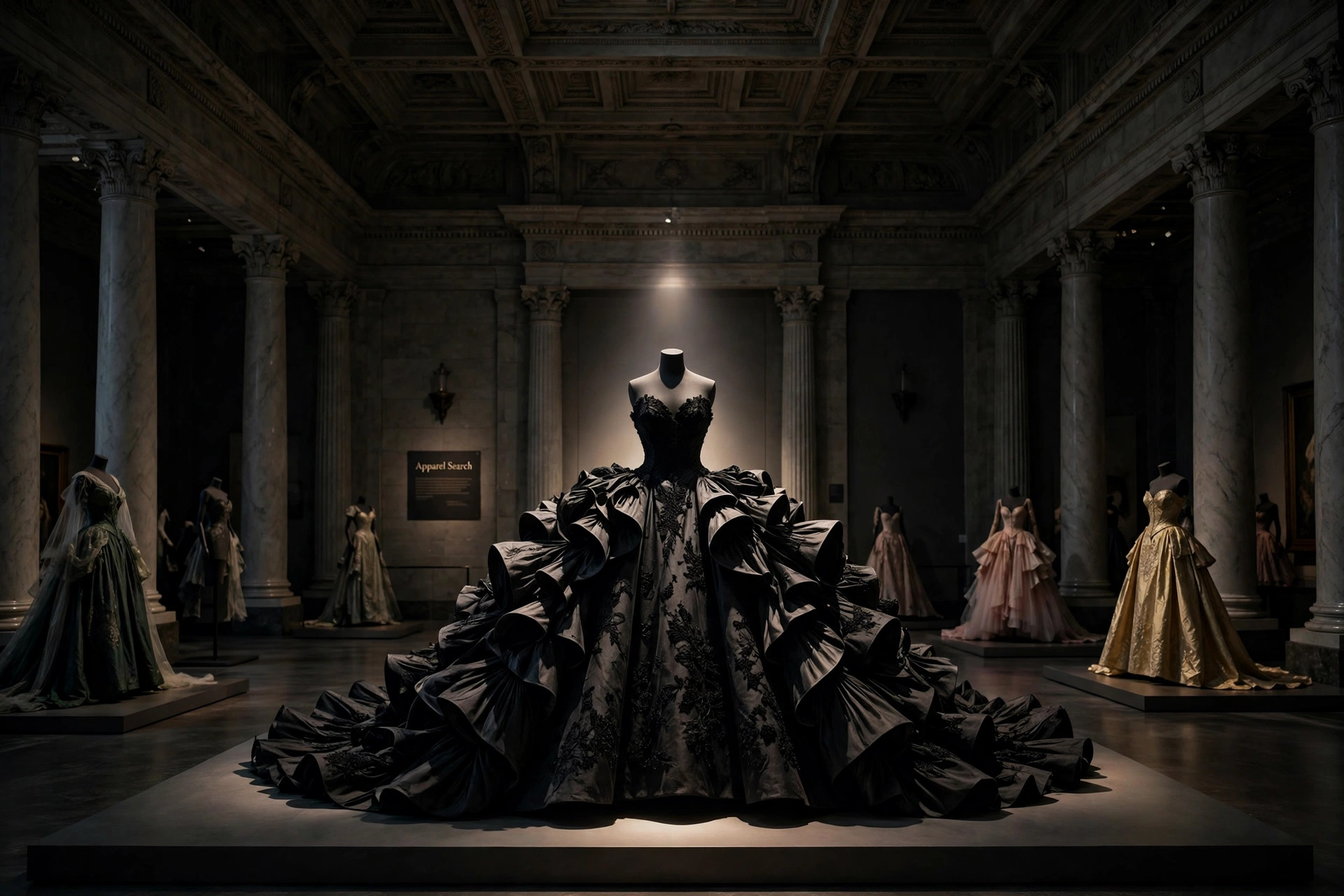
The Costume Institute is not a standalone museum. It is one of the Met's curatorial departments — the department responsible for dress — which means fashion sits inside the world's great encyclopedic art museum on exactly the same footing as painting, sculpture and arms and armour. That status matters. When a Chanel suit or a Charles James ball gown enters this collection, it is catalogued, conserved and argued about the way the Met treats a Rembrandt: as an object that carries history in its making.
The scale is documented by the Met itself: a collection of more than 33,000 objects, representing seven centuries of fashionable dress — fashionable dress from the 15th century to the present, drawn from Europe, the Americas and beyond. In January 2009 the holdings grew again when the Brooklyn Museum transferred its celebrated costume collection to the Met, forming the Brooklyn Museum Costume Collection at The Metropolitan Museum of Art. The Met describes the combined holdings, in its own words, as the largest and most comprehensive costume collection in the world — anchored by the Brooklyn material's definitive Charles James holdings and its strength in American fashion from the late 19th to the mid-20th century.
What the department does with that collection is exhibitions. Because textiles are among the most fragile objects any museum holds — light fades them, gravity strains them, handling wears them — the collection is not kept on permanent public view. Instead the Institute mounts exhibitions, usually one or two a year, that bring a few hundred objects out of storage at a time, rest them again afterwards, and in between open the collection to scholars and designers by appointment and to everyone through the Met's online collection pages.
Putting a historic garment on view is a craft in itself, and it is the part of the department visitors never see. A dress that has rested flat in storage for decades cannot simply be hung up: conservators assess its fibres and seams, repair what would tear under its own weight, and mount it on a form padded and carved to reproduce the body the garment was cut for — corseted waist, bustle cage and all. Get the mount wrong and the silhouette lies; get it right and a 150-year-old dress stands in the gallery with the posture it had on its first night out. That invisible work — conservators, mount-makers, and the registrars who track every object's light exposure — is what the department's funding quietly buys, and it is why a Costume Institute exhibition takes years to prepare.
History in Brief
From the Museum of Costume Art to a Department of the Met
The Institute began outside the Met entirely. In 1937 Irene Lewisohn — a founder of New York's Neighborhood Playhouse, whose theatre work had taught her what costume could do — established the Museum of Costume Art as an independent institution devoted to dress. In 1946, with the financial support of the fashion industry itself, the Museum of Costume Art merged into the Metropolitan Museum of Art, and in 1959 the collection formally became a curatorial department: the Costume Institute.
One condition of its life inside the Met shapes everything else in this guide. The Institute raises its own money. The Met states that its annual Benefit provides the department with its primary source of funding for exhibitions, publications, acquisitions and operations — a self-supporting arrangement that makes the department's famous party a structural necessity rather than a social extra, and that has pushed its curators, from the beginning, to make exhibitions the public actually wants to see.
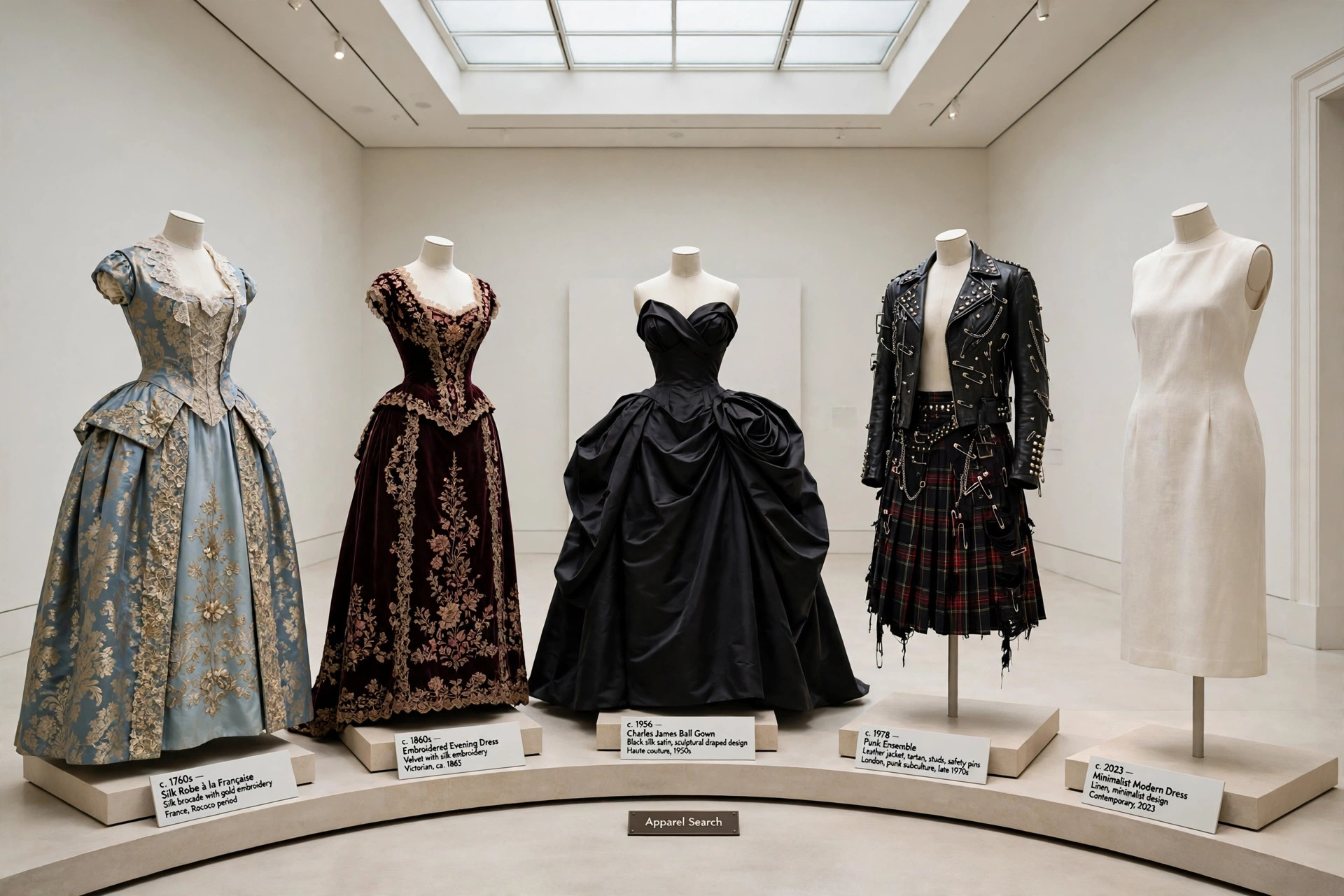
The modern era began in 1972, when Diana Vreeland — the former Vogue editor-in-chief — became the department's special consultant, a post she held until her death in 1989. Vreeland turned the costume exhibition into theatre: scented galleries, dramatic lighting, and shows built like magazine features at architectural scale. The World of Balenciaga (1973) honoured the great Spanish couturier — the designer whose house profile you can read in our Balenciaga company profile — and The Glory of Russian Costume (1976) and Vanity Fair (1977) followed. The Met credits Vreeland's dazzling productions with setting the standard for costume exhibitions worldwide, and every blockbuster fashion show since — including the ones in the other museums in this series — works in the format she proved.
After Vreeland, Richard Martin took the helm in 1989, supported by Harold Koda; Koda returned as curator in charge in 2000 and in 2002 hired a young curator named Andrew Bolton. The department they ran together produced the monographic exhibitions on Chanel (2005) and Poiret (2007) and the Alexander McQueen retrospective that changed the scale of fashion exhibitions everywhere — which brings the story to its current chapter.
The Bolton Era
The Blockbuster Years
Harold Koda retired in January 2016, and Andrew Bolton succeeded him as curator in charge; in March 2018 Bolton was named the Wendy Yu Curator in Charge of the Costume Institute. The run of exhibitions across the Koda–Bolton years is, by the Met's own attendance records, the most successful in the department's history — all five of the Met's most-attended Costume Institute exhibitions were curated by Bolton. The landmark shows, and what each one changed:
| Exhibition | Year | What it changed |
|---|---|---|
| Alexander McQueen: Savage Beauty | 2011 | Proved a fashion retrospective could be a mass-cultural event — the template for the modern blockbuster, later restaged to record crowds in London. |
| Schiaparelli and Prada: Impossible Conversations | 2012 | Put two designers a century apart in imagined dialogue, and made the exhibition-as-argument a fashion genre of its own. |
| PUNK: Chaos to Couture | 2013 | Took a street subculture into the Met's galleries and traced its line into couture — street style given museum standing. |
| Charles James: Beyond Fashion | 2014 | Reopened the department's renovated home (below) with America's first great couturier, built on the Brooklyn collection's James holdings. |
| China: Through the Looking Glass | 2015 | Fashion shown through the Western imagination of China, staged across the Met's Chinese galleries — the department thinking at museum scale. |
| Manus x Machina | 2016 | Fashion in the age of technology: hand craft against machine production, with the couture-versus-ready-to-wear hierarchy dissolved. |
| Rei Kawakubo / Comme des Garçons: Art of the In-Between | 2017 | A monographic show for a living designer, built as white architectural space — the exhibition design itself became the story. |
| Heavenly Bodies: Fashion and the Catholic Imagination | 2018 | The Met's most visited exhibition ever — more than 1.65 million visitors across The Met Fifth Avenue and The Met Cloisters. |
| Camp: Notes on Fashion | 2019 | Susan Sontag's 1964 essay turned into an exhibition — fashion as deliberate artifice, irony and exaggeration. |
| Costume Art | 2026 | The spring exhibition that opened the department's new Condé Nast Galleries beside the Great Hall — nearly 12,000 square feet created to house the spring shows. |
Read the pattern rather than the list: each show takes one idea — a designer, a subculture, a technology, an essay — and builds a world around a few hundred garments. That is the Vreeland inheritance, professionalised: scholarship rigorous enough for the Met, staged boldly enough to fill it.
The effect reaches well beyond the museum's walls. A Costume Institute retrospective re-prices a designer's archive, revives techniques the trade had let lapse, and sends a generation of design students back to the same silhouettes — working designers are among the collection's most regular study-appointment visitors, reading construction details off garments a century old. When the McQueen exhibition travelled on to London, it broke attendance records there too, and museum directors worldwide took the lesson: fashion, presented with this rigour and this theatre, is not a soft subject but one of the strongest draws a museum can programme. The other museums in this series — FIT, the V&A, the Palais Galliera, MoMu — each run their own version of the model the Costume Institute proved.
The Funding Engine
One Night in May: The Benefit
The Costume Institute Benefit — the party the world knows as the Met Gala — is held each year on the first Monday in May, and it has a job to do: it marks the opening of the department's spring exhibition, and it provides the department with its primary source of funding for the year's exhibitions, publications, acquisitions and operations. The Met is explicit about this, and it reframes the famous red carpet: the spectacle is the business model.
The Benefit was the brainchild of the fashion publicist Eleanor Lambert, introduced in 1948 as a midnight supper that society coverage dubbed "The Party of the Year". Anna Wintour has chaired or co-chaired the event since 1995, the era in which it grew from a New York society dinner into a global media occasion — and, not coincidentally, the era of the blockbuster exhibitions it funds.
The gala's own story — the themes, the guest list, the red-carpet dressing that has made it fashion's biggest night — deserves its own guide, and it has one: our Met Gala guide covers the party itself. This page's point is the quieter one: every exhibition in the table above exists because one night in May pays for it.
The Home
The Anna Wintour Costume Center
In May 2014, after a two-year renovation, the department's home reopened as the Anna Wintour Costume Center, inaugurated by the Charles James exhibition. Its main showcase is the Lizzie and Jonathan Tisch Gallery, built as a flexible space that can be re-formed — with video, sound and technology — around each exhibition's argument. Beside it, the Carl and Iris Barrel Apfel Gallery serves as the orientation gallery, giving visitors the context to read what they are about to see.
The public galleries are the smaller half of the Center. Behind them sit the working museum: a costume conservation laboratory, study and storage facilities for the combined Met and Brooklyn holdings, and the Irene Lewisohn Costume Reference Library — named for the Museum of Costume Art's founder and holding, by the Met's count, over 34,000 books, nearly 800 periodical titles and more than 1,500 designer files. It is one of the world's great fashion libraries, and for designers and researchers it is as much a reason this department matters as any exhibition.
A department that must fund itself learned to make exhibitions the world queues for — and then built the galleries, the library and the laboratory to deserve them.
Visiting
Visiting as a Fashion Pilgrim
The Costume Institute's home is The Met Fifth Avenue, the museum's main building at 1000 Fifth Avenue in New York. Plan a visit the way the department plans its year: around the exhibitions. There is no permanent costume display waiting for you on a quiet Tuesday — the collection rests in storage between shows — so what is on, and when, decides everything. The spring exhibition is the year's main event, typically joined by a smaller show; check the Met's own website for the current exhibitions, opening hours and ticket details before you go, since all three change.
What a fashion visitor should not miss: the spring exhibition in the Tisch Gallery, whatever is showing in the Apfel Gallery beside it, and — since you are inside the Met anyway — the dress staring back at you from the museum's other departments, in painted portraits and carved marble, which is the context the Costume Institute's garments were made for. If you work in fashion or study it, the department also opens its collection beyond the galleries: the collection is searchable through the Met's website, and scholars and designers can request study appointments. And if your trip falls in May, you will share the museum steps with the aftermath of the Benefit — the one night the department steps out of the galleries and onto the red carpet it funds itself with.
Exhibitions change and galleries are rehung, so the details here describe the Costume Institute as documented for this guide — the museum's own site always carries the latest version.
Common Questions
Common Questions
Is the Costume Institute a separate museum from the Met?
No. The Costume Institute is a curatorial department of the Metropolitan Museum of Art — the Met's fashion department — housed inside The Met Fifth Avenue in New York. It has its own curator in charge, its own galleries in the Anna Wintour Costume Center, and its own funding model, but it is part of the Met, and a visit to its exhibitions is a visit to the Met.
Why is the Costume Institute's collection not always on display?
Because textiles are fragile. Light, handling and gravity damage historic garments, so — as the Met itself explains — the collection is not on permanent public view. What visitors see is the department's exhibitions, usually one or two a year, drawn from storage for a limited run and then rested again. The collection can be searched online, and scholars and designers can request appointments to study it.
What is the connection between the Costume Institute and the Met Gala?
The Met Gala is the Costume Institute Benefit, the department's annual fundraising party, held on the first Monday in May to open its spring exhibition. The Met states that the Benefit provides the department with its primary source of funding for its exhibitions, publications, acquisitions and operations — the gala is not decoration on the department's work; it is what pays for the work.
Who runs the Costume Institute?
Andrew Bolton, who joined the department in 2002 under Harold Koda and succeeded him as curator in charge in 2016; in 2018 he was named the Wendy Yu Curator in Charge. Bolton has curated the department's record-breaking run of exhibitions, including China: Through the Looking Glass, Manus x Machina, Heavenly Bodies and Camp: Notes on Fashion.
What should a fashion lover not miss at the Costume Institute?
The spring exhibition, which is the department's biggest production of the year, in the Tisch Gallery of the Anna Wintour Costume Center — and whatever smaller show is running alongside it. Time your visit for an exhibition: there is no permanent costume display to fall back on. Check the Met's own website for what is on, opening hours and tickets before you go.
In This Series
Every guide in Fashion Museums of the World, from the section hub.
Museums & Exhibitions on Apparel Search
The site's existing museum coverage, including the term guide this series grows from.
Related on Apparel Search
The party this department throws, and the industry world around it.
Search Apparel Search