Fashion Museums of the World · Toronto
Bata Shoe Museum
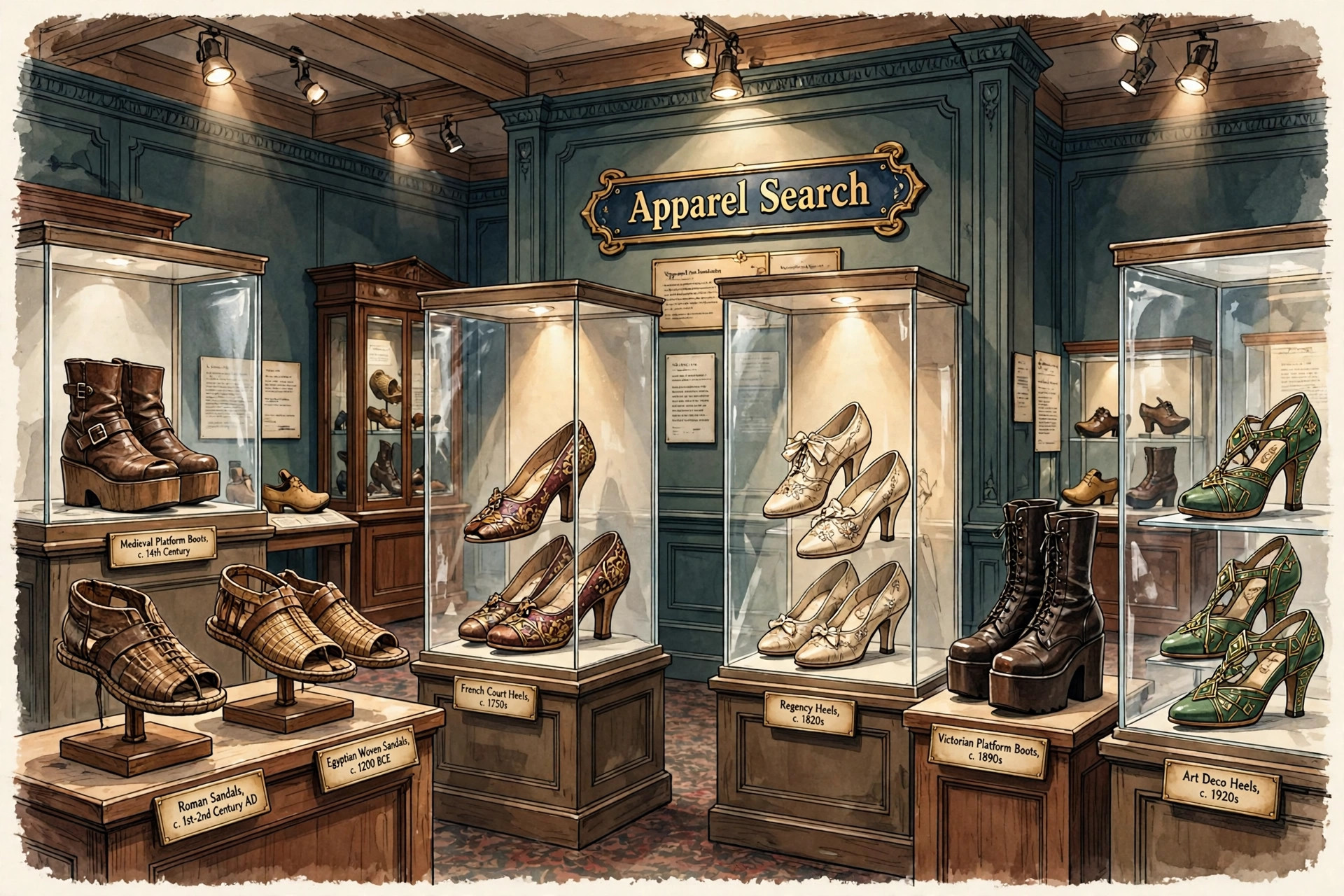
Every other museum in this series collects clothes. Toronto's Bata Shoe Museum collects the one garment humanity has reinvented in every culture on earth: the shoe. Nearly 15,000 shoes and shoe-related objects, spanning 4,500 years from ancient Egyptian sandals to Elton John's platform boots, fill a limestone building shaped like an opening shoebox — all of it grown from one woman's personal collection, gathered on business trips around the world. It is the most specialised museum in this series, and one of the most joyful.
Museum Label
- Institution
- Bata Shoe Museum (BSM) — a museum of footwear and calceology, supported by the Bata Shoe Museum Foundation
- Home
- 327 Bloor Street West, at St. George Street, downtown Toronto, Canada
- Founded
- Opened 6 May 1995; the Bata Shoe Museum Foundation was established in 1979
- Collection
- Nearly 15,000 shoes and related objects spanning 4,500 years (the museum's figure)
- Founder
- Sonja Bata (1926–2018), who began collecting footwear in the 1940s
- Known for
- The world's largest and most comprehensive footwear collection, the permanent exhibition All About Shoes, and Raymond Moriyama's shoebox-inspired building
The Institution
The Whole of Human History, Told From the Ankle Down
The Bata Shoe Museum's mission, in its own framing, is to communicate the central role of footwear in shaping the social and cultural life of humanity — to illuminate human history through footwear. That sounds like a slogan until you walk its permanent exhibition and see how literally it is meant. A shoe records the ground its owner walked on, the work they did, the status they claimed and the climate they survived. Read a culture's shoes and you have read its technology, its trade routes, its religion and its ideas about gender and rank, all in objects small enough to hold in one hand.
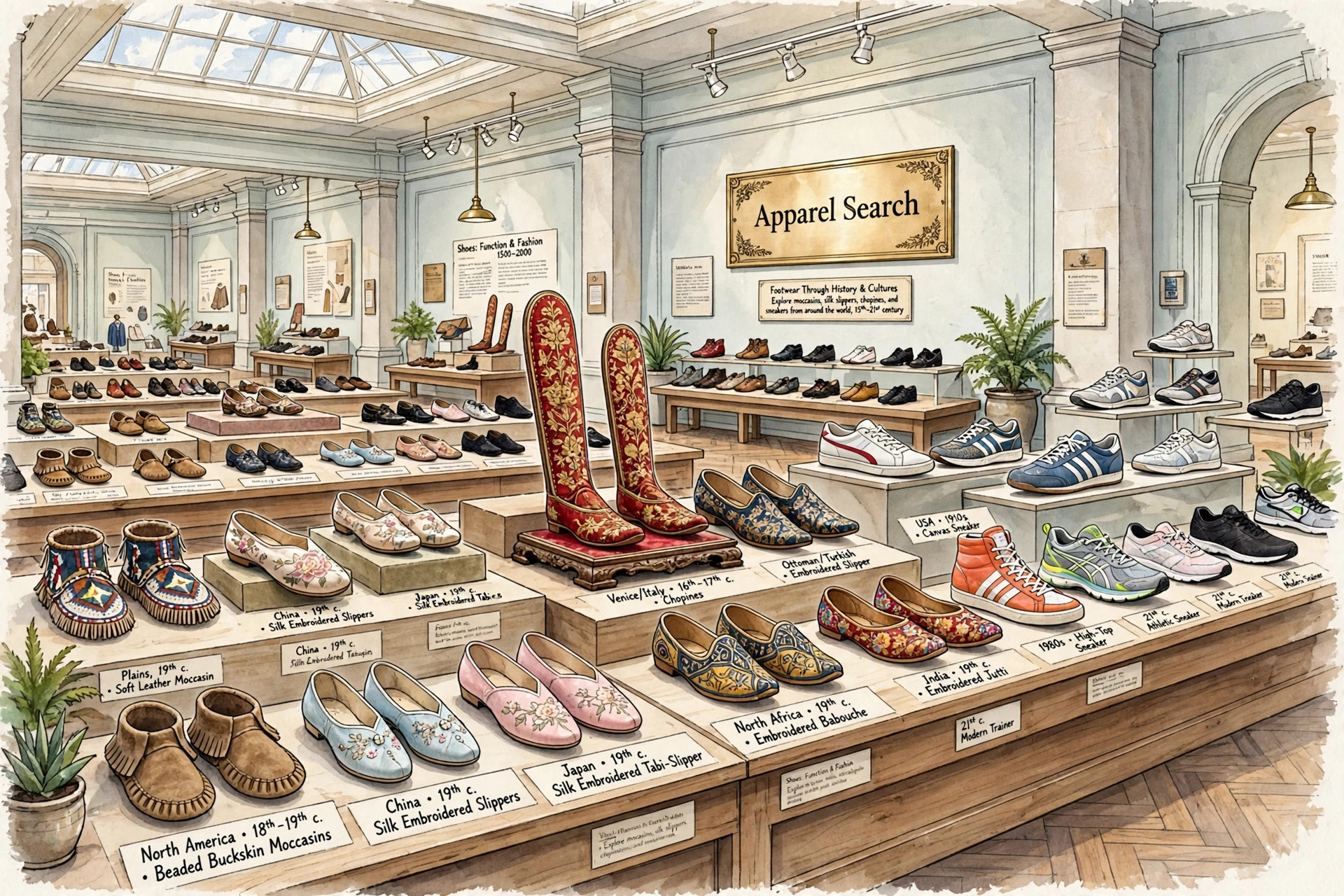
The museum describes itself, without much argument from anyone, as home to the world's largest and most comprehensive collection of shoes and footwear-related objects, and as an internationally recognised centre for footwear research. Its holdings — nearly 15,000 shoes and related objects spanning 4,500 years, by the museum's count — contain artefacts from virtually every culture in the world. French chestnut-crushing boots stand under the same roof as delicately embroidered Chinese silk shoes, bear-fur shoes made for Japanese samurai warriors, and footwear made from human hair. More than a thousand objects are on display at any one time, chosen from that collection across four galleries.
The range is the argument. At one end sit the archaeological treasures: ancient Egyptian sandals of the kind the modern flip-flop descends from, sarcophagi painted with sandal designs, Greek perfume vials shaped like sandalled feet, Roman bronze lamps in the form of feet. At the other end sit the celebrity shoes that visitors queue for — Queen Victoria's ballroom slippers, Elvis Presley's patent loafers, John Lennon's Beatle boot, Terry Fox's running shoe, and the monogrammed silver platform boots Elton John wore in the mid-1970s. Between them lies everything a foot can mean: work, worship, sport, seduction, status and play.
Two strengths deserve naming. The museum holds a diverse and important array of Indigenous footwear from across Turtle Island — North America — and the circumpolar regions, a collection built through foundation-funded fieldwork and research that has contributed substantially to the scholarship of shoes. And its fashion footwear runs from a rare, well-preserved velvet-covered platform chopine of 16th-century Italy — so tall its wearer could not walk unaided — through to the catwalk designers of today, a reminder that Salvatore Ferragamo and Vivienne Westwood were not the first to think of platforms, and will not be the last.
Education is the third strand of the work, and the one Sonja Bata is said to have loved most. The museum runs curriculum-based programmes for school groups — its Step Ahead initiative, launched in 2009, subsidises those programmes for underserved communities — alongside lectures, family programming and the publications that carry its exhibitions into print. A museum built from a private passion could have stayed a treasure house; the foundation's charter, to build an international centre for footwear research, made it a school as well, and the galleries are taught in as much as they are looked at.
History in Brief
Sonja Bata and the Collection That Outgrew Its Home
The collection began as a marriage's side effect. Sonja Bata (née Wettstein), born in Zurich in 1926, studied architecture before marrying Thomas Bata in 1946 — heir to the Bata Shoe Company, the global footwear manufacturing and retail empire founded by his father, Tomáš Baťa. The family had moved to Toronto in the 1940s, and in the postwar years Sonja travelled the world at her husband's side, rebuilding a business whose Eastern European assets had been nationalised. Travelling on shoe business, she began collecting footwear — traditional, rare and historic examples from every corner of the world, gathered with an ethnographer's eye for what a shoe says about the people who made it.
By the late 1970s the private collection had outgrown its home — by one account some 1,500 pairs were crowding the company's storerooms. In 1979 the Bata family established the Bata Shoe Museum Foundation, to have the collection professionally managed, to fund research into footwear — including fieldwork among Indigenous peoples of North America and the circumpolar regions, whose footwear innovation the foundation made a particular study — and to build toward an international centre for footwear research. The collection was first displayed to the public in 1992, at the Colonnade on Bloor Street, a few blocks from its eventual home.
On 6 May 1995 the Bata Shoe Museum opened its doors at 327 Bloor Street West in downtown Toronto. Founder Sonja Bata and Henry Jackman, the 25th Lieutenant Governor of Ontario, cut the ribbon on a museum that already held more than 10,000 shoes and shoe-related artefacts reflecting over 4,500 years of material culture, and visitors kicked off a “Shoe Week” of celebration. The museum opened with four exhibitions, including its permanent survey All About Shoes and Inuit Boots: A Woman's Art — a pairing that announced the institution's range on day one: the whole history of footwear, and one tradition studied in depth.
Sonja Bata remained the museum's guiding presence until her death on 20 February 2018. The institution she left behind describes her exactly as the collection suggests: a passionate collector who found great joy in sharing her finds, and who looked at shoes as a way to understand culture, anthropology, craftsmanship and ingenuity. The museum marked its thirtieth anniversary in 2025, still in the building made for it, still growing the collection she started on the road in the 1940s.
What Made Its Name
All About Shoes — and the Shows Around It
The museum's spine is its permanent exhibition, All About Shoes, which reflects the whole 4,500 years of the collection in one survey: footwear's style, development and function, from Chinese bound-foot shoes and ancient Egyptian sandals to chestnut-crushing clogs and glamorous platforms. Around that spine, three further galleries carry changing exhibitions, so the museum a visitor returns to is never quite the museum they left. The landmark exhibitions show the range the format allows:
| Exhibition | Year | What it showed |
|---|---|---|
| All About Shoes | 1995– | The permanent survey of 4,500 years of footwear, opened with the museum and renovated since — the collection's greatest hits and its deepest argument in one gallery. |
| Inuit Boots: A Woman's Art | 1995 | One of the four opening exhibitions, honouring the artistry of Inuit women's boot-making — the Indigenous footwear research the Foundation had funded since the 1980s. |
| Spirit of Siberia | 1997 | Built with researchers Jill Oakes and Rick Riewe and the Russian Museum of Ethnography, bringing circumpolar footwear scholarship — and rare loans from St. Petersburg — to Toronto. |
| Every Step a Lotus | 2001 | One of the museum's most popular exhibitions, curated by Dr. Dorothy Ko, exploring the cultural meanings of footbinding through the stages of a Chinese woman's life in late imperial China. |
| Icons of Elegance | 2005 | Influential shoe designers of the 20th century, with loans from the Met, the Museum at FIT and the Museo Salvatore Ferragamo, and Christian Louboutin and Beth Levine in attendance at the opening. |
| On a Pedestal | 2009 | A historically significant gathering of Renaissance chopines on loan from museums across Europe and North America — the platform shoe's extravagant ancestry, assembled in one room. |
| Roger Vivier: Process to Perfection | 2011 | Nearly 80 of the museum's own Vivier pullovers — the designer's working prototypes — with loans from the Met and from Roger Vivier in France. |
The pattern is worth reading. A single-subject museum could easily become a cabinet of curiosities; the Bata instead programmes like a much larger institution, alternating deep cultural studies — Siberia, China, the Arctic — with the designer retrospectives and object-gatherings, like the chopine show, that only a collection and a loan network of this depth can stage. Its exhibitions travel, too: its Arctic footwear and elevated-shoe exhibitions have toured, carrying Toronto's collection to audiences who may never reach Bloor Street.
The research programme underneath the shows is the other half of the name. The museum sponsors field research, publishes its findings and promotes education, and its conservation laboratory — opened in 2000 to an award citation for the museum's dedication to the care of collections — works in view of visitors. Shoes are unforgiving objects to keep: leather dries, silk shatters, and a shoe, unlike a dress, was built to be destroyed by use. That so many survive here at all is a conservation story in itself.
The Home
A Shoebox, Slightly Open
Sonja Bata asked architect Raymond Moriyama, of Moriyama & Teshima Architects, for “a small gem of a museum” — and the building that opened in 1995 at the corner of Bloor and St. George streets, in what is now Toronto's Bloor Street Culture Corridor, is exactly that. Moriyama found his idea in the collection itself. “When I first viewed the collection,” he recalled, “I was impressed by the array of shoe boxes that protected the shoes from light, moisture and dust.” The museum would be a container: a shoebox, with its lid slightly lifted.
The metaphor is built, not just spoken. The roof plane sits like a lid resting on an open box — its copper cladding visible from the street below — while the limestone walls below cant inward, clad in a dense French limestone from Lyons whose warm tone, soft sheen and fine texture Moriyama's team likened to raw leather, the basic material of the shoe industry. The main entrance is a wedge of glass that bursts through the stone onto Bloor Street, and inside, a dramatic multi-level cut through the building carries the main circulation — a floating, cantilevered staircase beneath a faceted glass wall — so that light falls through the box the way it does when a lid is cracked open. The building won the City of Toronto's Urban Design Award of Excellence in its opening year, when the Toronto Star called it one of the most sculptural pieces of architecture to appear in the city in recent memory.
Inside the box, the plan serves the collection. Four galleries — the permanent All About Shoes and three changing-exhibition spaces — hold the thousand-plus objects on view, while below and behind them sit the storage vaults for the nearly 15,000 that are resting, the conservation laboratory, and the research facilities of the foundation. Only a small fraction of the collection can ever be displayed at once, which is precisely why the changing galleries matter: the box keeps opening onto different contents.
One woman's travelling collection, given a limestone shoebox of its own — and opened, lid lifted, to the whole world.
Visiting
Visiting as a Fashion Pilgrim
The Bata Shoe Museum stands at 327 Bloor Street West, at St. George Street in downtown Toronto — beside the University of Toronto's St. George campus, steps from St. George subway station, and within easy walking distance of the Royal Ontario Museum and the Gardiner Museum, its neighbours in the Bloor Street Culture Corridor. It is the most manageable museum in this series: a single, complete idea, in a single, beautiful building, that a visitor can absorb whole in a visit and remember entire.
What a fashion visitor should not miss: the permanent All About Shoes survey, taken slowly — it is 4,500 years in one gallery, and its juxtapositions, a samurai's bear-fur shoes a case away from a pair of platforms, are the museum's argument made visible; the 16th-century velvet chopine, the collection's great treasure; whichever of the three changing exhibitions catch the themes the museum does best, whether that is a designer's working process or a whole culture's footwear; and the famous feet — Queen Victoria's slippers, Elvis Presley's loafers, Elton John's platform boots — remembering that, for conservation, individual celebrity pieces are not always on display. If shoes are your trade, spare a thought for the designer whose museum in Florence shares this one's devotion to a single craft: our guide's companion read is the Salvatore Ferragamo designer profile. Check the museum's own website for current exhibitions, opening arrangements and programme details before you go, since all three change.
Exhibitions change and galleries are rehung, so the details here describe the Bata Shoe Museum as documented for this guide — the museum's own site always carries the latest version.
Common Questions
Common Questions
Is the Bata Shoe Museum only about fashionable shoes?
No — and that is its point. Fashion footwear is one strand, from a 16th-century Italian chopine to today's catwalk designers, but the collection of nearly 15,000 objects spans 4,500 years and virtually every culture: ancient Egyptian sandals, Indigenous footwear from across North America and the circumpolar regions, Chinese bound-foot shoes, work boots, sports shoes and celebrity footwear. The museum uses shoes to illuminate human history, not just fashion history.
Who founded the Bata Shoe Museum?
Sonja Bata (1926–2018), who began collecting footwear in the 1940s while travelling the world on business for the Bata Shoe Company with her husband Thomas. When her private collection outgrew its home, the Bata family established the Bata Shoe Museum Foundation in 1979 to manage it professionally and fund footwear research. The museum itself opened on 6 May 1995 at 327 Bloor Street West in Toronto.
How many shoes does the Bata Shoe Museum hold?
Nearly 15,000 shoes and shoe-related objects, by the museum's own count, spanning 4,500 years of history — described by the museum as the world's largest and most comprehensive collection of footwear. More than a thousand objects are on display at any one time across its four galleries; the rest are held in storage and rotated into exhibitions, since leather, silk and other shoe materials need rest from light and display.
Why is the Bata Shoe Museum building shaped like a box?
Because its architect, Raymond Moriyama, designed it as a shoebox. Commissioned to create “a small gem of a museum”, Moriyama took his idea from the shoeboxes that protected Sonja Bata's collection from light, moisture and dust: the roof sits like a lifted lid, the walls are clad in limestone with a texture like raw leather, and a glass wedge forms the entrance. The building opened in 1995 and won a City of Toronto Urban Design Award of Excellence.
What should a fashion lover not miss at the Bata Shoe Museum?
The permanent exhibition All About Shoes, which surveys 4,500 years of footwear in one gallery; the rare velvet-covered platform chopine from 16th-century Italy; the Indigenous footwear collection from Turtle Island and the circumpolar regions; and the celebrity shoes, from Queen Victoria's ballroom slippers to Elton John's platform boots — though individual pieces rotate off display for conservation. Check the museum's own website for what is on before you go.
In This Series
Every guide in Fashion Museums of the World, from the section hub.
Museums & Exhibitions on Apparel Search
The site's existing museum coverage, including the term guide this series grows from.
Related on Apparel Search
The industry world around the museum, and the designer profile for footwear's most famous name.
Search Apparel Search