Fashion Museums of the World · Phoenix
Phoenix Art Museum
In the middle of the Sonoran Desert stands one of America's most committed fashion collections: more than 9,000 garments and accessories gathered since 1966 by Phoenix Art Museum and the Arizona Costume Institute, kept in dedicated fashion galleries, and celebrated in 2026 with an anniversary exhibition arranged as a runway of pure colour. This guide tells the story of fashion's most improbable American stronghold.
Museum Label
- Institution
- Phoenix Art Museum (PhxArt) — fashion design collection and the Arizona Costume Institute
- Home
- 1625 North Central Avenue, Phoenix, Arizona — fashion shown in the Kelly Ellman Fashion Galleries
- Founded
- Museum opened 1959; fashion collection begun 1966, with the founding of the Arizona Costume Institute
- Collection
- More than 9,000 objects of women's, men's and children's dress, 18th century to the present (the museum's figure)
- Curator of Fashion
- Helen Jean, Jacquie Dorrance Curator of Fashion (since 2019)
- Known for
- The Kelly Ellman Fashion Galleries; the Geoffrey Beene, Emphatics, Ann Bonfoey Taylor and Paper Dress archives; the 60th-anniversary exhibition Colorwear (to August 2027)
The Institution
Fashion in the Desert: An Art Museum That Collects Clothes
Phoenix Art Museum — PhxArt, to its city — is the largest art museum in the southwestern United States, and fashion is not a side programme there. It is one of the museum's collecting areas, pursued continuously since 1966, and the museum states the standing plainly: it is one of few institutions in the United States that continually collects, preserves and exhibits works of fashion, which places this desert museum in the company of the country's leading fashion museums. For a visitor used to thinking of American fashion collections as a New York and Los Angeles story, Phoenix is the correction.
The fashion collection today houses more than 9,000 objects — the museum's own figure — of women's, men's and children's dress spanning the 18th century through the present. Put in proportion, fashion is no garnish on the wider museum: by the Arizona Costume Institute's count, those 9,000-plus objects make up nearly 43 per cent of the museum's total holdings, a share that explains why fashion exhibitions here are headline events rather than filler between painting shows, and why the museum maintains a dedicated curator of fashion and dedicated fashion galleries.
Inside the collection sit four special archives, and they are the fastest way to understand its character. The Geoffrey Beene Archive holds more than 300 garments by the American master of restraint, gifted by Patsy Tarr. The Emphatics Archive preserves the avant-garde stock and ephemera of the legendary Pittsburgh boutique of that name — Alexander McQueen, Issey Miyake, Thierry Mugler and their peers, kept as a boutique's-eye view of late 20th-century radical fashion. The Ann Bonfoey Taylor Archive keeps the custom-couture wardrobe of the American socialite and tastemaker, a one-woman record of mid-century made-to-measure dressing. And the Paper Dress archive keeps fashion's most disposable decade honest — the 1960s paper dresses that were never meant to survive at all.
Keeping 9,000 garments alive in a desert museum is a discipline of its own. Historic dress cannot hang permanently — light, gravity and handling all take their toll — so, as at the Met, the collection rests in storage and comes out for exhibitions, each garment assessed, supported and mounted on a form shaped to the body it was cut for before it meets the public. The rotation built into Colorwear, with ensembles changed across its sixteen-month run, is that conservation logic turned into a visitor benefit: the show you see in its second year is not quite the show that opened it, and objects too fragile for a long run can still take a short turn in the galleries.
Those archives give Phoenix a profile unlike any other museum in this series. The Met collects the world; Phoenix collects, alongside the world, the evidence of how fashion was actually sold, worn and lived with in America — a boutique's rails, a society wardrobe, a fad printed on paper. For students of American dress, that ground-level evidence is exactly what the grand couture narratives leave out, and it is preserved here because generations of Arizona supporters decided it was worth keeping.
History in Brief
1959, 1966, and the Institute That Built a Collection
The museum itself opened on 18 November 1959, in a three-story building designed by Alden B. Dow, a student of Frank Lloyd Wright, on Phoenix's Central Avenue corridor — the culmination of a civic art movement that reached back through the Depression-era Phoenix Art Center, directed by the painter Philip C. Curtis, to art committees of 1915. The building grew with the city: an east wing in 1965 tripled it, and major expansions in 1996 and 2006, led by Tod Williams Billie Tsien Architects, made it the Southwest's largest art museum. Fashion, though, has its own founding date inside that story.
In 1966 the museum established a fashion design programme — and, crucially, the community to pay for it. The Arizona Costume Institute (ACI) was founded that year, initially as the Arizona Costume Guild, as a museum support group dedicated to the acquisition and preservation of garments and accessories of historical and aesthetic significance. The model will sound familiar from our Met guide: a fashion collection inside a general museum, sustained by a devoted support organisation that raises funds, underwrites exhibitions and education, and keeps fashion politically strong inside its own institution. ACI has now done that work for sixty years.
The collection's growth ran through a lineage of curators the institute itself keeps on record: Jean Hildreth (1971–1994) and Karen Hodges (1994–1999) built the early holdings; Dennita Sewell, who arrived in January 2000 and served nearly two decades, transformed its scale and reputation — adding more than 3,000 objects, taking the collection past 8,000, and curating dozens of exhibitions covered by Vogue, Harper's Bazaar, Women's Wear Daily and Elle before leaving in 2019 to build a fashion degree programme at Arizona State University. Since 2019 the Jacquie Dorrance Curator of Fashion has been Helen Jean, whose tenure brings the story to the anniversary exhibition below.
One date deserves emphasis, because it overturns the usual geography of American fashion. Phoenix began collecting fashion in 1966 — a serious, funded, staffed commitment made when the city itself was still young, in a museum then only seven years old. The fashion collection is not a recent fashion-week garnish on an old institution; it is nearly as old as the museum, and it has been championed for six decades by the same support community that founded it.
The Exhibitions
From Sant'Angelo to Colorwear: Sixty Years on View
Under Sewell, Phoenix developed a signature the national press noticed: exhibitions that treated fashion as an idea, not just a parade of pretty dresses. The record, drawn from the museum's own accounts, shows the range — a first major museum retrospective of Giorgio di Sant'Angelo in 2011; Fashion Independent the same year, built on Ann Bonfoey Taylor's wardrobe; The White Shirt According to Me. Gianfranco Ferré in 2015, an entire exhibition thinking through 27 examples of one garment; Emphatics: Avant-Garde Fashion 1963–2013 in 2016; and in 2018 the museum's first virtual-reality exhibition, Moonage Virtual Reality, a journey through rock-and-roll fashion and Pop Art. Studies of the cape, of 1920s fashion, of dress inspired by the sea, by automobiles, by graffiti and by medievalism filled the years between, alongside monographic shows for designers from Ralph Rucci and Iris van Herpen to James Galanos and Cristóbal Balenciaga — whose house you can explore in our Balenciaga company profile.
| Exhibition | Year | Why it matters |
|---|---|---|
| Giorgio di Sant'Angelo retrospective | 2011 | The first major museum retrospective of the American designer, with more than 40 ensembles spanning the 1960s to 1989. |
| Fashion Independent | 2011 | Ann Bonfoey Taylor's custom-couture wardrobe, gifted in 2008, shown as one woman's complete record of mid-century dressing. |
| The White Shirt According to Me. Gianfranco Ferré | 2015 | Twenty-seven white shirts as a whole exhibition — Ferré's signature garment studied like architecture. |
| Emphatics: Avant-Garde Fashion 1963–2013 | 2016 | The Pittsburgh boutique's archive — McQueen, Miyake, Mugler — as a history of radical retail. |
| Moonage Virtual Reality | 2018 | The museum's first VR exhibition: rock-and-roll fashion and Pop Art as an immersive journey. |
| Colorwear: A Kaleidoscope of Fashion | 2026–27 | The 60th-anniversary exhibition (below): the whole collection retold through colour. |
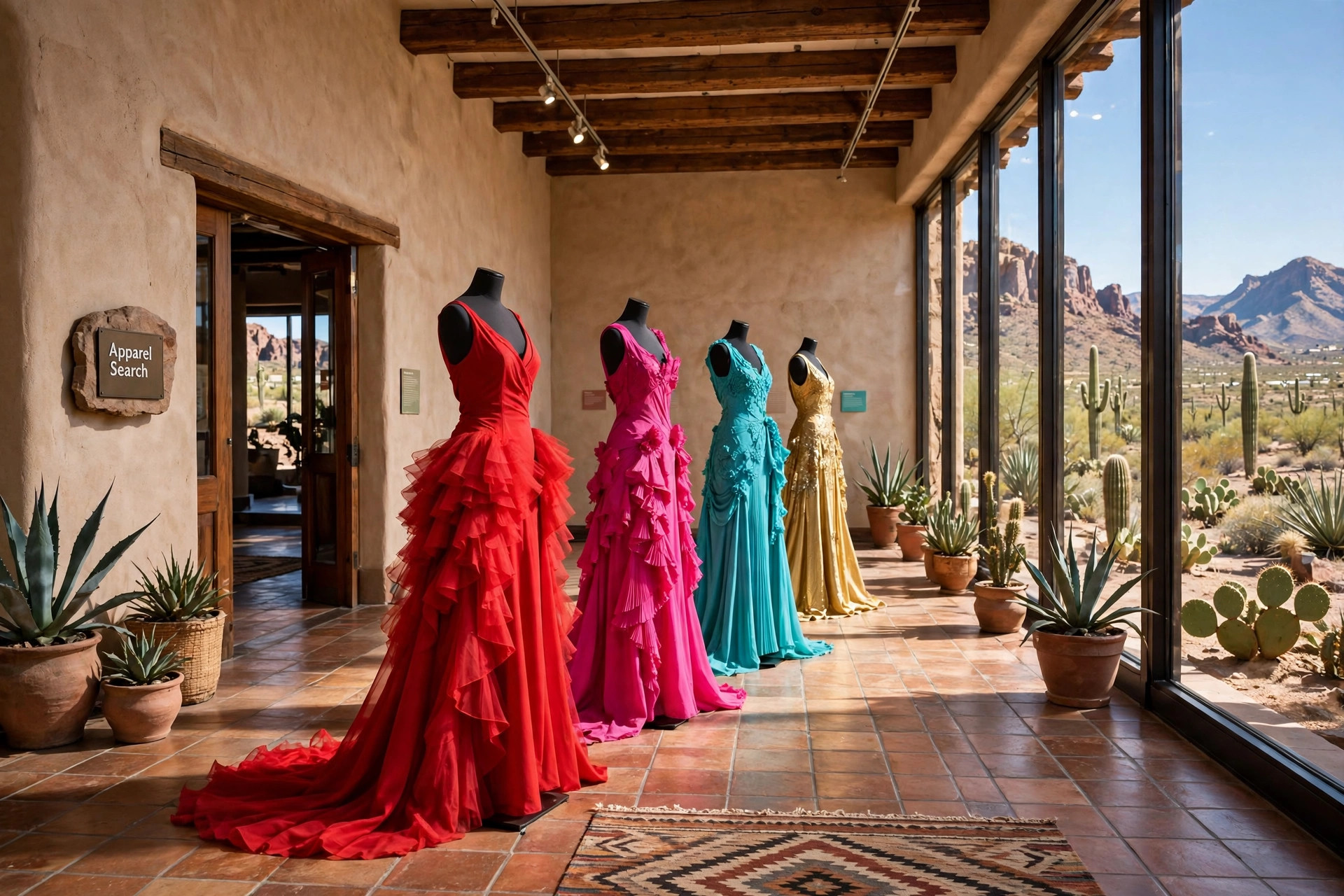
The anniversary show is the one to plan around. Colorwear: A Kaleidoscope of Fashion opened on 15 April 2026 in the Kelly Ellman Fashion Galleries and runs to 15 August 2027, commemorating sixty years of the fashion collection with a chromatic celebration arranged, in the museum's words, across a runway of vibrant hues. Hubert de Givenchy, Olivier Lapidus, Tina Leser and Giorgio di Sant'Angelo show how designers build with colour; beside the gowns sit the collection's smallest extremes — Judith Leiber pillboxes encased in multicoloured crystals, psychedelic scarves, and shoes that run from Egyptian gold to graffiti paint. The show keeps moving: rotating ensembles, a new commission — an ombré Christian Siriano gown moving from a fuchsia bodice through sixteen ruffled tiers of purple, unveiled in the galleries in October 2026 — and the museum's first fashion collection book, also titled Colorwear, published by Scala. Helen Jean, who curated the exhibition with curatorial assistant Summer Rye, puts its premise simply: colour is one of the first elements we describe when we talk about an ensemble, and designers from Schiaparelli, with her Shocking Pink, to Dior and Chanel built signatures out of it.
The Support System
The Arizona Costume Institute at Sixty
Every durable fashion collection has an engine room, and Phoenix's is unusually visible. The Arizona Costume Institute funds acquisitions, underwrites exhibitions and education, runs lectures and films, and maintains a body of research material — the Astaire Library of Costumes, housed within the museum's art research library. All fashion exhibitions at the museum are underwritten by the Kelly Ellman Fashion Endowment Fund and the Thomas Carlton Rogers II Fashion Exhibition Fund, and the galleries themselves carry Kelly Ellman's name: the Kelly Ellman Fashion Galleries are the collection's permanent home inside the museum, the rooms where Colorwear and its successors hang.
The institute's sixtieth year shows the model at full stretch: an anniversary exhibition drawn entirely from the collection it built, a first fashion book to publish that collection to the world, a programme of lectures by nationally recognised fashion professionals, and a one-night runway show in October 2026 at which Christian Siriano presented his Spring/Summer 2027 collection fresh from New York Fashion Week and unveiled the ombré gown the museum had commissioned from him for the collection — the new acquisition wearing the anniversary's colours on the cover of the anniversary book. A support group founded to buy dresses had become, sixty years on, a commissioning, publishing, programming institution in its own right.
What ACI really demonstrates is a transferable lesson in how fashion survives inside general museums. A curator can build a collection; only an organised community of supporters can defend its budget, endow its exhibitions and hand the commitment on across sixty years of directors, recessions and changing taste. New York has its Benefit; Phoenix has its Institute — different instruments, the same structural insight, and the reason this comparatively young museum holds a fashion collection of national standing at all.
A young museum in a young desert city decided in 1966 that clothes were worth collecting seriously — and then organised the supporters to keep that promise for sixty years.
The Home
Central Avenue: A Museum Built for the Desert Light
The museum stands at 1625 North Central Avenue, in Phoenix's Central Corridor, on the civic-centre site assembled from the 1940s. Alden B. Dow's original 1959 building gave the young museum a modernist home shaped by a Wright-trained hand; the 1965 east wing added the Western and Mexican galleries and a sculpture courtyard; and the Tod Williams Billie Tsien expansions of 1996 and 2006 layered in the great lobby, new gallery wings and the Ellen and Howard C. Katz Wing for Modern Art. Today the museum covers some 285,000 square feet, with a collection of more than 21,000 works across American, Western American, Asian, European, Latin American, modern and contemporary art — and fashion.
For the fashion visitor, that breadth is the bonus. A morning in the Kelly Ellman Fashion Galleries can run straight into photography shown through the museum's landmark partnership with the Center for Creative Photography, or into the Latin American and Western American galleries that frame the regional culture Phoenix fashion grew up in. Dress does not sit in a silo here; it sits in the middle of the Southwest's art story, which is precisely where the Arizona Costume Institute always argued it belonged.
Visiting
Visiting as a Fashion Pilgrim
Make the Kelly Ellman Fashion Galleries your first stop, and if your trip falls while Colorwear is on — it runs to August 2027 — give it the time its rotating installations reward: the anniversary show is designed to change across its run, with ensembles rotated and new acquisitions, including work by contemporary designers, set alongside the historic archives. Then work outward: the Beene, Emphatics and Taylor archives surface across the museum's fashion programming, so ask what is on, and leave time for the wider museum — the photography partnership alone justifies an extra hour.
Phoenix rewards the fashion traveller beyond the museum, too: the city has its own fashion week scene, which our Phoenix Fashion Week page covers, and Arizona State University now teaches fashion in a degree programme built by the museum's own former curator — a sign of how thoroughly PhxArt's fashion work has seeded its region. As with every guide in this series, check the museum's own website — phxart.org — for current exhibitions, opening hours and admission details before you go; this guide deliberately lists none, because all three change.
Exhibitions change and galleries are rehung, so the details here describe Phoenix Art Museum as documented for this guide — the museum's own site always carries the latest version.
Common Questions
Common Questions
Is Phoenix Art Museum a fashion museum or an art museum?
Both. Phoenix Art Museum is a general art museum — the largest in the southwestern United States, opened in 1959 — with a dedicated fashion design collection that it has built continuously since 1966. Fashion is one of its collecting areas, with its own curator, its own support institute and its own galleries, the Kelly Ellman Fashion Galleries.
How big is the Phoenix Art Museum fashion collection?
More than 9,000 objects, by the museum's own count: women's, men's and children's dress spanning the 18th century through the present. It includes four special archives — the Geoffrey Beene Archive, the Emphatics Archive, the Ann Bonfoey Taylor Archive and the Paper Dress archive.
What is the Arizona Costume Institute?
The Arizona Costume Institute (ACI) is the museum support group founded in 1966 to build and sustain the fashion collection. It supports acquisitions and preservation of garments and accessories of historical and aesthetic significance, and funds and promotes the museum's fashion exhibitions and education programmes. The fashion collection exists in its present form because of ACI's sixty years of support.
What is Colorwear at Phoenix Art Museum?
Colorwear: A Kaleidoscope of Fashion is the exhibition marking the 60th anniversary of the fashion collection, on view in the Kelly Ellman Fashion Galleries from 15 April 2026 to 15 August 2027. Arranged as a runway of colour, it shows how designers including Givenchy, Tina Leser and Giorgio di Sant'Angelo have used colour as inspiration, from couture gowns to crystal Judith Leiber pillboxes and psychedelic scarves.
Who curates fashion at Phoenix Art Museum?
Helen Jean, the Jacquie Dorrance Curator of Fashion, who has held the post since 2019 and curated Colorwear with curatorial assistant Summer Rye. She succeeded Dennita Sewell, whose nearly twenty years in the role (2000–2019) added more than 3,000 objects and brought the museum's fashion exhibitions national press coverage.
In This Series
Every guide in Fashion Museums of the World, from the section hub.
Museums & Exhibitions on Apparel Search
The site's existing museum coverage, including the term guide this series grows from.
Related on Apparel Search
The industry around the museum, and a designer it championed.
Search Apparel Search