Fashion Museums of the World · New York
The Museum at FIT
New York has two great fashion museums, and they could hardly be more different. Uptown, the Costume Institute stages blockbusters inside the Met. Downtown in Chelsea, inside a working fashion college, the Museum at FIT does something quieter and, for people who make and study clothes, just as essential: it treats fashion as an idea to be argued about, in exhibitions built from a collection of more than 50,000 garments and accessories. Michael Kors has called it “the fashion insider's fashion museum” — this guide explains why.
Museum Label
- Institution
- The Museum at FIT — the museum of the Fashion Institute of Technology (FIT), part of the State University of New York
- Home
- The FIT campus, Seventh Avenue at 27th Street, Chelsea, New York
- Founded
- 1969, as the Design Laboratory; renamed The Museum at FIT in 1993
- Collection
- More than 50,000 garments and accessories from the 18th century to the present, plus thousands of textiles (the museum's figure)
- Director
- Dr. Valerie Steele, director since 2003 and chief curator since 1997
- Known for
- Innovative, award-winning thematic exhibitions and a fashion history gallery completely re-hung roughly every six months
The Institution
A Fashion Museum Inside a Fashion School
The Museum at FIT is one of only a handful of museums in the world devoted to the art of fashion — and it is the only museum in New York City dedicated solely to it. What sets it apart from every other museum in this series is its address: it is not a standalone palace of culture but the museum of a college, the Fashion Institute of Technology, a part of the State University of New York whose students learn design, business and technology for the fashion industry in the buildings around it. The museum was founded to support that teaching, and teaching — of students first, and of the hundred thousand visitors the museum says it welcomes each year — is still written into everything it does.
That origin gives the museum its particular character. Where a great encyclopedic museum displays fashion as one art among many, FIT displays it as a discipline: something with techniques to be mastered, a history to be argued over and a culture to be read. Its exhibitions are famous in the field for being thesis-driven — each one advances an argument about what fashion means, not simply a parade of beautiful objects — and its publications and annual Fashion Symposium carry those arguments to scholars, designers and curators around the world.
The museum is accredited by the American Alliance of Museums, an honour it received in the summer of 2012, which places its professional standards — conservation, documentation, governance — alongside those of the country's major art museums. It sits, as the museum itself notes, in a select group of specialised fashion museums worldwide, in the company of institutions such as the Musée de la Mode in Paris, Antwerp's Mode Museum and Santiago's Museo de la Moda — several of which have their own guides in this series.
For the fashion industry, the museum's position inside a school is a practical gift as well as an intellectual one. The students who walk its galleries in the morning are the designers, buyers and journalists who will shape the trade in a decade, and the museum's staff collaborate with FIT's graduate students each year to mount a professional exhibition — training the next generation of fashion curators in the same galleries where the field's history is kept.
History in Brief
From Design Laboratory to The Museum at FIT
The museum was founded in 1969 to support the educational programmes of the Fashion Institute of Technology. Known then as the Design Laboratory, it began presenting exhibitions in the 1970s — the museum was installed in its current building in 1974 and exhibitions began there in 1975 — working at first with a collection on long-term loan from the Brooklyn Museum of Art. A teaching collection, borrowed from a neighbour: that was the modest beginning.
Over time the Design Laboratory acquired a collection of its own, and in the 1980s it became something more than a valuable educational tool. The late Richard Martin and his colleague Harold Koda — both later famous uptown at the Costume Institute — organised seminal fashion exhibitions there, among them Fashion and Surrealism, Three Women and Jocks and Nerds, shows that treated fashion as a subject for serious cultural argument years before that was fashionable. A conservation laboratory was also established in that decade to care for the rapidly growing collection of clothing and textiles.
In 1993 the Board of Trustees of FIT, noting the significance of the Design Laboratory's collections and exhibitions, changed the institution's name to The Museum at FIT — a formal admission that the teaching lab had become a museum in its own right. Four years later, in 1997, the fashion historian Dr. Valerie Steele joined the staff. Steele had already made her name as a scholar of fashion's darker and more intimate corners, and at FIT she curated exhibitions such as London Fashion — which received the first Richard Martin Award for Excellence in Costume Exhibitions from the Costume Society of America — The Corset: Fashioning the Body and Gothic: Dark Glamour. She was named director of the museum in 2003, while also serving as its chief curator, and she has led it ever since.
Under Steele the museum added the public programmes that now frame its exhibitions: the annual Fashion Symposium, launched in 2003 alongside the exhibition Femme Fatale: Fashion and Visual Culture in Fin-de-Siècle Paris, which brings an interdisciplinary mix of scholars, authors and curators to FIT for two days of argument about a theme drawn from the current special exhibition; and the Couture Council, a membership group founded to support the museum's exhibitions and programmes, whose annual Award for Artistry of Fashion — first given to Ralph Rucci in 2006 — has since honoured designers from Alber Elbaz and Karl Lagerfeld to Christian Louboutin and Thom Browne.
What Made Its Name
Exhibitions With an Argument
The Museum at FIT is best known, in its own words, for its innovative and award-winning special exhibitions — more than 200 of them across its first half-century. The pattern was set early: take a subject the fashion world thinks it already understands — a garment, a subculture, a city, a body — and rebuild it as a question. The landmark shows, and what each one argued:
| Exhibition | Year | What it argued |
|---|---|---|
| Fashion and Surrealism | 1980s | One of the Martin and Koda exhibitions that established the Design Laboratory as a place where fashion was read against art and ideas, not just displayed. |
| London Fashion | 2001 | Valerie Steele's portrait of London as a fashion capital, winner of the first Richard Martin Award for Excellence in Costume Exhibitions. |
| The Corset: Fashioning the Body | 2000 | Took the most controversial garment in fashion history — instrument of oppression or of erotic power, depending on who was asked — and let the objects make both cases. |
| Madame Grès: The Sphinx of Fashion | 2007 | A monographic retrospective examining the working methods and unique aesthetic of a great couturier, built around how Grès actually made her draped gowns. |
| Gothic: Dark Glamour | 2008 | Traced gothic style from its literary and architectural roots into the work of Alexander McQueen, Rick Owens and the goth subculture — darkness as a permanent fashion language. |
| A Queer History of Fashion: From the Closet to the Catwalk | 2013 | A pioneering exhibition, organised by Steele with senior curator Fred Dennis, on LGBTQ contributions to fashion — the museum taking up a history the industry had lived but rarely stated. |
| Paris, Capital of Fashion | 2019 | Asked why Paris, of all cities, became fashion's capital — and what that crown has meant, in the special exhibitions gallery. |
| Exhibitionism: 50 Years of The Museum at FIT | 2019 | The museum turned its own method on itself, restaging 33 of its most influential exhibitions for its fiftieth anniversary. |
Read together, the list explains the museum's reputation. A Costume Institute show is an event; a Museum at FIT show is an essay you can walk through. Steele herself has described the museum's exhibitions as “intelligent, innovative, and independent”, and the description has stuck because the shows keep earning it — on subjects, from sustainability in Eco-Fashion: Going Green to the ballerina's influence in Ballerina: Fashion's Modern Muse, that treat fashion as a lens on the whole culture rather than a world of its own.
That seriousness travels. The museum's exhibitions are accompanied by scholarly books — several of them standard references in fashion studies — and its curators are among the most quoted voices in the field. When a newspaper needs someone to explain why a silhouette changed, or what a corset really did, it is very often this museum's director who gets the call.
The Collection & The Home
Three Galleries, One Rotating Survey of Fashion
The collection the exhibitions draw on now consists, by the museum's count, of more than 50,000 garments and accessories from the 18th century to the present, as well as thousands of textiles and other fashion-related material. Important designers such as Adrian, Balenciaga, Chanel and Dior are represented, and the collecting policy is explicit about its taste: aesthetically and historically significant, directional clothing, accessories, textiles and visual materials, with emphasis on contemporary avant-garde fashion. This is a collection that buys the difficult new thing on purpose, while it is still new — which is why its holdings of recent decades are the ones other museums come to borrow.
The museum works in three galleries. The lower-level gallery is devoted to the special exhibitions — the big thematic shows described above. Gallery FIT, on the main floor, is dedicated to student and faculty exhibitions, including the graduating students' show each May. And on the main floor sits the gallery that makes this museum unique among the blockbuster houses: the Fashion and Textile History Gallery.
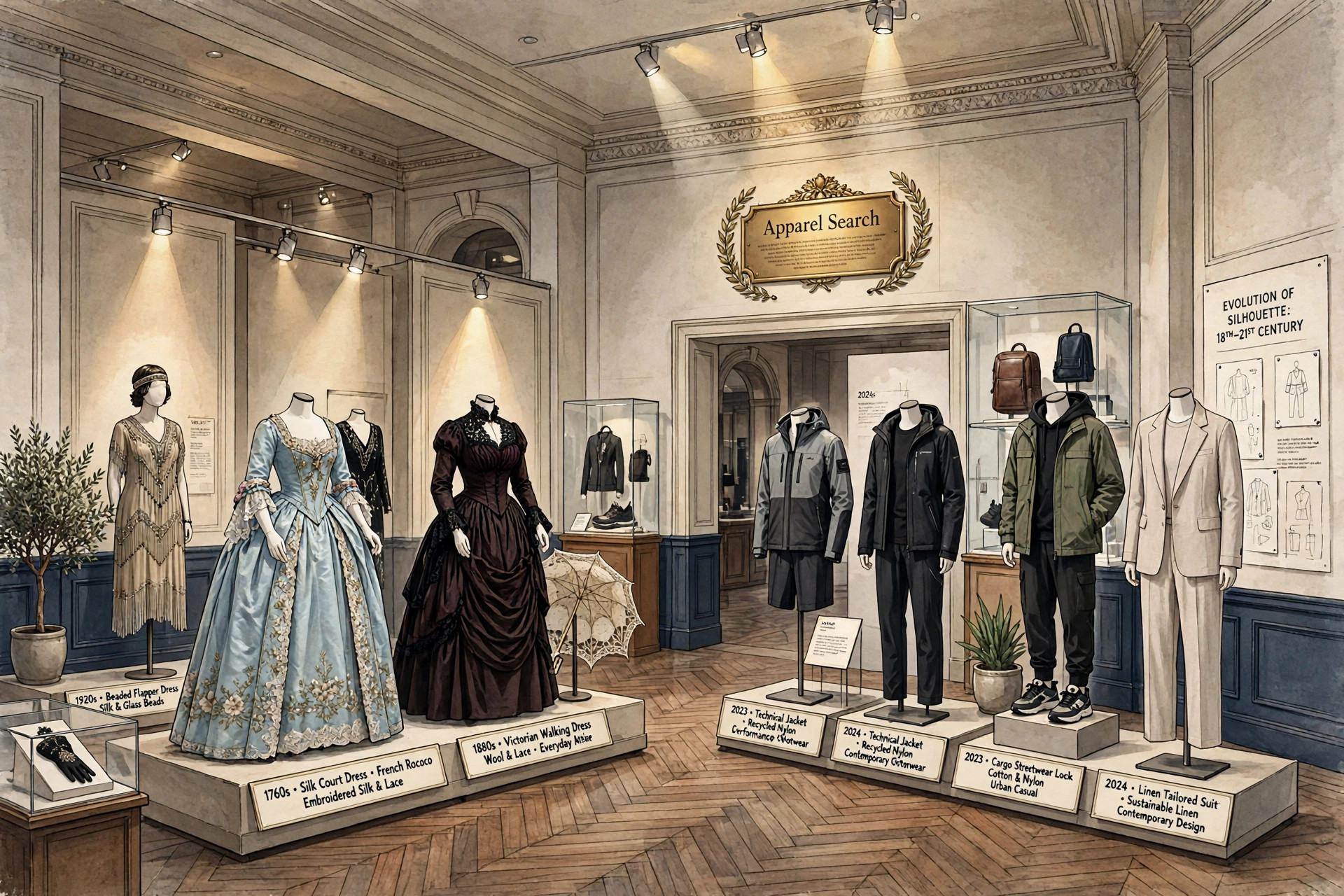
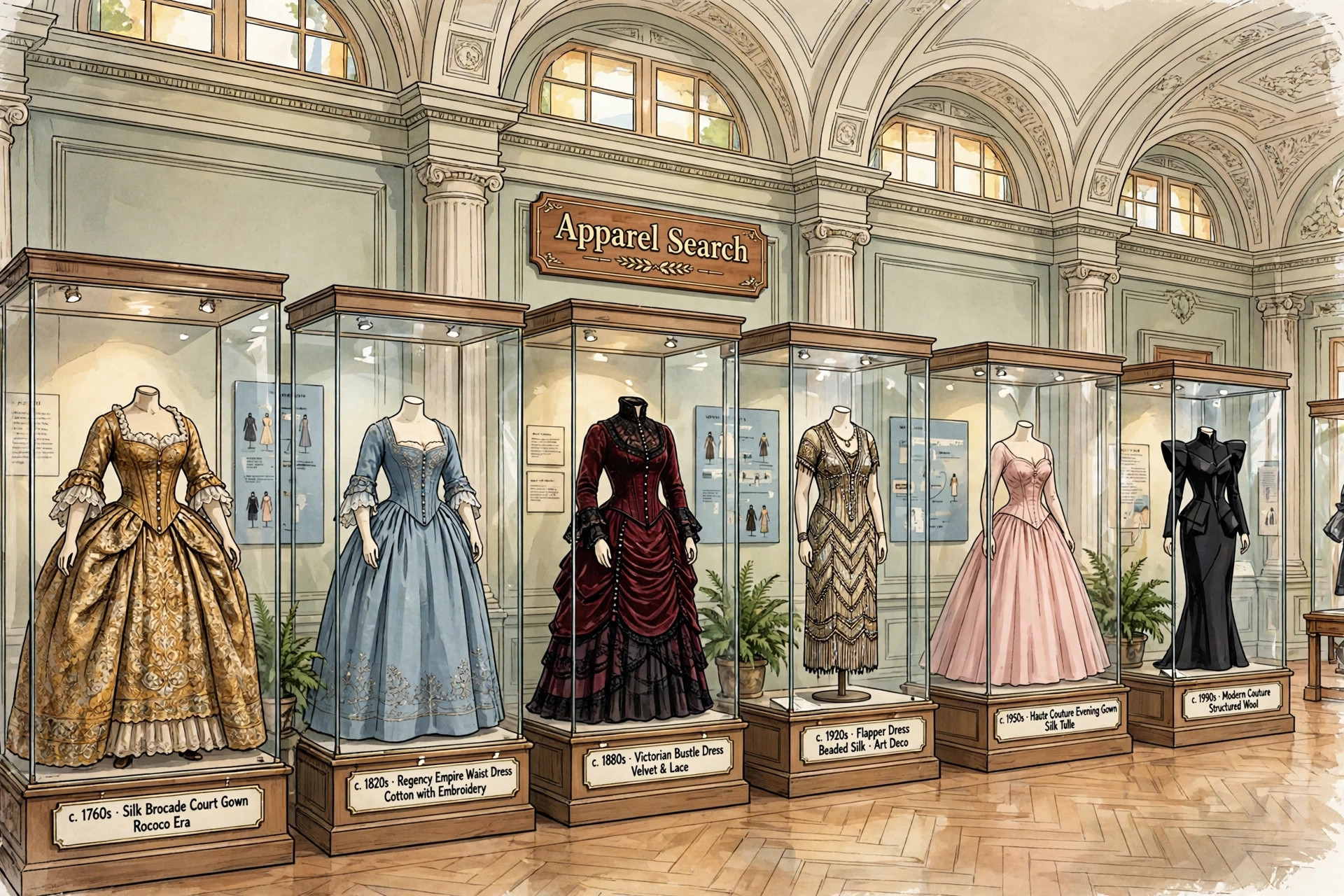
The History Gallery presents a rotating selection of approximately 200 historically and artistically significant objects from the permanent collection — and every six months, the exhibition in the gallery is completely changed, although it always covers a history of fashion. In effect, the museum re-hangs its own permanent survey twice a year: an 18th-century court dress gives way to a different one, the 1920s are retold through different flappers, the avant-garde of one decade steps aside for another's. For a collection of 50,000 objects, of which only a few hundred can ever be on view, that rhythm is both a conservation duty — textiles rest in the dark between outings — and a standing invitation to return. A visitor who came last year has, in this gallery at least, a genuinely new museum waiting.
Behind the galleries sits the working museum: a conservation laboratory, a photographic studio and workshop, more than 14,000 square feet of on-site storage, classrooms, and offices for a staff of some thirty full-time specialists in the conservation, documentation, exhibition and interpretation of fashion. It is the infrastructure of a research institution wearing the clothes of a small Chelsea museum.
A teaching collection that outgrew its classroom — and became the museum the fashion industry itself calls its own.
Visiting
Visiting as a Fashion Pilgrim
The Museum at FIT stands on the FIT campus at Seventh Avenue and 27th Street in Chelsea — a short walk from the Garment District whose history fills its cases, and an easy pairing with the Costume Institute uptown for anyone making a New York fashion pilgrimage. The museum says more than 100,000 people visit it each year — students between classes, designers between collections, and visitors who have learned that the smartest fashion exhibition in New York is often the one hanging in a college in Chelsea. Plan around the galleries: the special exhibition in the lower-level gallery is the headline, the Fashion and Textile History Gallery on the main floor is the essential context — remember that it is completely re-hung roughly every six months, so even a repeat visit is a new survey — and Gallery FIT shows you the students whose work the museum exists to teach, the fashion future hanging a few steps from its past.
Build time into the visit for the museum's public life. Its Fashion Culture programmes — lectures, panel discussions, fashion conversations and guided tours — run alongside the exhibitions, and the annual Fashion Symposium is the field's liveliest two days of argument about dress. If you study or work in fashion, note what kind of institution this is: a museum inside a college, whose collection, library culture and curators are oriented to research as much as to display. The museum's own website carries its current exhibitions — its programme is listed well ahead, into future seasons — along with opening arrangements and programme details, all of which change, so check it before you go.
Exhibitions change and galleries are rehung, so the details here describe the Museum at FIT as documented for this guide — the museum's own site always carries the latest version.
Common Questions
Common Questions
Is the Museum at FIT the same as the Costume Institute?
No. They are New York's two fashion museums, but they are different institutions. The Costume Institute is the fashion department of the Metropolitan Museum of Art, uptown at the Met Fifth Avenue. The Museum at FIT is the museum of the Fashion Institute of Technology, a State University of New York college in Chelsea — founded in 1969 as the Design Laboratory and renamed The Museum at FIT in 1993. Fashion lovers visiting New York should see both.
How big is the Museum at FIT's collection?
More than 50,000 garments and accessories from the 18th century to the present, by the museum's own count, as well as thousands of textiles and other fashion-related material. Its collecting policy emphasises aesthetically and historically significant, directional fashion, with a particular strength in contemporary avant-garde work by designers from Adrian and Chanel to the present day.
Who runs the Museum at FIT?
Dr. Valerie Steele, who joined the museum in 1997 as chief curator and was named its director in 2003. A fashion historian, Steele has curated exhibitions including London Fashion, The Corset: Fashioning the Body and Gothic: Dark Glamour, and founded the museum's annual Fashion Symposium. She is one of the most widely quoted scholars of fashion in the world.
Why does the fashion history gallery keep changing?
Because the museum designed it that way. The Fashion and Textile History Gallery shows a rotating selection of approximately 200 objects from the permanent collection, and every six months the exhibition is completely changed, although it always covers a history of fashion. Rotation rests fragile textiles, brings more of the 50,000-object collection into view, and means the survey is new on every visit.
What should a fashion lover not miss at the Museum at FIT?
The special exhibition in the lower-level gallery — the museum's famous thesis-driven shows — and the Fashion and Textile History Gallery on the main floor, whose roughly 200-object survey of fashion history is re-hung about every six months. Add Gallery FIT for student and faculty work, and check the museum's own website for the current exhibitions and programme details before you go.
In This Series
Every guide in Fashion Museums of the World, from the section hub.
Museums & Exhibitions on Apparel Search
The site's existing museum coverage, including the term guide this series grows from.
Related on Apparel Search
The industry world around the museum, and the summary page that pairs it with New York's other fashion museums.
Search Apparel Search