Apparel Search · Seasonal Color Analysis
How to Find Your Color Season
The step-by-step method: undertone tests, value and chroma checks, and a daylight draping test to confirm which of the twelve seasons is yours.

Every palette in the Seasonal Color Analysis Guide starts with one piece of self-knowledge: which season's colors harmonize with you. Finding your season is a process of elimination built on three observations — your undertone, your value and your chroma — followed by a draping test that confirms the answer with your own eyes. None of it requires a professional; a mirror, natural light and a handful of garments in different colors are enough. Work through the steps in order, because each one narrows the field for the next.
Step One: Find Your Undertone
- The jewelry test. Hold gold and silver jewelry (or fabric) against the inside of your wrist or beside your face. On warm undertones, gold seems to blend in and flatter; on cool undertones, silver does. If both look equally fine, you may have a neutral undertone — common in the sub-seasons that sit between warm and cool neighbors.
- The vein and white tests. In daylight, wrist veins that look greenish suggest warm undertones; blue or purple veins suggest cool. Similarly, warm skin tends to look better against cream and ivory, cool skin against bright optical white.
- Your natural palette. Warm coloring usually comes with golden, red or strawberry hair tones and green, hazel or warm brown eyes. Cool coloring pairs with ash-toned hair, and blue, grey or cool brown eyes. These are tendencies, not rules — dyed hair especially should be judged by what grows at the root and by your skin.
Your undertone splits the four seasons into two camps: warm points to Spring or Autumn; cool points to Summer or Winter. That single answer already tells you which metals, whites and foundation shades are likely to suit you.
Step Two: Judge Your Value and Chroma
Value asks how light or deep your overall coloring is. A quick trick is to look at a black-and-white photo of yourself: if your hair, skin and eyes cluster at the light end, you are light; if they cluster deep, you are deep; most people sit in the middle. Light value points toward Spring or Summer; deep value toward Autumn or Winter. Chroma asks how bright or soft your coloring looks. Bright coloring has clear, contrasting features — sparkling eyes, distinct contrast between hair and skin. Soft coloring is blended and gentle, with features that melt into one another. Bright points to Spring or Winter; soft points to Summer or Autumn.
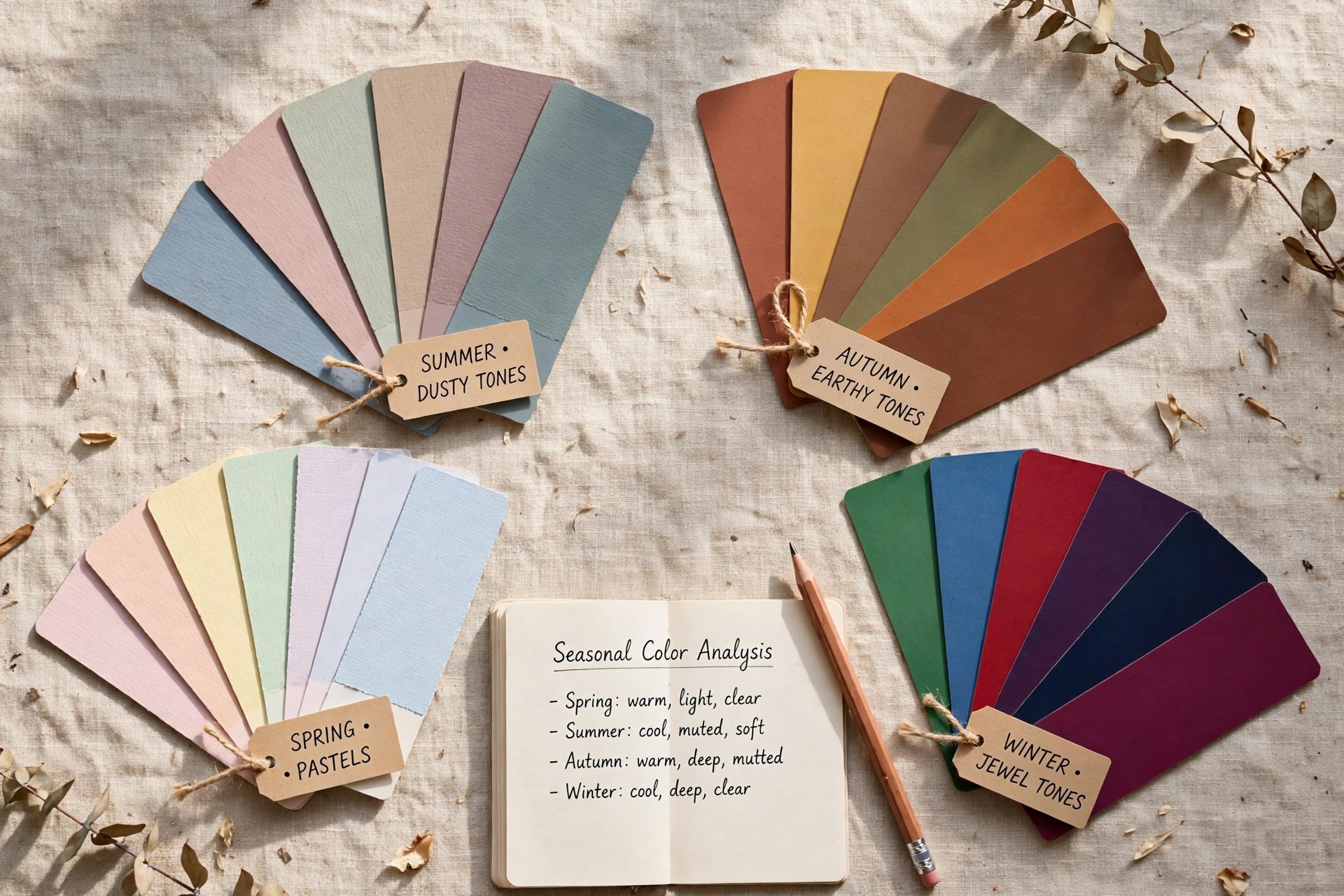
Combine the three answers and one season usually emerges: warm + light + bright = Spring; cool + light + soft = Summer; warm + deep + soft = Autumn; cool + deep + bright = Winter. If your three answers point at two different seasons, the dimension that is most obvious in you — your dominant characteristic — decides, and that is exactly how the twelve sub-seasons work: a Soft Autumn, for example, is soft first and warm second.
Step Three: The Draping Test
Draping is the confirmation step, and the most convincing. Sit in front of a mirror in natural daylight, without makeup, hair pulled back. Hold fabrics from opposite seasons under your chin, one at a time: a warm coral against a cool fuchsia, a soft dusty blue against a clear royal blue, ivory against pure white, mustard against icy pink. Watch your face, not the fabric. In your season's colors, skin looks even, eyes look bright, and shadows under the chin soften. In the wrong season, you may see sallowness, redness emphasized, or a tired, grey cast — effects that appear within seconds and are hard to unsee once spotted.
Test the two candidate seasons from step two first, then their shared border: many people land in a sub-season that leans toward the neighbor, such as Bright Spring (between Spring and Winter) or Soft Summer (between Summer and Autumn). When two seasons both look good, trust the drapes over the theory — the mirror is the final authority in this system.
Common Traps
Three mistakes catch most self-analysts. First, judging by your dyed hair color or a tan rather than your natural coloring; test against your roots and your untanned skin. Second, testing under yellow bathroom lighting, which warms every color and flatters warm seasons falsely — daylight is non-negotiable. Third, deciding by the colors you like rather than the colors that like you: preference and palette often differ, and the fix is not to abandon favorites but to wear them further from the face or in your season's version of that color family — every season, for example, has its own red, its own blue and its own white, as the four palette guides in this cluster show.
Once you have your season, go straight to its palette guide — Spring, Summer, Autumn or Winter — for exact shades, neutrals and metals. And if shopping is next, the clothes-by-color guide families linked from each palette page will take you from a shade to actual garments.
Common Questions
Can I find my color season without a professional analyst?
Yes. The standard self-analysis follows the same steps professionals use: determine undertone with jewelry and white tests, judge value and chroma from a black-and-white photo and your natural contrast, then confirm with a draping test in daylight. A professional adds trained eyes and a full set of drapes, which helps most in borderline cases.
What if I fall between two seasons?
That usually means one of the twelve sub-seasons fits you: the ones named Light, Soft, Bright or Deep lean toward a neighboring season. Identify your dominant characteristic — the quality that stands out most — and use the sub-season built on it, borrowing selectively from the neighbor.
Does hair dye or tanning change my season?
No. Your season is based on your natural coloring — skin undertone does not change with a tan, and analysts judge hair by its natural color at the roots. Dyeing your hair to a shade inside your palette, however, is one of the easiest ways to make your season work harder for you.
My favorite color is not in my palette. Should I stop wearing it?
No. Wear it away from your face — trousers, skirts, shoes, bags — or pair it with a palette color in the top or a scarf near your face. Every color family also has a version in every season, so your favorite hue usually has a close cousin inside your palette.
Back to the Seasonal Color Analysis Guide
The Seasonal Color Analysis Guide hub maps the whole twelve-season system — all four seasons, every sub-season palette, and how the pieces of this cluster fit together.