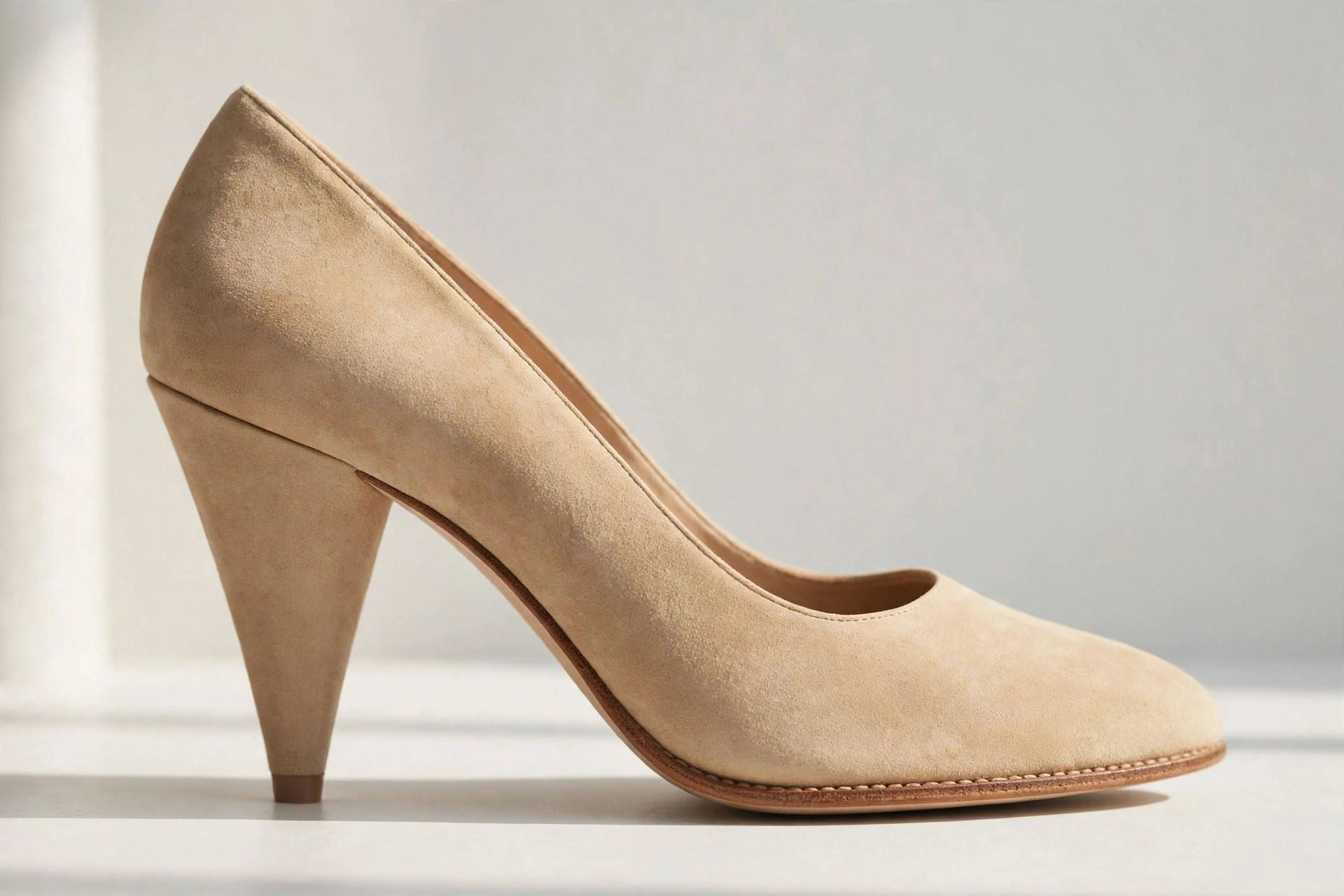
A cone heel is a heel that is wide where it joins the sole of the shoe and tapers smoothly to a narrower point at the base, so its profile resembles an inverted cone. The broad top gives the heel a firm connection to the shoe, while the sides slope inward on a straight or gently curved line. Cone heels appear at low, medium, and high heights, and the shape reads as sculptural and deliberate rather than thin or spindly.
How to Recognise a Cone Heel
Look at the heel from the side and from behind. A cone heel starts with a wide, often round or oval footprint at the sole line, then narrows steadily all the way down. There is no waist, bulge, or outward flare on the way: the outline is one continuous inward slope. That clean taper is what separates a cone from its close neighbours in the heel family.
- Cone heel — wide at the top, narrower at the base, in one smooth taper.
- Stiletto heel — thin and straight, with very little taper and a tiny ground contact.
- Flared and spool heels — these widen again toward the base, the opposite of the cone outline.
Because the shape is geometric, cone heels are often used as a design feature in their own right. Designers match them to a pointed toe, carve them in clear or metallic materials, or cover them in the same fabric as the upper so the whole shoe looks moulded from one piece.
Where Cone Heels Are Used
Cone heels suit shoes that need presence without the delicacy of a stiletto. On pumps and court shoes the taper gives a formal shoe a modern, architectural line. On sandals it balances wide straps and platform soles, and on ankle boots a low cone heel adds height while keeping the boot grounded and easy to wear through the day.
The wide top is more than decoration. It spreads the join between heel and sole over a larger area than a thin heel can, which helps the heel feel planted under the heel of the foot. The ground contact is still smaller than on a block or Cuban heel, so a tall cone heel asks for the same care on soft grass, gratings, and uneven paving as any other narrow-based heel.
When shopping, check the tip: replacing a worn heel tip promptly protects the tapered heel itself from splitting or chipping.
FAQs
- What does a cone heel look like?
- It looks like an upside-down cone: wide where it meets the sole of the shoe, then tapering smoothly to a narrower, rounded or flat point where it touches the ground.
- Is a cone heel easier to walk in than a stiletto?
- For many wearers, yes. The cone heel is broader where it joins the shoe and feels more planted than a thin stiletto, although its narrow base still needs care on soft or uneven ground.
- What shoes use cone heels?
- Cone heels are used on pumps, sandals, and ankle boots, at heights from low to high. The tapered shape is often chosen as a visible design feature, not just for support.
Detailed Guides: see Cone Heel in the glossary A–Z listing of the Apparel Search fashion glossary for related terms.