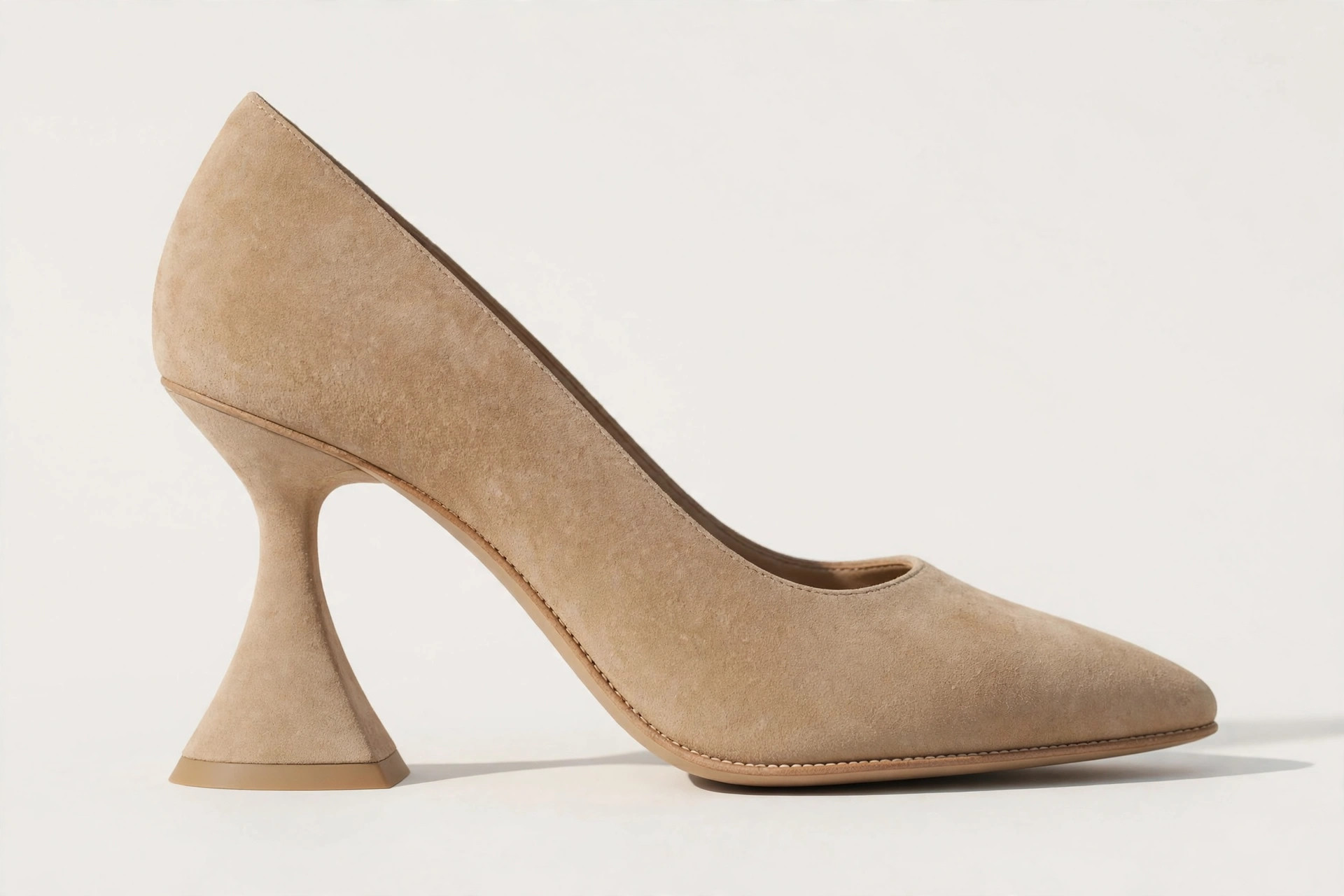
A flared heel is a heel that is narrower where it leaves the sole of the shoe and flares outward as it descends, so the base on the ground is wider than the top. The outward sweep is usually curved rather than straight, giving the heel an elegant, trumpet-like profile. Flared heels belong to the Louis heel family, the shaped heels named for the footwear of the French court.
How to Recognise a Flared Heel
Check the direction of the taper. Most heels are widest at the top and narrowest at the ground; a flared heel reverses that idea at the base. It leaves the sole fairly slim, often pinches in slightly, and then widens in a smooth outward curve to a broad, flat base. That final widening is the flare, and it is visible from both the side and the back.
- Flared heel — narrower at the top, wider at the base, with a curved sweep.
- Cone heel — the opposite outline: wide at the top, tapering to a narrower base.
- Spool heel — wide at top and bottom with a pinched waist; a close Louis-family relative.
The flare can be subtle, a gentle widening on a dress pump, or dramatic, as on retro and 1970s-inspired shoes where the heel sweeps out boldly and becomes the main design statement of the shoe.
The Louis Heel Family and Where Flared Heels Are Used
Flared heels descend from the Louis heel, the curved, flaring heel worn at the court of Louis XIV of France and revived many times since. Period shoes, historical costumes, and traditional character shoes still use the shape because it instantly signals an earlier era, while fashion revivals bring it back whenever vintage silhouettes return.
There is a practical side to the beauty. A wider base puts more of the heel in contact with the ground, which can make a flared heel feel steadier than a heel of the same height that ends in a small point. The weight of each step lands on a broader footprint, and the shoe is less likely to sink into soft ground than a stiletto.
Today flared heels appear on pumps, Mary Janes, sandals, and boots, in low and medium heights as well as taller retro styles. When buying, look for a base that sits flat: a well-made flared heel meets the floor across its whole base, with no rocking at the edges of the flare.
FAQs
- What is the difference between a flared heel and a cone heel?
- The taper runs in opposite directions. A cone heel is wide at the top and narrows to the base, while a flared heel is narrower at the top and widens outward toward the base.
- Is a flared heel stable?
- Yes, comparatively. Its wider base gives more contact with the ground than a narrow-pointed heel of the same height, so weight lands on a broader footprint with each step.
- What is a Louis heel?
- A Louis heel is the historic curved, flaring heel named for the court of Louis XIV of France. Flared and spool heels belong to this family of shaped, outward-sweeping heels.
Detailed Guides: see Flared Heel in the glossary A–Z listing of the Apparel Search fashion glossary for related terms.