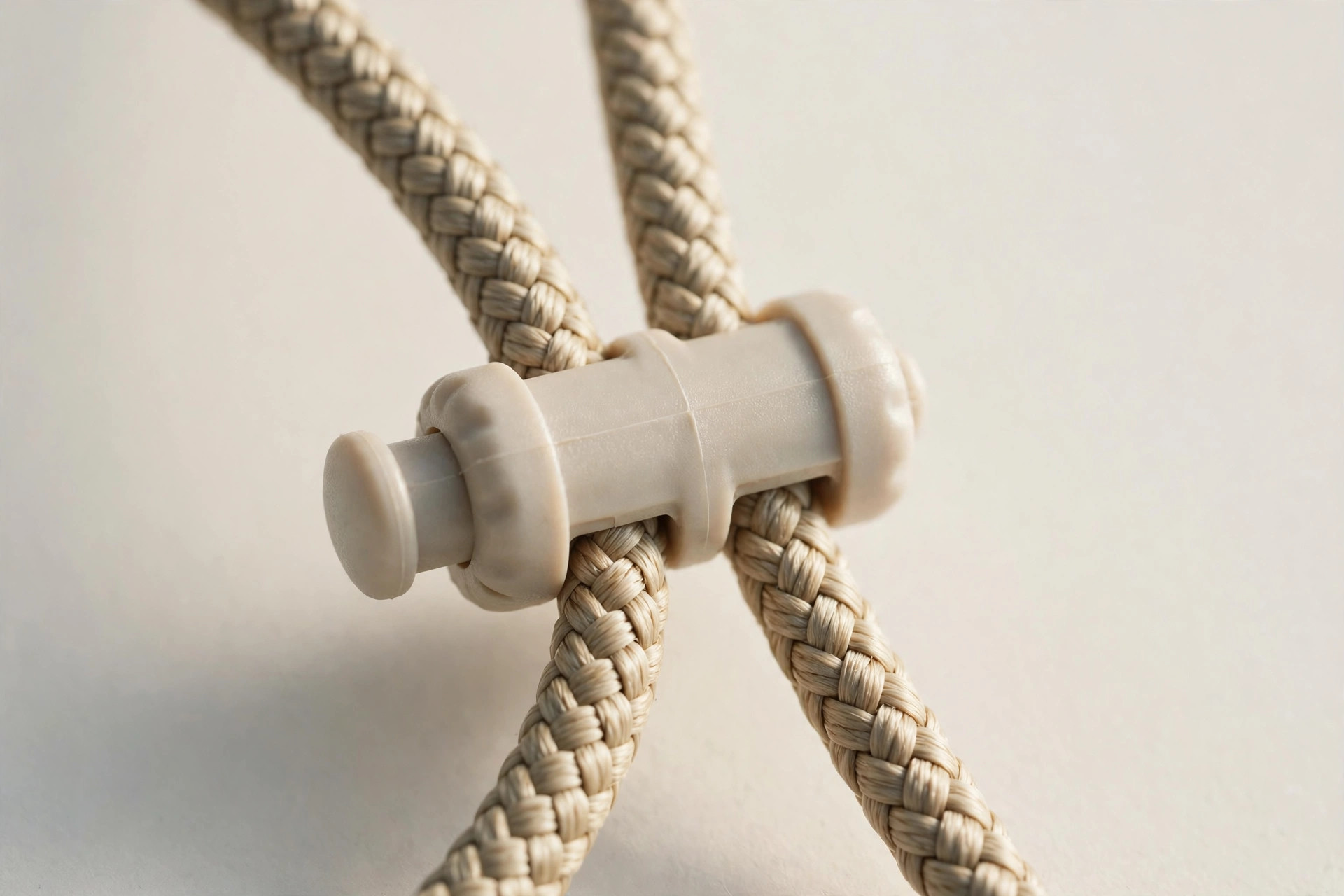
A cord lock (also called a cord toggle or barrel lock) is a small spring-loaded fitting threaded onto a drawcord. Inside its barrel, a spring pushes a plunger against the cord and clamps it fast; squeezing the plunger frees the cord so the lock slides, and releasing it locks the cord at the new position. It lets a hood, hem, or stuff sack be adjusted one-handed and stay adjusted.
How a Cord Lock Works
A standard cord lock has three parts: a hollow barrel, a plunger with a hole through it, and a spring between them. At rest, the spring holds the plunger's hole out of line with the barrel's holes, pinching the cord between the edges. Squeeze the plunger and the holes align — the cord runs free. Let go, and the spring clamps it again. Single-hole locks grip one cord end; double-hole locks take both ends of a looped cord, which is how most hood and hem adjustments are built. Fit one to a drawcord by squeezing, threading the cord end through, and knotting or fitting an aglet so the lock cannot slide off.
Where Cord Locks Are Used
- Hoods and jacket hems — one-handed cinching against wind and rain.
- Stuff sacks, laundry bags, and backpacks — closures that open and shut hundreds of times.
- Footwear and gloves — quick-lace and cuff adjustments.
- Camping and outdoor gear — tent guy-lines, sleeping-bag hoods, and pack compression.
Choosing and Specifying a Cord Lock
Size is the critical spec: the lock's holes must match the cord diameter — too large and the clamp slips under load, too small and the cord will not thread or the spring cannot travel. Plastic locks (usually acetal or nylon) are light, rust-proof, and standard on apparel; metal locks serve heavy outdoor and workwear duty. Shape matters to fingers in cold weather — large, textured plungers work with gloves on. On children's garments, cord locks count as toggles under drawcord safety rules, so their use, size, and placement need checking against the regulations for the market, just as cord length does.
FAQs
- How do you put a cord lock on a drawcord?
- Squeeze the lock's plunger to align the holes, push the cord end through the barrel and plunger, then release — the spring clamps the cord. Finish the cord end with a knot or aglet behind the lock so it cannot slide off, and slide the lock up to set the tension.
- Cord lock or a knot — which is better?
- A knot is free and permanent but slow to adjust and hard to undo when wet or cold. A cord lock adjusts in a second, one-handed, and holds a precise setting — which is why adjustable hoods, hems, and sacks use locks and fixed closures use knots.
- What size cord lock do I need?
- Match the lock to the cord diameter stated in its specification — a lock sold for 3 mm cord will not grip 2 mm cord reliably and will not accept 5 mm cord at all. When in doubt, spec the cord and lock together as a pair, exactly as a factory would order them.
Detailed Guides: see Cord Lock in the glossary A–Z listing of the Apparel Search fashion glossary for related terms.