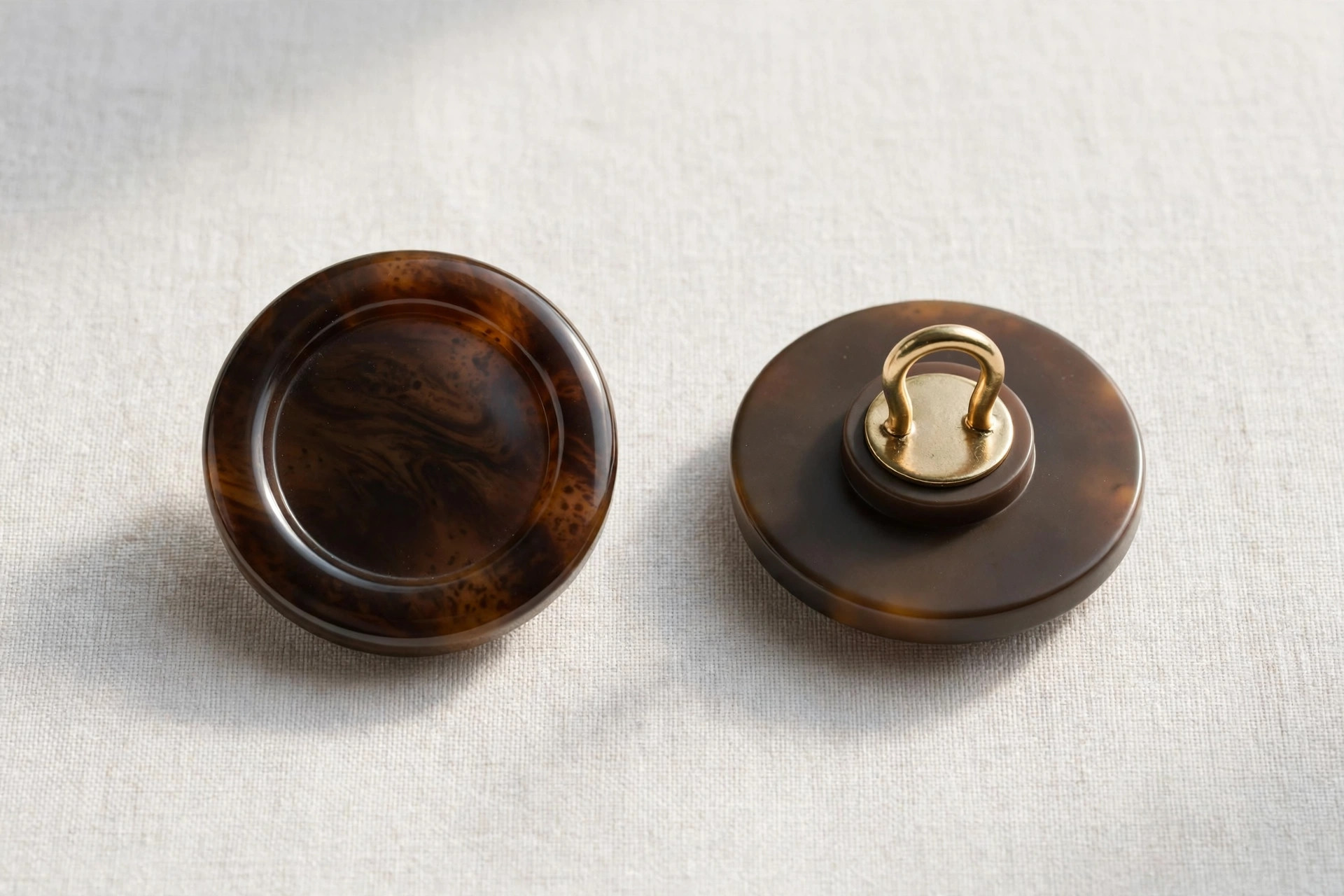
A shank button is a button with no holes through its face. Instead, it has a loop — the shank — of metal, plastic, or self-fabric fixed to its back, and it is sewn to the garment by passing the thread through that loop. The shank lifts the button away from the fabric surface, leaving room for the buttoned layer to sit underneath without pulling or puckering.
Why the Shank Matters
A flat sew-through button clamps the two layers of a closure tightly together. That is fine on a shirt, but on a coat the buttoned-through layer is thick: forced flat, the button strains its threads, the front puckers, and the button can pop or tear out. The shank solves this by building in a stem. The button face floats at shank height, the opposing fabric slides underneath, and the closure lies smooth. A side benefit is a clean face — with no visible holes or thread, shank buttons carry decoration, domes, crests, and covered-fabric designs that holes would spoil, which is why blazer, uniform, and military buttons are almost always shank style.
Where Shank Buttons Are Used
- Coats and overcoats — thick fronts and facings need the clearance a shank provides.
- Blazers and tailored jackets — metal and crested shank buttons are the tailored standard.
- Uniforms — domed metal shank buttons that polish and carry insignia.
- Knitwear and heavy fabrics — bulky yarns and tweeds sit under the button without distortion.
How a Shank Button Is Sewn
The button is stitched through the shank with several firm passes, leaving the thread stem between shank and fabric at roughly the thickness of the layer that will button under it — a home sewer's trick is to sew over a matchstick or pin to gauge the space. On heavy coats the stem is then wrapped with thread to firm it up, and a small flat anchor button is often sewn inside the facing to spread the strain. Buttons such as the natural corozo button are made in both sew-through and shank versions for exactly this tailored market.
FAQs
- What is the difference between a shank button and a flat button?
- A flat (sew-through) button has two or four holes through its face and sits flush on the fabric. A shank button has a loop on its back and stands off the fabric, leaving room for a thick buttoned layer underneath — which is why coats use shanks and shirts use flat buttons.
- How much space should a shank button leave?
- About the thickness of the fabric that will pass under it, including facings. Too little space strains the closure and puckers the front; too much leaves the button floppy. The shank height is chosen — or built up with thread when sewing — to match the garment.
- Can shank buttons be used on shirts?
- They can, but they are rarely the right choice. Shirts are thin, so the clearance is wasted, the raised button is more likely to catch and press uncomfortably, and flat sew-through buttons are cheaper and faster to attach by machine in production.
Detailed Guides: see Shank Button in the glossary A–Z listing of the Apparel Search fashion glossary for related terms.