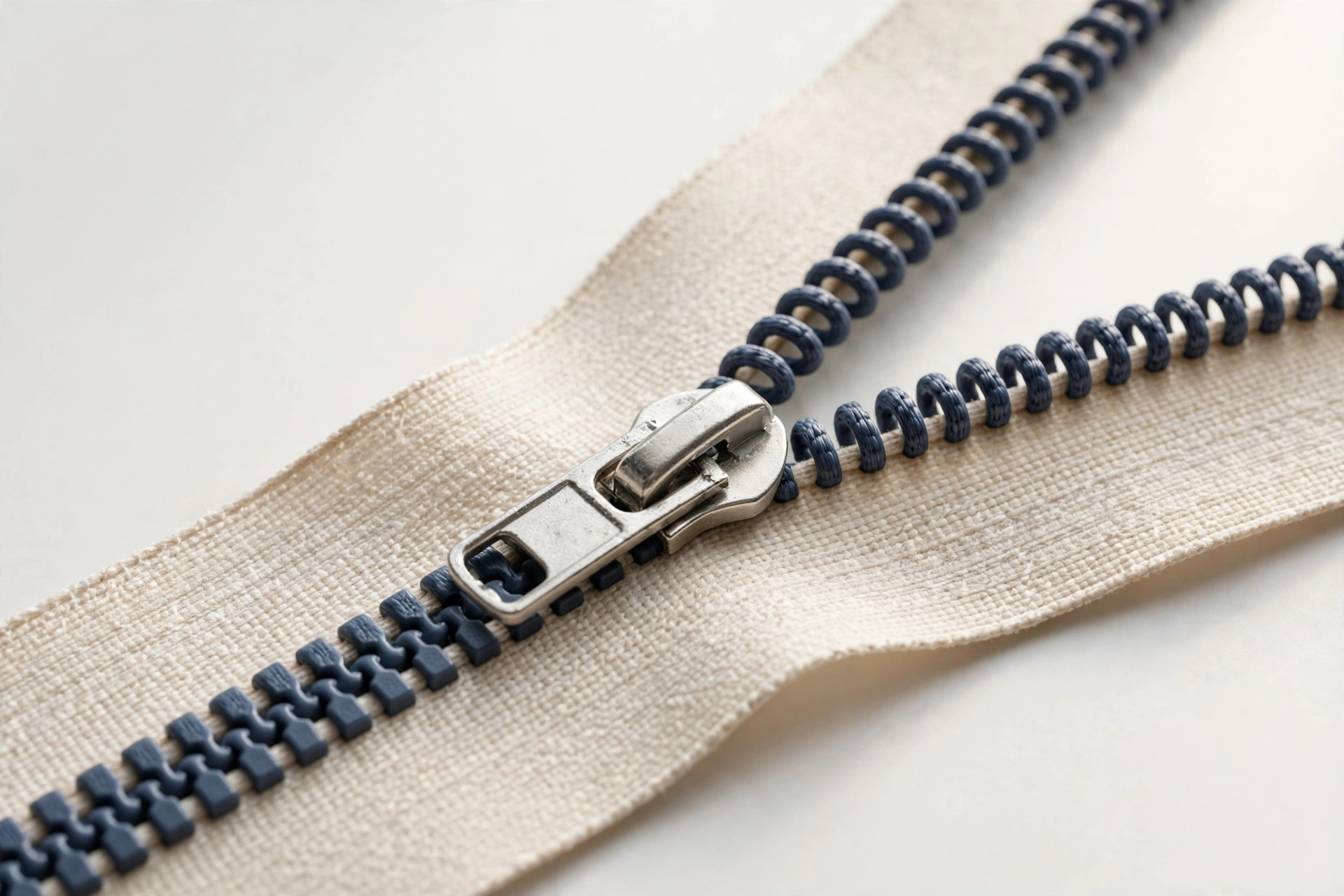
A coil zipper is a zipper whose teeth are not separate elements but one continuous spiral — a coil of nylon or polyester monofilament stitched or woven along the edge of each fabric tape. A slider joins the two coils by interlocking their loops. Because the coil is continuous and flexible, a coil zipper bends easily around curves, runs smoothly, and weighs very little.
How a Coil Zipper Is Built
Manufacturers form the coil by winding monofilament into a tight spiral and sewing it to the tape edge (or, in woven constructions, weaving it in). The slider's internal channels press the loops of the left and right coils into each other as it travels; the interlocked loops resist pulling apart sideways surprisingly well. Coil zippers are sized by coil width — fine #3 coils for dresses and cushions, #5 for jackets and bags, up to #10 for luggage and tents — and sold as finished zippers or as continuous chain by the meter, cut and fitted with sliders and stops on the production line.
Strengths and Where They Are Used
- Lightweight and flexible — follows curved seams on footwear, bags, and fitted garments.
- Smooth and quiet — no individual teeth to click, snag, or misalign one by one.
- Reversible and two-way use — sliders can run from either end or either face; a coil sewn face-down gives an invisible-style closure.
- Everywhere — luggage, backpacks, sportswear, tents, upholstery, and most everyday jackets and dresses.
Limits to Spec Around
A coil's weakness is the coil itself: it can be crushed flat, abraded through, or deformed by high ironing heat in ways a metal tooth survives, and if the stitching holding the coil breaks, the teeth go with it. For heavy abrasion, marine, and workwear duty, metal or molded-tooth zippers are usually specified instead. Within its range, though, the coil zipper is the workhorse of the industry — cheap, dependable, and easy to sew. Pair it with the right tape weight and slider, and compare it against the other constructions in our zippers directory.
FAQs
- Coil vs. molded plastic vs. metal zippers — which is strongest?
- For pull-apart and abrasion resistance, metal teeth are toughest, molded plastic teeth next, and coil last — but coil is the lightest and most flexible of the three, and strong enough for most garments, bags, and luggage. Strength also depends on size: a #10 coil out-pulls a small metal zipper.
- Can a coil zipper be repaired?
- Often, yes. Most failures are the slider wearing loose, and replacing the slider restores the zipper. A coil that is crushed, melted, or torn from its tape cannot be repaired and the whole zipper must be replaced — the same is true of a broken tooth on other zipper types.
- Why are coil zippers used so much in luggage and tents?
- They tolerate being bent, stuffed, and pulled around corners, they do not rust, they are light, and they can be bought as continuous chain and made to any length on site. A damaged metal tooth, by contrast, stops a zipper dead — a coil has no individual teeth to lose.
Detailed Guides: see Coil Zipper in the glossary A–Z listing of the Apparel Search fashion glossary for related terms.