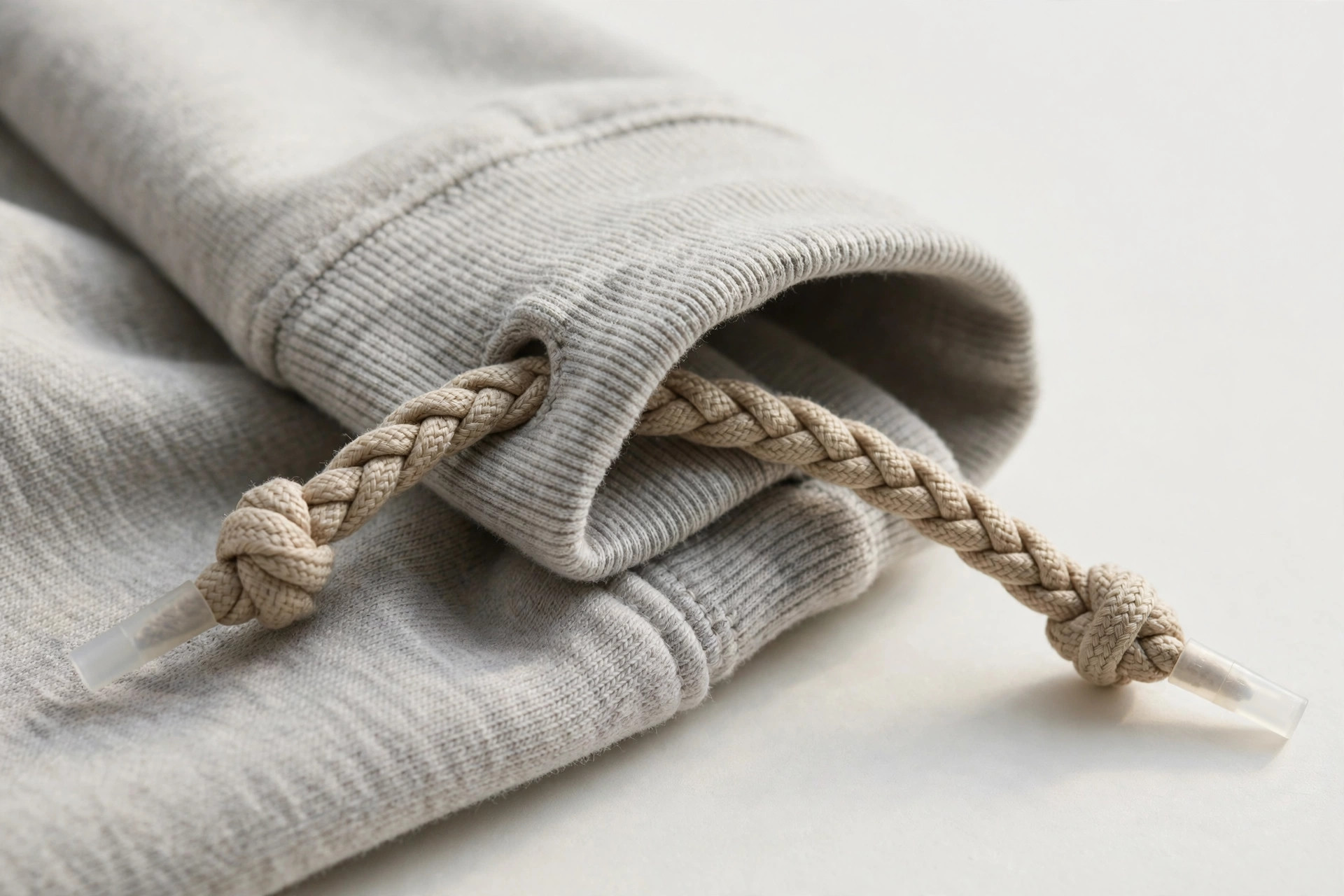
A drawcord (also called a drawstring) is a cord, rope, or flat tape threaded through a sewn channel — a casing — at the hood, waistband, hem, or cuff of a garment. Pulling the exposed ends gathers the casing and adjusts the fit; the cord is then tied, knotted, or held with a cord lock. It is the simplest adjustable closure in clothing, and one of the oldest.
Where Drawcords Are Used
Drawcords appear anywhere a garment must fit many bodies or adjust on the move: hoods that snug against wind, sweatpant and shorts waistbands, jacket and parka hems that seal out drafts, swim trunks, scrub and chef trousers, and the mouths of laundry bags, stuff sacks, and backpacks. In waistbands the cord is usually paired with elastic — the elastic does the everyday holding, the cord sets the final tension — while in hoods and hems the cord works alone, adjusted once and held by knots or a cord lock.
Materials, Ends, and Finishing
Cords are braided or knitted from cotton (soft, traditional, but weakens when wet), polyester (strong, quick-drying, the sportswear standard), or nylon, in round or flat profiles from about 3 to 8 mm. What matters most in production is the ending. Cut cord frays and disappears back into its casing, so ends are finished with aglets — small metal or plastic tips, like shoelace ends — heat-sealed, dipped, knotted, or bar-tacked in place. Better garments stitch the cord's midpoint to the back of the casing so it can never pull out entirely, a detail worth specifying in any tech pack.
Safety and Specification Notes
Drawcords on children's clothing are regulated in many markets: hood and neck drawcords on young children's garments are restricted or banned because they catch on playground equipment and doors, and waist and hem cords have length and toggle rules. Designers of children's styles should check the current rules for their market before specifying cord length, knots, or locks. For adult garments, spec the cord material, diameter, finished length, end finish, and whether a cord lock is included — 'drawcord' alone leaves all of it to the factory.
FAQs
- Is a drawcord the same as a drawstring?
- Yes — the two terms describe the same thing: a cord or string run through a casing to gather and adjust a garment. Drawcord is the more common term in technical packs and production, drawstring in everyday and retail language.
- What is an aglet on a drawcord?
- An aglet is the small tip — metal, plastic, or heat-shrunk film — fitted to the end of a cord to stop it fraying and make it easy to thread. It is the same fitting found on shoelaces. Knotted, dipped, and heat-sealed ends do the same job at lower cost.
- How do you stop a drawcord pulling out of its casing?
- Finish the ends so they cannot slip back — knots, aglets, or toggles wider than the eyelet — and, best of all, anchor the cord: a bar-tack or stitch through the cord at the center back of the casing holds it permanently while still letting both ends adjust.
Detailed Guides: see Drawcord in the glossary A–Z listing of the Apparel Search fashion glossary for related terms.