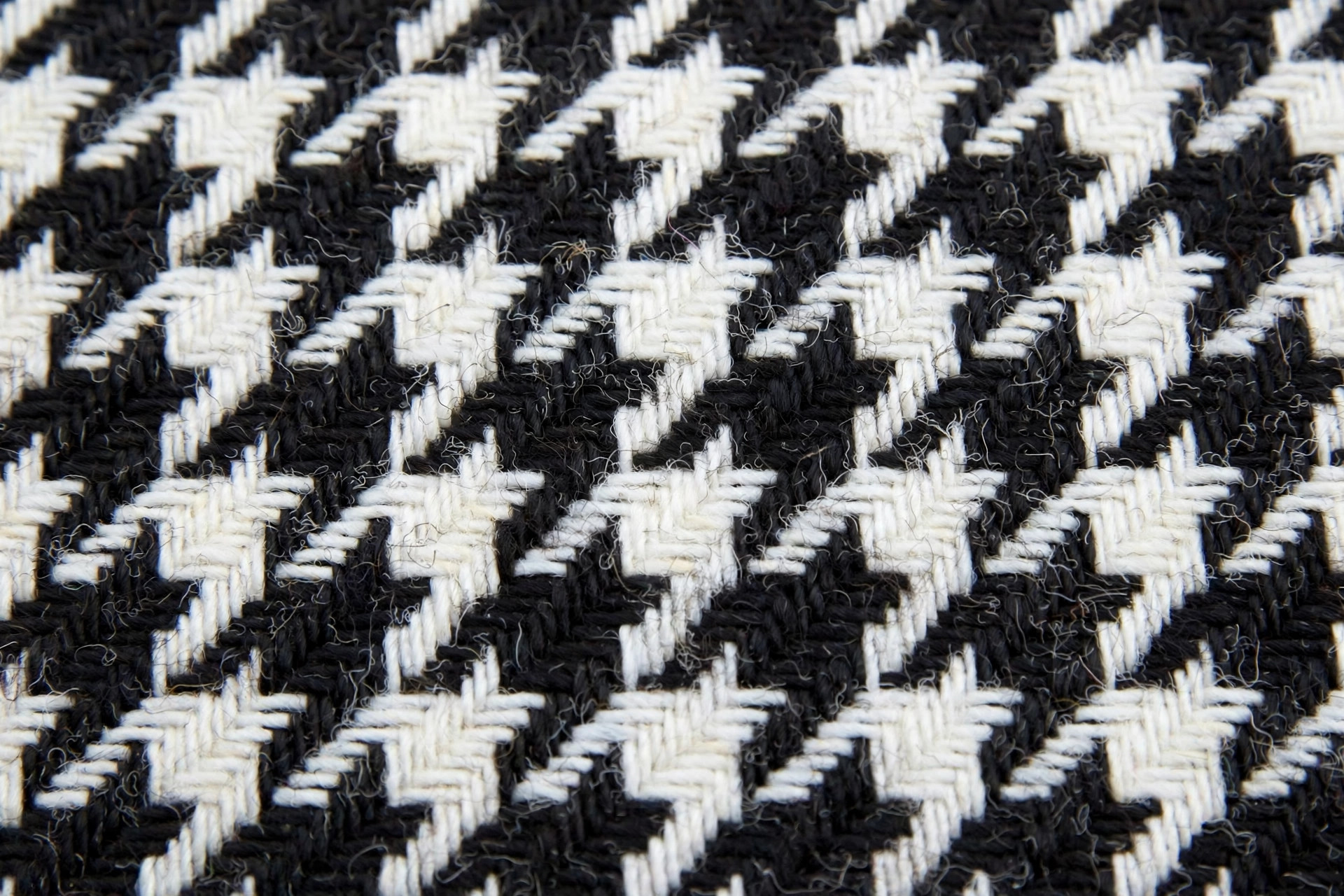
Houndstooth is a woven pattern of broken, jagged checks with uneven four-pointed star shapes, created by alternating bands of two contrasting yarns — classically black and white — in a 2/2 twill weave. The points of each check break and interlock instead of forming clean squares, which gives the pattern its restless, almost vibrating surface. At medium scale it is also called dogstooth; in miniature, puppytooth.
01 / The Weave
How Houndstooth Is Woven
Houndstooth is a true woven pattern, not a print — although prints copy it constantly. The loom works bands of dark and light yarn in both the warp (lengthwise) and the weft (crosswise), traditionally four threads of one colour then four of the other, in a 2/2 twill. Where two dark bands cross, the cloth is solid dark; where two light bands cross, solid light; and where the bands cross each other, the twill's diagonal steps chop the corners off each block. Those chopped corners are the pattern's signature: abstract four-pointed stars and broken teeth — the "hound's teeth" of the name.
Because the effect lives in the weave, genuine woven houndstooth has a slight texture and the pattern shows, softened, on the reverse. Printed houndstooth sits flat on the surface and looks identical front and back. Wool is the classic fibre — the pattern grew up in Scottish woollen cloth — but it is now woven and printed in cotton, silk, and synthetics at every scale from pinhead puppytooth to oversized checks several inches across.
02 / History
From Shepherd's Plaid to the Runway
Houndstooth belongs to the family of district checks woven for centuries in the Scottish Lowlands and Borders, where shepherds wore undyed wool checks in the natural black-brown and white of the sheep — the same tradition that produced the even, regular shepherd's check. By the nineteenth century the broken-check version was a standard woollen suiting and outerwear pattern in Britain, valued because its busy surface hid wear and dirt on working cloth.
Fashion adopted it in the twentieth century. Christian Dior made houndstooth a house signature from 1947 onward, using it on suits, coats, and packaging until it became shorthand for Parisian polish; through the 1950s and 1960s it dressed everyone from film stars to flight attendants. It has cycled back roughly every decade since — scaled up to graphic proportions in the 1960s and again in recent seasons, when designers have blown the check up to coat-size and rendered it in colour combinations far from the original black and white.
03 / Know Your Checks
Houndstooth vs. Other Checks
- Glen check — a muted grid of small and large checks built partly FROM houndstooth-like blocks; lower contrast, softer, and read as a suiting texture rather than a bold pattern.
- Shepherd's check — the even, unbroken parent pattern: regular twill checks with clean square corners and a fine overcheck border.
- Windowpane check — thin light lines forming large, widely spaced squares on a plain ground; the opposite temperament, minimal where houndstooth is busy.
- Buffalo check — large, even blocks of two colours (classically red and black), woven plain and bold rather than broken and twilled.
For the woollen cloth houndstooth most often appears in, see the tweed definitions in the fabric glossary.
04 / In the Wardrobe
Where Houndstooth Is Worn
- Tailored suits and blazers — the pattern's home ground; small and medium scales read as texture at conversation distance.
- Coats and outerwear — large-scale houndstooth is a perennial winter-coat statement.
- Dresses and skirts — a Dior-era staple that returns whenever retro tailoring trends.
- Accessories — scarves, caps, and bags carry the pattern without committing an outfit.
- Interiors — upholstery and throws borrow it as a graphic neutral.
Styling rule of thumb: the bigger the check, the quieter everything else should be. Small-scale houndstooth behaves almost like a solid and can sit with a striped shirt or dotted tie; oversized houndstooth wants plain companions and one clear focal role.
FAQs
- What is the difference between houndstooth, dogstooth and puppytooth?
- Scale only. Full-size houndstooth is the largest version, dogstooth is the classic medium scale, and puppytooth is a miniature version of the same broken check.
- Is houndstooth the same as shepherd's check?
- They are close relatives from the same Scottish weaving tradition. Shepherd's check is a regular, even twill check, while houndstooth breaks the corners of each check into jagged, star-like points — that broken edge is what defines houndstooth.
- Can houndstooth be worn with other patterns?
- Yes, if the scales differ clearly. Small-scale houndstooth reads almost as a texture and pairs with stripes or dots; large-scale houndstooth is a statement and is best worn with solids.
Detailed Guides: see Houndstooth in the glossary A–Z listing of the Apparel Search fashion glossary for related terms.
Search Apparel Search